Mother-to-Mother support groups spread helpful messages in Kadugli
How mothers get together to advise and discuss issues that matter to them

- English
- العربية
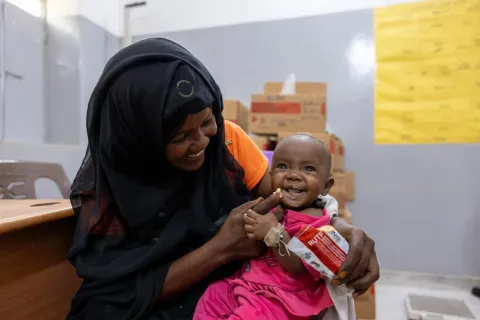
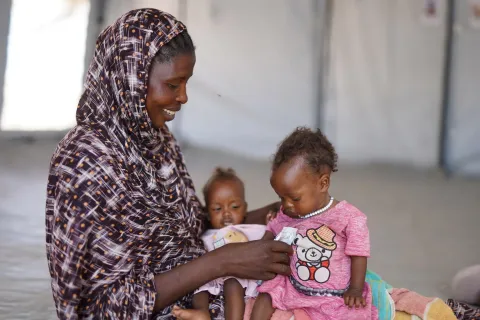
Ilham Ahmed Khamis, a mother of four, has organized mother-to-mother support group sessions for a year and a half. Every Saturday, at least 8 women gather at her house on Block 1 of Hajar Al-Mak neighborhood in the Eastern part of Kadugli, South Kordofan’s capital, and they enjoy cups of Sudanese coffee and engage in an informative dialogue about the tribulations of motherhood. Sometimes, they even bring friends and accompany each other to assist a neighbor in need.
“During our last session, one of the women left to help a mother with a new-born. She had plugged milk ducts and was in great pain. She used a hands-on method requiring warm water that we had learned here in the support group and it worked. We relieved her just as her family wanted to transport her to Khartoum for treatment because they couldn’t help her,” said Khamis, a leader in the mother-to-mother support group.
There are 50 mother-to-mother support groups in Kadugli as well as Al-Koweik town. Each group aims to reach 10 women with hopes to reach 500 women each month. Overall, UNICEF estimates that the eight Key Family Care Practices discussed during the support groups have reached 800,000 community members all over Sudan. Khamis and her deputy and other women leaders were trained last year by UNICEF to manage the groups and understand different methods of sharing messages on the Key Family Care Practices on protection against COVID-19, prevention of diarrhea and other diseases in children and encouraging exclusive breastfeeding.
These messages are critical because in the state of South Kordofan, recent UNICEF statistics show that 10,125 children under 5 are severely acutely malnourished, 21.48 percent of people lack access to safe water and up to 55,890 children under 5 are unvaccinated against preventable diseases[1].
Exclusive breastfeeding is crucial to protecting babies from infection, obesity, asthma and heart disease, while protecting mothers from cardiovascular disease, Breast Cancer and type 2 diabetes.
Each group leader aims to contextualize this knowledge to their surrounding especially that many of them are struggling to make ends meet. Employment opportunities are scarce in this conflict-ridden state and their husbands are dependent on sporadic work opportunities which makes their children especially susceptible to malnutrition and diseases. This means that every small piece of information such as not giving infants water and relying on breast milk as a source of water is crucial and helps in the development of their children.
Nuha Ahmed Dawood has been a supervisor with UNICEF’s mother-to-mother support group since December 2020 after she took a workshop in Key Family Care Practices. She now leads a support group on Block 3 in Hajar Al-Mak neighborhood.
“My group has ten women including myself and we meet twice a month. We discuss the key messages and we’ve recently discussed the importance of birth registration, FGM/C and breastfeeding. We have a good success story, one of the members used to give birth every year until we showed her how to use breastfeeding as a tool for family planning and it worked for her,” said Dawood.
When asked about the changes in their daily habits, Hajir Yousif, one of the members in Dawood’s group, had introduced mosquito nets into her home to protect her family against Malaria and other diseases.
Covid-19 is also an issue that the groups focus on. In Dawood’s group, the women often speak about the best social distancing practices as well as not sharing kitchen utensils inside the family unit. Moreover, they also isolate anyone with flu symptoms until they are safe.


Fight against Female Genital Mutilation/Cutting FGM/C and child marriage
One of the critical issues discussed in the two mother-to-mother support groups we visited is FGM/C which has high prevalence in the community.
“All the women and the older girls are cut; we are trying to save the younger girls. Unfortunately, we have women and men who still support this practice and we must keep working with them,” said Khamis.
The women in the group spoke about the difficulties they face during menstruation and child-birth due to FGM/C.
Another issue affecting the community is child marriage which is prevalent in Sudan and is due to societal norms, economic and social circumstances as well inadequate laws to combat it.
According to recent UNICEF statistics, 60.2 per cent of girls aged 20-24 years were first married or in union before 18 years of age.
“The issue of child marriage needs a widescale intervention. There was a recent incident of a marriage officer (mazoon) who refused to complete the marriage when he saw the birth certificate of the girl and realized that she is under 18 years old. We need more advocates like him,” said Dawood.
Khamis and Dawood continue to organize the sessions with their scarce resources and hope to get a tablet device to record the sessions and share them with other women and make sure they are documented for future reference.
We would like to acknowledge the generous support of the Government of Sweden, the Government of the Netherlands and the United States Government (USAID) for this important work.