African Vaccination Week 2025: Big Catch-Up and vaccine introduction to boost South Sudan’s health
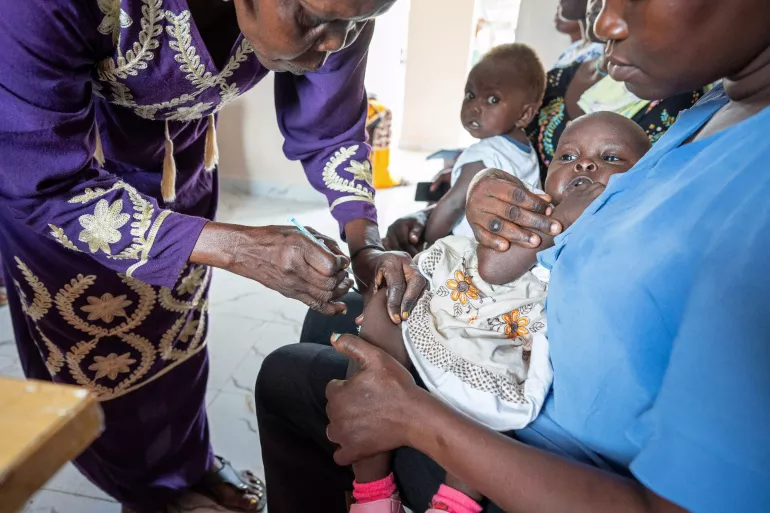
From 24th to 30th April, South Sudan will celebrate African Vaccination Week (AVW) under the theme “Immunization for All is Humanly Possible”. This year’s commemoration coincides with the 50th anniversary of the Expanded Programme on Immunization (EPI), which, over the past five decades, has driven progress in combating vaccine-preventable diseases, saving lives and promoting health.
In South Sudan, the country’s national immunization programme has progressively introduced life-saving vaccines, expanding coverage with lifesaving vaccines. BCG (tuberculosis vaccine), Oral Polio Vaccine (OPV), DTP (diphtheria, tetanus, pertussis), measles (first dose), and Tetanus Toxoid (TT) vaccines were first introduced in 1976. This was followed by the introduction of the Pentavalent vaccine in 2015 and the Inactivated Polio Vaccine (IPV) in 2016. Subsequently, the tetanus-diphtheria booster (Td) and second dose of IPV were introduced in 2021. Most recently, the malaria vaccine was added to the routine immunization schedule in 2024.
This year, with the support of Gavi, the Vaccine Alliance, the country is introducing additional vaccines, including the Pneumococcal Conjugate vaccine (PCV), the Rotavirus vaccine, and the second dose of Measles-Containing Vaccine (MCV2) to its routine immunization programme, keeping children safe from pneumonia, measles and diarrhoea.
South Sudan’s Ministry of Health highlighted the progress that has been driven by the Expanded programme on Immunization and called on the people of South Sudan to take an active role by getting vaccinated. “As we observe African Vaccination Week, we celebrate progress while passing an important message to our communities that individual health is a personal responsibility. It starts with you. While the Government, through its health entities, is working to ensure protection from vaccine-preventable diseases by introducing these new vaccines, the responsibility to make use of them to protect yourself and your family is in your hand,” said Dr Anin Ngot Mou, Under-Secretary of South Sudan’s Ministry of Health.
Data from the WHO Regional Office for Africa shows that since the celebration of the first African Vaccination Week in 2011, countries in the region have used the occasion to conduct a wide range of activities including advocacy, communications, vaccination campaigns, and other high impact health interventions. As a result, over the past 14 years, more than 180 million individuals of all age groups were reached with different vaccines; an estimated 120 million were reached with Vitamin A supplementation and 100 million children with deworming tablets.
The World Health Organization continues to advocate for immunization as a cornerstone of global initiatives aiming to rid the world of vaccine preventable diseases and achieve global health goals. “Vaccination is the most cost-effective tool to save lives and the first line of defence for protection against disease. WHO commends the Government’s efforts and support by partners to ensure the successful introduction of new vaccines into South Sudan’s routine immunization programme. ‘Prioritizing pregnant women and children will be key to building a safer and healthier population, helping us to save lives and build a robust health system,” said Dr Humphrey Karamagi, WHO Representative for South Sudan.
Over the past five decades, immunization has saved more than 154 million lives—an average of over 3 million lives each year. In Africa, immunization has saved over 50 million lives and data modelling shows that in 2024, a child under age 10 in Africa had a 50 per cent higher chance of surviving to their next birthday than they would have had in the absence of vaccination programmes.
"The introduction of these new vaccines marks a major milestone in South Sudan’s efforts to ensure no child dies or becomes sick because of a vaccine-preventable disease. As we commemorate African Vaccination Week and 50 years of immunization progress, we are reminded of the extraordinary power of vaccines to give every child a fighting chance. UNICEF remains committed to working with the Government and partners to ensure every child, no matter where he or she lives, is reached with life-saving immunization services," said Noala Skinner, UNICEF Representative in South Sudan.
Despite ongoing routine vaccination efforts, the program has faced numerous challenges during the reporting year, including outbreaks of measles, yellow fever, cholera, and cVDPV2. Additionally, the influx of returnees and refugees fleeing the Sudan crisis, coupled with severe flooding and consequent internal displacement, has strained health systems. These challenges have, nevertheless, not halted the delivery of immunization services, which continue, both within and outside health facilities, even in affected areas.
To address the significant immunization backlog accumulated between 2019 and 2022, as well as to reach children who defaulted on routine vaccinations in 2023 and 2024, the Government of South Sudan has also launched the ‘Big Catch-Up’ vaccination initiative. This national effort is aimed at identifying and reaching all children under the age of five (0–59 months) who have either missed one or more antigens or have never received any routine immunization doses. Through this initiative, South Sudan is intensifying efforts to close immunity gaps and prevent outbreaks of vaccine-preventable diseases, which remain a persistent threat due to low routine coverage in many parts of the country. As part of the campaign, the Ministry of Health—working in close coordination with key partners such as UNICEF and WHO—is rolling out catch-up vaccination activities in 30 counties across the nation. These efforts specifically target 146,054 zero-dose children those who have not received a single dose of any routine vaccine with the full schedule of routine Expanded Programme on Immunization vaccines.
It is in this regards that this year the AVW celebrates and recognizes the collective efforts to save and improve countless lives from vaccine-preventable diseases and underscores that immunization for all is an achievable goal.
About the vaccines introduced
Pneumococcal Conjugate Vaccine (PCV): Pneumococcal Conjugate Vaccine (PCV) is a vaccine that protects against infections caused by the bacterium Streptococcus pneumoniae (pneumococcus). PCV is recommended for infants, young children, to prevent severe forms of pneumococcal disease like pneumonia, meningitis, and bacteremia (Link )
Rotavirus Vaccine (Rota): The rotavirus vaccine (Rota) is a live, oral vaccine used to protect against rotavirus infections, the leading cause of severe diarrhea in young children. The World Health Organization (WHO) recommends that it be included in national immunization schedules, especially in countries with high rates of rotavirus gastroenteritis (link)
Measles Vaccine (MCV2): WHO recommends all countries to include a second routine dose of measles containing vaccine (MCV2) in their national routine vaccination schedules regardless of the level of coverage with the first routine dose of measles containing vaccine (MCV1)
Media contacts
About UNICEF
UNICEF promotes the rights and wellbeing of every child, in everything we do. Together with our partners, we work in 190 countries and territories to translate that commitment into practical action, focusing special effort on reaching the most vulnerable and excluded children, to the benefit of all children, everywhere.
For more information about UNICEF and its work in South Sudan visit: www.unicef.org/southsudan
Follow UNICEF South Sudan on Twitter, Facebook, Instagram and YouTube