Opening a door to knowledge and safety for Mothers
Celebrating maternal and neonatal tetanus elimination in South Sudan

In South Sudan, where women don’t always have access to a health facility or trained midwife, maternal and neonatal tetanus (MNT) long posed a public health threat. Now, led by the National Ministry of Health, with support from UNICEF, a coordinated effort to train health workers to educate and vaccinate women of childbearing age has led to a historic milestone: the elimination of MNT in South Sudan. The dedicated health workers at the Munuki Primary Health Centre (PHCC) in Juba, South Sudan, exemplify the caring and skill that went into this major public health feat.
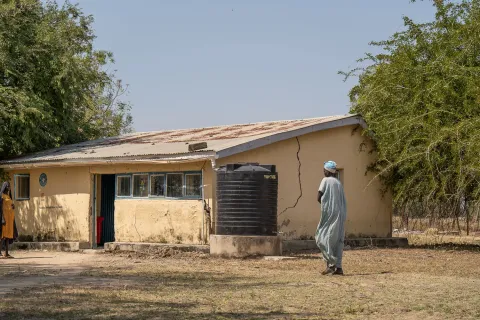
Mornings in Munuki begin quietly. Named for the Juba residential area where it is located, Munuki is a first-level referral facility fully integrated into the community it serves. Each day at Munuki PHCC is a crossroads of lives and stories. People arrive carrying fears, questions, and expectations, shaped by circumstances far beyond the clinic’s walls. Walking across the sandy path that leads to the entrance feels like entering an oasis of safety and knowledge.
While South Sudan continues to navigate a period of political uncertainty and increased violence, the people gathered in the waiting room find something rare : certainty. For young mothers in particular, the Munuki PHCC offers clear information and reliable care in a context where health opportunities can be limited, and misinformation travels easily. But here, the staff provide reassurance and earn trust in return, one conversation at a time.
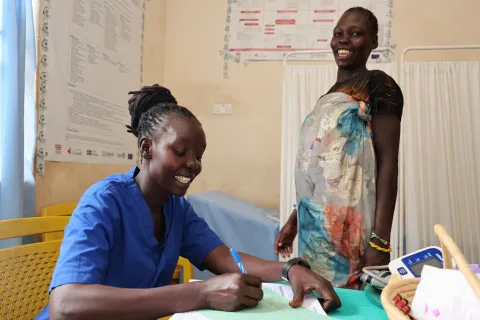
Munuki is an area where formal infrastructure blends into peri-urban life, and families rely on the centre for services ranging from antenatal care and deliveries to routine immunisation. The flow of patients reflects the rhythm of a busy urban catchment. For the staff, flexibility is not an added skill but a daily requirement. Among them are Lonjino Bernando Lodu, the head nurse, Joyce Weja, a technician, and Jane Paya, a vaccinator. All three took part in tetanus vaccine service training organised by the Ministry of Health with support from UNICEF in October 2025. During antenatal visits, their role is not only clinical. Through counselling and health education, they help pregnant women understand the importance and timing of tetanus vaccination matters.

This is the kind of quiet, methodical work that has contributed to a significant national achievement: South Sudan has reached elimination status for MNT, one of the deadliest vaccine-preventable diseases, with fatality among affected newborns often exceeding 80 per cent.
It is a remarkable milestone that gives hope to the millions of women and mothers across a country in which maternal and newborn mortality rates remain among the highest globally, with over 1,150 maternal deaths per 100,000 live births and around 40 newborn deaths per 1,000 live births in recent estimates. At Munuki PHCC, this achievement is not announced with banners or slogans, but reflected in ordinary mornings like this one, where prevention has become part of routine care.
Today, two young women, Amira and Josela, arrive at the centre at different stages of motherhood. Their paths cross here, in the same waiting room, shaped by different experiences but guided by the same promise of protection. Amira, 21, is four months pregnant. She has come to the centre to receive her first dose of the tetanus vaccine and sits quietly as Lonjino prepares the injection. This is her second pregnancy; the first ended in a miscarriage. When she visited the centre earlier in her pregnancy, it was not for vaccination but for treatment. She had been feeling feverish and was diagnosed with malaria. That visit became her point of entry not only into treatment, but into information.
I came for my check-up and treatment as I was feeling feverish. The service providers informed me about the tetanus vaccine. I had never taken it before. They recommended that I come back once I completed 16 weeks of pregnancy, so I came today for my first dose.


Along with malaria treatment, Amira received multivitamins and counselling. She had heard about vaccines from her husband, but not from family members or women in her community. It was the explanation she received at the health centre that shifted her understanding. “I am very happy to have received this information,” she says.
“Now I ask other women to take the vaccines so that they can have healthy, bouncing babies.”
A short distance away Josela, 24, holds her three-month-old daughter, Rina. Josela’s hand cups her daughter’s small belly in a quiet, protective reflex. Today, Rina will receive her routine pentavalent vaccination, which protects against five diseases, including tetanus. Josela did not receive tetanus vaccination during her pregnancy with Rina. The decision is rooted in loss. Before Rina was born, Josela and her husband lost a son at the age of two. In the emotional aftermath, her husband believed the tetanus vaccine she had taken played a role, a claim with no medical basis.

“We lost a two-year-old son before I gave birth to Rina,” Josela says. “My husband thinks that our boy passed away because of the vaccines I took during my first pregnancy. So, I didn’t take vaccines when I was pregnant with Rina.”
Josela, however, now understands the importance of vaccination and knows trusting health workers is the best way to protect her baby. With guidance from the health workers, she brought her daughter to the clinic.
I know that vaccines will protect my baby from diseases. Even though I didn’t take any vaccines myself, I want to make sure that Rina receives them all.
Looking ahead, she is clear about what she would do differently. “If I have another pregnancy, I will go to my mother’s house to receive vaccines from nearby health facilities if my husband denies taking me again,” she adds, calmly.
Across South Sudan, immunization efforts occasionally face rumours and misinformation, such as unverified claims about vaccine safety, which underscores why trusted information and counselling at the clinic level are crucial to sustaining community confidence in vaccines. UNICEF-supported social and behaviour change activities, including community outreach programmes with community health workers and volunteers, radio programmes, and direct conversations with health facility staff, are vital to debunk myths and vaccine-related disinformation. These efforts enhance regular outreach activities that enable pregnant women living in hard-to-reach areas to access the tetanus vaccine, alongside health education provided during antenatal care visits, which motivates pregnant women to receive tetanus vaccination.
At Munuki PHCC, this national support translates into daily practice. Lonjino and his team provide tetanus vaccine services to an average of 260 women every month at Munuki PHCC. “When pregnant women come for their regular visits, we make sure they are asked about tetanus vaccination,” he explains. “The counselling team then refers them to the Expanded Programme on Immunization, or EPI.” When women miss follow-up appointments, the team tracks them through bi-monthly outreach services, encouraging them to return to the health centre or complete their doses at nearby facilities.”
In 2025, 19 service providers at Munuki PHCC were trained in vaccine service delivery.
The generous support of partners such as The Church of Jesus Christ of Latter-day Saints, Gavi, the World Bank, the United Kingdom’s Foreign, Commonwealth & Development Office, and the European Union has been vital in sustaining these activities. Through this support, UNICEF continues to provide tetanus-diphtheria (Td) vaccines, Expanded Programme on Immunization (EPI) supplies, and cold chain equipment to health facilities, while working with the Government of South Sudan through the Health Sector Transformation Project (HSTP) to provide incentives to health workers and support the delivery of immunization services, including Td vaccines.

In different ways, this support allows women like Amira and Josela to arrive at the same place: a decision to protect their children. That decision is shaped here, in small rooms and routine exchanges, where Lonjino and his team turn information into action, making the elimination of maternal and neonatal tetanus a lived reality for mothers and newborns alike.
Across South Sudan and around the world, UNICEF works with governments and communities to protect mothers and their children’s right to grow up healthy and safe. The elimination of maternal and neonatal tetanus in South Sudan is reflected in the steady, everyday courage of clinics like Munuki, where trusted care, clear information, and persistent vaccination efforts transform fear into protection for mothers and newborns. Across the country, dedicated health workers, trained vaccinators, communities, and partners have joined forces through strong engagement, targeted campaigns, and reliable routine immunization services. Together, they have turned a once-fatal disease into a preventable and protected reality.
This milestone earned through thousands of quiet, hopeful mornings and sustained by ongoing outreach and education ushers in a new chapter of safer pregnancies, healthier newborns, and renewed trust in vaccines as a lifeline for families nationwide.
UNICEF does not endorse any company, brand, organization, product or service.