Mobile health brings hope after devastating floods in Aweil
Health workers bring medicine, comfort, and resilience to isolated communities

Mamer Village, Mangok Payam, Aweil, South Sudan
When floods affected large areas of Aweil in 2025, UNICEF with partner International Rescue Committee (IRC) was quick to respond. They set up mobile health clinics to cater for displaced communities and provided lifesaving, integrated health services. The health workers, and support staff visit the remote areas every week, and have a spare vehicle/ambulance available for quick referrals to the main hospital in Malualkon, around 40 kms away.
Services provided at the mobile health centres include general medical services, testing for common illnesses, ante natal services, referrals for victims of gender based violence, immunisation, health education and dispensing of common medicines.
The clinical officer, Dut Luka Anei, explains the most common conditions he sees are malaria, diarrhoea, pneumonia, urinary tract infections (UTIs), typhoid and skin infections. He has the ability to test for malaria, pregnancy, cholera, Hepatitis B and syphilis, with rapid testing kits.
Aluel Mawien Dut is 6 or 7 months pregnant, she’s not sure. She had some initial antenatal checks in Aweil hospital and came today after a 3 hour walk from home. She found out about the service when it was announced in the community the day before and is very grateful to be seen by the ante natal officer, and to find out her baby is doing well.
Without this service, I would have to travel to Aweil hospital, which takes a long time and incurs costs which I can’t afford.

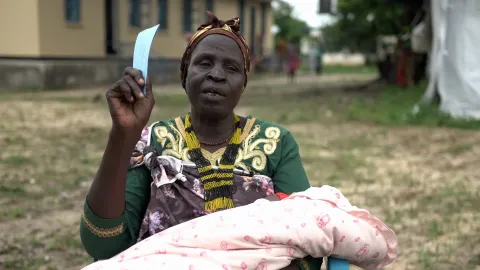
Achol Deng Kuch is visiting the clinic with her two-year-old daughter Ariuk. She lives close by and has seven children in total.
She has brought her daughter to see the doctor as she has a fever and appears lethargic.
In September Ariuk had a fever, then developed a rash, and her neighbours said she had to go to the hospital. She went to Aweil hospital where Ariuk was admitted with measles.
She was very sick and it was a scary time. I was happy that after a week she was discharged. But since then, Ariuk would not latch on to breastfeed and has not taken breastmilk.

Her mother goes on to say that since having measles, Ariuk has been more vulnerable to sickness. “Before measles Ariuk breastfed well, but after she became weaker and started to lose weight. In October she was admitted to the malnutrition programme with severe acute malnutrition. After starting the nutrition supplements, she slowly gained weight and in December she was discharged.”
Since December she’s been to the mobile clinic three times, and the service has proved critical. Ariuk was tested, and found to have malaria, and given treatment at the dispensary desk. Achol works hard to provide for her family, making and selling groundnut paste in the market.
I have now made sure all my children receive their vaccines, and now I can afford to send all of them to school”
‘But I’m worried about my youngest, because measles seems to have left her weaker than the others” said Achol.
The mobile health clinics are implemented by UNICEF and IRC in response to the extensive flooding experienced in Aweil during the 2025/26 rainy season. Funding was provided by the Japanese Government.