"Boma Health Workers are our lifelines,” says Nangdimo Community
In Yambio Boma Health Workers are the lifeline for mothers and children, bringing healthcare home

In Nangdimo Boma, Yambio County, 18 Boma Health Workers serve as the backbone of healthcare for approximately 6,000 residents delivering essential services to the doorsteps of mothers and children, one by one.
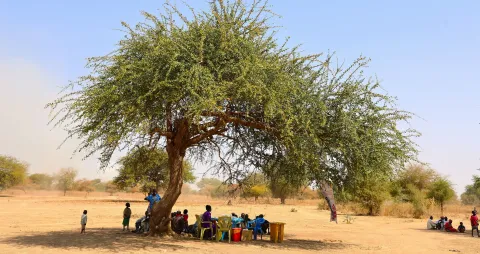
When a child falls sick, especially in the middle of the night, families here cannot rush to distant health facilities. Instead, they turn to the people they trust most — their Boma Health Workers. In a village where the nearest clinic is over 5 kms away and often hard to reach, these workers are the first and frequently only source of help.

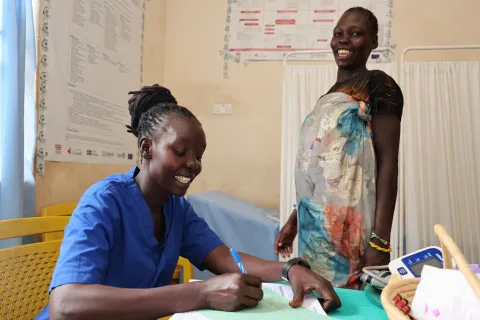
Glora Idia John is one of them. At just 25, and a mother of four herself, she has spent the last five years walking from household to household offering what many here consider lifesaving health services.
Her role includes educating pregnant and breastfeeding women about prevention of communicable diseases, antenatal care attendance, safe delivery with a skilled birth attendant and the importance of immunization as well as treating children for common illnesses like malaria, pneumonia, and diarrhoea. Gloria also identifies malnourished children and ensures they are referred to the nearest facility for further care.
What I love about my job is helping mothers and children who can’t walk long distances for treatment. I give first aid, support, and information that could save lives.
The impact of her work is visible. Gloria recalls how simple, consistent health education has contributed to a noticeable drop in malaria cases. “We have managed to save many children suffering from preventable diseases. I truly believe that my referrals, especially for pregnant mothers and malnourished children, have made the difference between life and death.”
But she worries about what still needs to be done. “In many homes, five or more children sleep under a single mosquito net. If we want to keep malaria down, we need more nets,” she says.
Thankfully, UNICEF, with support from the Global Fund, plans to distribute millions of treated mosquito nets across South Sudan in early 2026, giving hope to families like those Gloria serves.

That hope is reinforced by Joyce Daniel, a 30-year-old mother of nine. She considers Gloria not just a health worker, but a guardian.
Just last month, my four-year-old son was terribly sick with malaria. For two weeks, he had a fever and was losing weight. If Gloria hadn’t come to check on us and offer help, I’m not sure he would have survived because I did not have money to take him to the hospital.


Our Boma Health Workers are always there even at night. Without them, we would be lost. They are the reason many of our children and women are still alive.
At the state level, the impact is not lost on health authorities. Rose Obede, Director General of the Western Equatoria State Ministry of Health, has witnessed the changes brought about by these frontline workers.
Since HSTP began, access to both primary and secondary healthcare has significantly improved. We now have better-trained staff, health supplies, and more consistent service delivery. I am incredibly proud of our Boma Health Workers. Their dedication has saved lives and brought real hope to communities that once had none.

Indeed, the story of Nangdimo is not just about numbers. It’s about the quiet, unseen moments: a child treated in time, a mother referred safely, a baby pulled back from the brink of malnutrition. These are the true, quiet markers of progress, driven by the work of 882 Boma Health Workers across Western Equatoria State.
These heroes wear no white coats, but they carry medicine kits, respiratory beads, timers, and hope in their hands. They don’t wait in clinics; they walk to homes. And in doing so, they are rewriting the story of healthcare in South Sudan, one village at a time.
Nangdimo Boma is just one of the 931 Bomas benefiting from the Health Sector Transformation Project (HSTP), a government-led initiative to strengthen health systems, train health workers and provide a regular flow of drugs and medical equipment under the National Ministry of Health. The project is managed with technical support from UNICEF and WHO.
AMREF, as one of UNICEF’s key implementing partners on the ground, plays a critical role in delivering services to communities like Nangdimo.
The initiative is supported by a consortium of global partners: the World Bank, Global Affairs Canada, the Global Fund, Global Vaccine Alliance (GAVI), and the European Union (EU).