UNICEF Deputy Executive Director of Programmes Omar Abdi visits Rwanda
While in Rwanda to attend the YouthConnekt Summit, the Deputy Executive Director took time to visit UNICEF programmes in early childhood development and education.
- English
- Kinyarwanda
NGOMA, Rwanda - “When I was a child, I also learned in a rural school like this one. My mother could not read or help me with my homework. But she found other ways to help me. She would sit next to me and burn wood so that the mosquitoes would not bite me while I studied.”
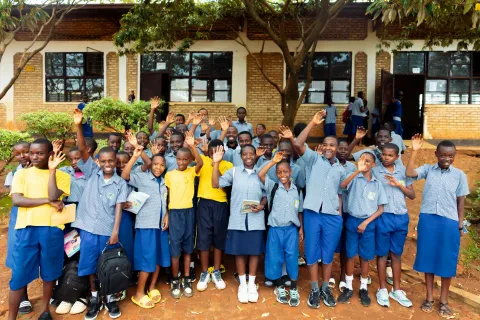
Parents at G.S. Rurenge school in Rwanda listened earnestly to Mr. Omar Abdi, UNICEF Deputy Executive Director of Programmes, while he spoke to them about the importance of education and how they could support their children.

Remedial learning clubs at G.S. Rurenge
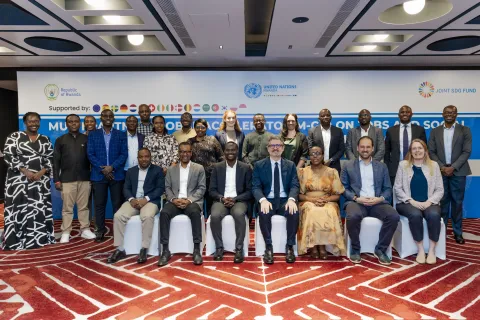
Mr. Abdi visited Rwanda to speak on a panel at the YouthConnekt Africa Summit in Kigali. During this panel, he spoke about engaging young people to achieve the Sustainable Development Goals. To complement his participation at the Summit, Mr. Abdi also visited UNICEF-supported programmes such as those at G.S. Rurenge.
Unfortunately, some students at G.S. Rurenge are not passing their final exams. They struggle to learn at the same speed or with the same methods as their peers. But special learning clubs are helping these students catch up, where teachers use interactive games and activities to make learning more fun. And when it’s more fun, it sticks.
“What do you see?” Asked the teacher, holding a cup high in the air. He threw a small ball to one student, asking for her participation.
Nervous, she caught the ball and stood up. “I see… a cup,” she said quietly.
“Flowers and fruits!” Her classmates raise their voices in a playful phrase of congratulations, waving their fingers like flower petals followed up two thumbs-up.
About 40 students at G.S. Rurenge attend these learning clubs, representing about 5 per cent of the 767 total primary students.
Parents are excited to see their struggling children catch up to their classmates, and hope that clubs like this one will emerge in other schools, too.

Early childhood development centres in Ngoma
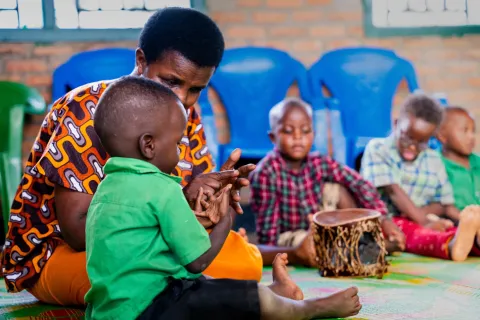
Surrounded by small, exuberant, uniform-clad students at Ngoma District Early Childhood Development Centre, it is impossible not to smile. Mr. Abdi was thrilled to see so many young children able to learn and play in a safe and structured environment. Children sang and clapped to welcome him. They shared drawings and studied picture books while Mr. Abdi joined in.
“What are you building?” Mr. Abdi asked one boy playing with colourful toy blocks.
Stunned by the cameras and more adults than usual, the boy looked at Mr. Abdi, eyes wide, and handed him a block.

Although this centre and Rwanda’s 16 other model ECD centres were originally established by UNICEF, this centre is now operated entirely by local government authorities, with UNICEF providing technical support when needed.
The centre provides integrated services for 129 children, such as nutrition, sanitation and hygiene, cooking demonstrations for parents, and a half-day programme of early care, stimulation and play-based learning. The centre also supports 523 additional children through home-based ECD programmes.
Yego Youth Centre
Mr. Abdi also visited YEGO Youth Centre in Kayonza District where the energy was palpable. With over 30,000 young Rwandans in attendance per year, the centre was bursting with activity and a variety of talent.
“HAYYY-YAHHH!” Dozens of young children practicing martial arts raised their voices in unison, simulating an attack technique.
Other teenagers played basketball, impressing the UNICEF staff who tried to join in. All around the centre, Mr. Abdi met girls practicing coding, reading clubs studying vocabulary, and musicians and painters demonstrating their craft.
It was all too much fun to leave. But before leaving, Mr. Abdi took care to note what is being done well and what must be stronger. Across the globe, UNICEF has more work to do in the second decade of children’s lives, especially with youth issues such as protection and mental health.
“Leading is not only about money. UNICEF can be a leader in many other ways besides giving funds. We have a lot of ideas to offer, and we should always be available for technical support.”