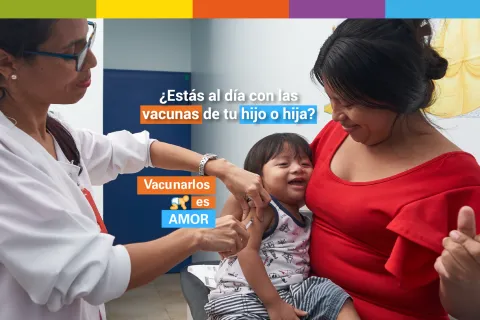
MINSA and UNICEF launch media campaign to promote immunization for children
The campaign “Vacunarlos es amor (Vaccination is an Act of Love)” includes messages which will be circulating nationwide in radio and social media, in Spanish and other indigenous languages.

- Since the beginning of the Covid-19 pandemic, childhood immunization worldwide has had its largest decline in the last 30 years.
- Panama has one of the most complete routine immunization programs in the world.
Panama, 30 January 2023. The Ministry of Health of Panama (MINSA) and the United Nations Children’s Fund (UNICEF) launched a media campaign to promote routine and COVID - 9 child vaccination, through messages in social mass media like radio nationwide, in Spanish and indigenous languages. Under the title “Vacunarlos es amor (Vaccination is an Act of Love)”, the campaign aims to invite more parents and caregivers in the regions in Panama to continue completing the routine immunization program for children, protecting them from diseases, and providing them with adequate development.
Panama has one of the most complete routine immunization programs in the world, offering its population 23 free and safe vaccines that protect people against more than 30 preventable diseases. However, since the beginning of the pandemic, childhood immunization has had its largest decline in the last 30 years.
Sandie Blanchet, UNICEF representative in Panama, indicated that: UNICEF is pleased to continue supporting the MINSA in promoting childhood vaccination through the diffusion of messages in six indigenous languages and Spanish. In addition, we are helping the MINSA in identifying barriers that limit the access and the use of vaccines and supporting the communities in recognizing rumours and fake news that affect immunization”.
Panama is one of the first countries in Latin America that has a paediatric immunization against COVID – 19. According to the immunization program of MINSA (PAI), up to date, children under 11 years of age have received 495, 282 doses of Pfizer vaccines against COVID – 19; out of theses, 12,474 are children in the ages between 6 months and 5 years.
Recommendations for the general public:
- When babies are born, their immune system has not been fully developed, which can put them at a higher risk of disease infection. Vaccines reduce the risk of contracting diseases because they work with the natural defenses of the bodies of children.
- Vaccines can benefit immunized children as well as those who have not been vaccinated (community immunity).
- Visit the closest health facility or participate in the medical tours and get the complete routine immunization for children for free.
- The Libreta del niño y la niña (Child Booklet) includes the full list of recommended vaccines to protect children in a safer and more efficient way. It also lists the main health services that children in Panama require.
- Delaying childhood immunization represents exposing children to diseases. Request information to the health workers to keep your child’s vaccines up to date.
For additional information, please go to: www.unicef.org/panama/vacunarlos-es-amor
Contactos de prensa
About UNICEF
UNICEF promotes the rights and wellbeing of every child, in everything we do. Together with our partners, we work in 190 countries and territories to translate that commitment into practical action, focusing special effort on reaching the most vulnerable and excluded children, to the benefit of all children, everywhere.
For more information about UNICEF and its work for children, visit www.unicef.org/panama
Follow us on Facebook, Twitter, Instagram, YouTube, LinkedIn