Twenty Thousand Bottles, One Simple Idea, and a School That Finally Has a Toilet
From Waste to Walls: Restoring Dignity for Children at Aleyita Primary School

At Aleyita Primary School in Lugbe, Abuja, when nature called, children had only one answer, the bush. No walls. No doors. No privacy. Just open ground and the quiet understanding that this was how things were.
That has changed.
Today, on the same school grounds, stands a toilet. Solid. Functional. Built not with cement or bricks, but with plastic bottles.
The same bottles that once clogged gutters, littered roads, and piled up in corners of the community have been given a second life. Each one filled tightly with sand, stacked carefully, bound together until they form walls strong enough to hold a structure, and strong enough to change a daily reality for children.
More than twenty thousand of them.
What was once waste is now safety, privacy, dignity for children.
Before this, the gap was clear. Schools in the area had access to water, but no sanitation. Aleyita Primary School was no different. Children came every day, learned every day, but had nowhere to go when they needed something as basic as a toilet.
The solution did not arrive from outside alone. It was built from within.
Pupils became part of the answer. Through the school’s Environmental Health Club, they brought bottles from home, collected them from their surroundings, carried them into school. What looked like small acts added up, one bottle at a time, until they became walls.


Outside the school, 42 youth volunteers from NG Youths SDGs stepped in, collecting plastic bottles, organising clean-ups, community awareness, speaking to families, turning what was once seen as waste into something of value. Conversations shifted, from garbage to health, from litter to dignity.
The community was not left out. Families were engaged, not just in the building, but in understanding why it mattered, hygiene, the risks of open defecation, the shared responsibility of keeping a facility clean and usable.
“This is a pilot,” says Aisha Bakpet, Head of Sanitation and Hygiene at FCT RUWASSA for the project. “Building a toilet is one thing. Keeping it usable is another.”
“We didn’t just build,” she adds. “We made sure the community understood how to take care of it.”
The structure itself is a collaboration, UNICEF Generation Unlimited Nigeria, FCT RUWASSA, International Climate Change Development Initiative, NG Youths SDGs, the school, Aleyita community and the pupils. Construction was led by the International Climate Change Development Initiative.
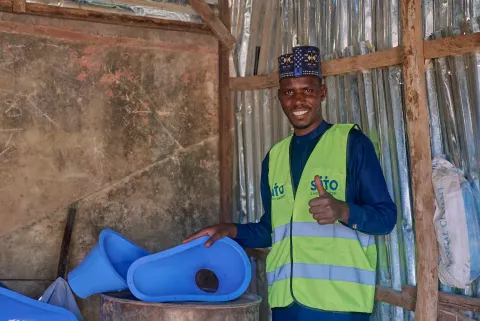
“We used over twenty thousand bottles, and the entire construction took less than three months,” says Oloruntoba, Gender and Communications Lead at ICCDI.
"It is not just innovative. It is practical. The structure reuses waste that would otherwise pollute the environment. It stays cool in the heat, more comfortable than many traditional buildings. It works " Oloruntoba, Gender and Communications Lead at ICCDI.


But beyond the design, beyond the numbers, is what it means to the children.
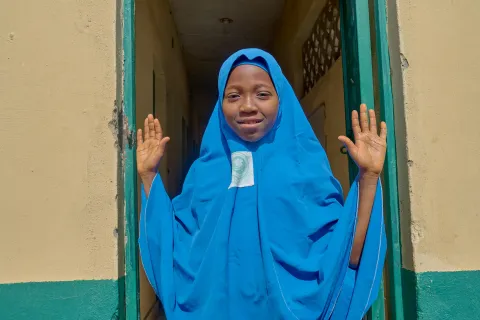
“Before, there was no toilet, so everywhere was dirty,” says Hameedah, head of the school’s Environmental Club.
“But now our school is clean. We are happy.”
It is a simple statement. But it carries the weight of what has changed.
Because this is not just about a toilet.
It is about giving children a basic right they did not have. It is about turning a problem into a solution. It is about showing that even in places where resources are limited, dignity does not have to be.
For UNICEF and its partners, Aleyita is not the end of the story. It is the beginning of something that can grow. A model that can be taken to other schools, other communities, places where the need is the same and the answer could be just as simple.
Because sometimes, transformation does not come from something new.
It comes from seeing value in what was thrown away and building something that lasts.