The Borehole That Keeps Hajara in School
A simple flow of water is helping children affected by conflict stay healthy, learn better, and hold on to something many children still lack, the chance to simply be children

Hajara Umar knows every corner of her school by heart.
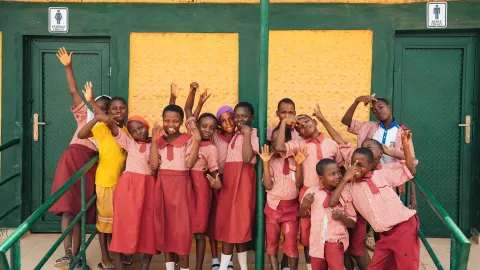
She knows the headteacher’s office near the entrance. The kindergarten classrooms where younger children sit shoulder to shoulder learning their alphabets. The freshly painted toilets with blue handwashing stations outside. The dusty playground where nearly 4,000 children burst into noisy excitement during breaktime.
But the place she loves most stands near the school gate.
It is the solar-powered borehole, tall above the school compound, its twin overhead tanks visible from almost anywhere in the school. When water begins to overflow from the tanks, Hajara and her friends run towards it laughing, stretching out their hands and faces beneath the cool spray.
For a few moments, the heat disappears. So do the worries.
The children scream with delight as the water splashes over them.
It looks like play. But for children like Hajara, it is much more than that.
Until September 2025, Sabon Layi Primary and Junior Secondary School in Potiskum, northeast Nigeria, had no reliable water source. The school’s old motorised borehole had stopped working long ago, leaving thousands of children without safe water during the school day.


For Hajara, that meant carrying water from home every morning.
“We had no water in school, so I used to bring water from home,” says the 10-year-old. “But my bottle was small and the water finished quickly. I was often thirsty.”
In a school filled with children already growing up in the shadow of conflict and hardship, even something as basic as drinking water had become another struggle.
Hajara is one of millions of children in Nigeria affected by poor access to water in schools. According to the 2023 Water, Sanitation and Hygiene National Outcome Routine Mapping (WASHNORM), released in 2024, nearly 29 million children in Nigeria do not have drinking water in their schools.
The consequences go far beyond thirst.
Children struggle to concentrate in class. Illness spreads more easily. Girls, especially those reaching adolescence, often miss school because there are no safe sanitation facilities or water for hygiene.

Research continues to show that water, sanitation and hygiene services in schools are directly linked to better learning, lower absenteeism, improved health, and greater dignity for children, particularly girls.
Through the Multisectoral Integrated Nutrition Action (MINA) for Children in Northeast Nigeria project, funded by the Foreign, Commonwealth and Development Office (FCDO), UNICEF is supporting the Government to improve access to education and essential services for children affected by conflict across northeast Nigeria.
At Hajara’s school, UNICEF supported the conversion of the old defunct borehole into a solar-powered water system. Water collection points were also installed both inside and outside the school, allowing nearby families to benefit as well.
The school now has functioning group handwashing facilities with running water and soap close to the toilets.
For Hajara and her friends, the changes are impossible to miss.
“My friends and I use the handwashing facility often,” she says. “It is near our toilets and there is always water and soap.”
Small things, perhaps, to those who have never had to think about water before walking into a classroom. Humans are remarkable that way. Entire societies built around turning a tap without gratitude.
But for children like Hajara, water changes the rhythm of a school day. It keeps children healthier. It helps girls stay in school. It gives children relief from the brutal heat. It restores dignity in quiet, ordinary ways.
And sometimes, on hot afternoons in Potiskum, it gives children one more reason to laugh.