From Gender Sensitivity to Transformation: Nigeria's WASH GALA Findings
For World Water Day 2026, UNICEF shares findings from a 2024 assessment across Kaduna and Adamawa States that reveals a sector fluent in the language of gender equality and still taking its first steps in practice
A country with the right words and a gap in actions
Nigeria has the policies. The National Gender Policy (2021–2026) names WASH explicitly. The Water Resources Gender Mainstreaming Policy (2022) commits the sector to equitable access and women's leadership. The Clean Nigeria: Use the Toilet Campaign aims for universal sanitation by 2030.
It also has the data. According to the Multiple Indictor Cluster Survey (MICS 2021,) more girls and women aged 15+ (40%) are primarily collecting the drinking water as compared to boys and men (30%). The 2021 WASH-NORM survey finds that just 11% of Nigerians have access to complete basic WASH — water, sanitation, and hygiene together. Around 47 million people still practice open defecation. Only 6% of healthcare facilities and 16% of schools have basic WASH services. In communities where women and girls shoulder the primary burden of water collection, this is not an infrastructure deficit alone. It is a gender justice crisis.
A WASH Gender Landscape Assessment (WASH GALA) conducted between October and December 2024 in Kaduna and Adamawa States under UNICEF's ASWA III programme examines not just what Nigeria's WASH sector delivers, but how it operates: who makes decisions, who designs infrastructure, whose safety is protected, and whether the policies on paper are backed by money and enforcement.

"Women and girls remain disadvantaged in every aspect of WASH — from safety and access to participation and leadership."
Measuring transformation, not just access
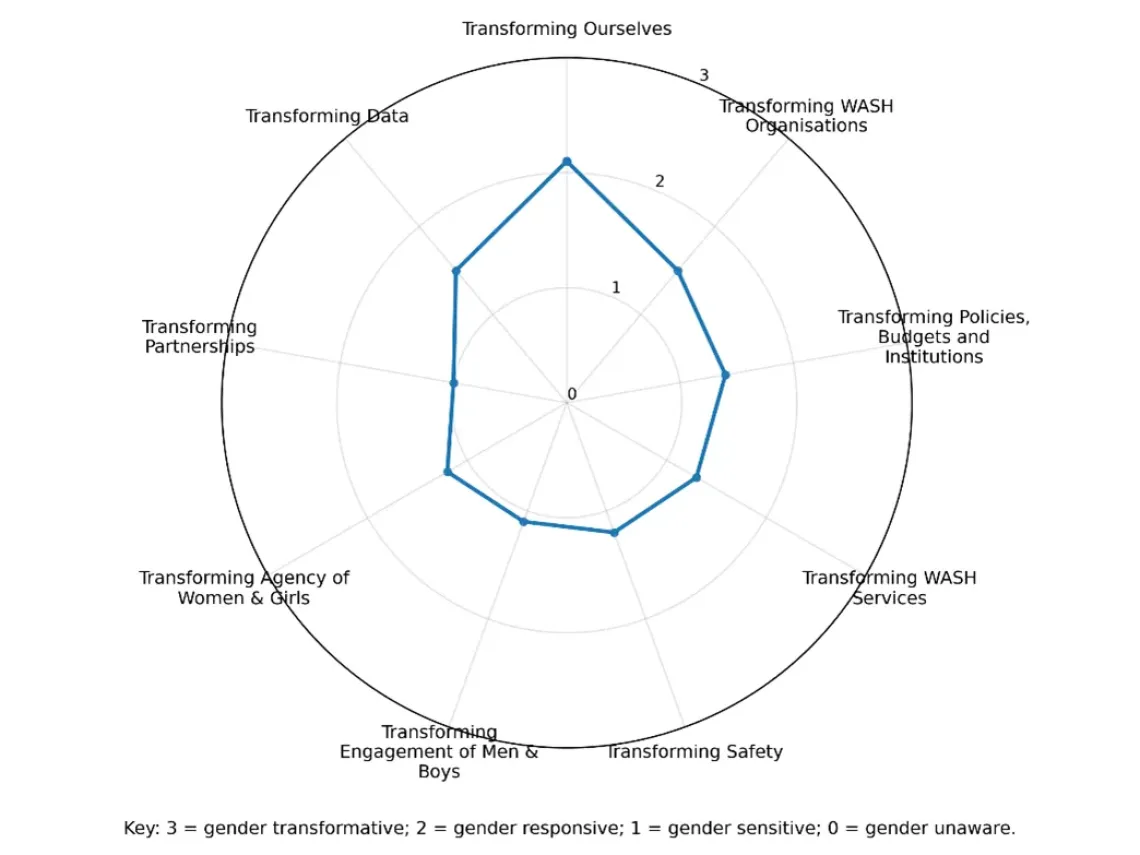
The WASH GALA tool moves beyond standard coverage metrics to evaluate nine transformative principles from personal and organisational culture to safety, men and boys' engagement, partnerships, and data. Each is scored on a 0–3 continuum from gender-discriminatory/unaware to gender-transformative.
In Nigeria, the assessment was conducted at national level and in both Kaduna and Adamawa States. The team led by a WASH and Gender Specialist, UNICEF's Gender and Development Manager, and WASH Manager used a mixed-methods approach: desk reviews, a staff survey via Microsoft Forms, 92 key informant interviews and focus group discussions (15 national, 43 Adamawa, 34 Kaduna), and safety and accessibility audits of WASH facilities. The multi-level design is one of the assessment's strengths: it allows direct comparison between national ambition and state-level reality.


A sector that is sensitive, not yet transformative
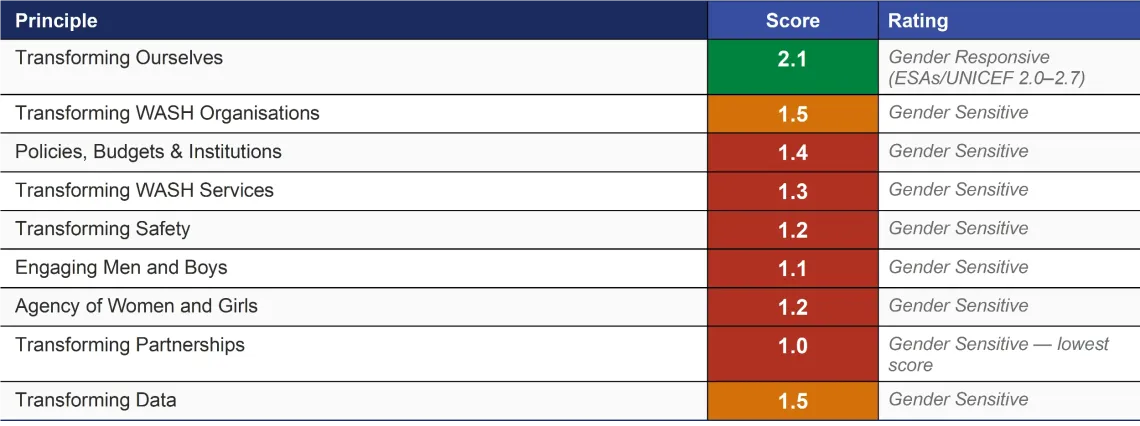
Across all nine principles, Nigeria's WASH sector scores between 1.0 and 2.1 indicating broad gender sensitivity, with pockets of genuine responsiveness, but no transformative performance in any area. The range across institutional levels is wide: UNICEF staff and external support agencies score 2.0–2.7, while federal and state MDAs score 1.0–1.5 — the same assessment, dramatically different results.
Four findings that define the gap
Policy exists; implementation does not. Multiple ministries have gender policies. Almost none have implementation frameworks or budget lines behind them. In Kaduna, only the Ministry of Education has both a gender policy and a corresponding budget. The gap between written commitment and funded action is not a minor shortfall it is the defining failure of Nigeria's gender-WASH framework.
Safety is failing women and girls daily. With a score of 1.2, safety is among the weakest domains. Poor lighting, absent locks, insecure siting, and inaccessible reporting mechanisms mean that many women and girls limit or avoid facility use at night. Reporting systems exist on paper; in practice, they are poorly understood and rarely used. Underreporting is not a sign that risks are low it is a sign that reporting is not safe.
"Despite the presence of policies such as Nigeria's National Gender Policy (2021) and the Water Resources Gender Mainstreaming Policy (2022), these frameworks are yet to be systematically implemented or backed with adequate resources."
Challenging restrictive norms and promoting inclusive practices require further investment. With a score of 1.3, transforming the agency of women and girls continues to lag. While quotas for women on WASH committees exist in some states, these rarely translate into real leadership. Cultural and religious norms override formal mechanisms. Women's participation peaks during election periods, suggesting inclusion remains instrumentalised rather than institutionally embedded.
Culture remains a decisive force in shaping norm change. Engaging Men and Boys scores 1.1 the second-lowest in the series. "Men construct toilets, women clean them" is not an anecdote; it is a description of how WASH labour is systematically distributed across Nigeria's communities. Few programmes explicitly target men and boys as norm-change partners. Until this changes, women's time, safety, and agency will continue to be constrained by labour patterns that WASH programmes are unwilling to challenge.
Partnerships are the floor, not the foundation. Partnerships score 1.0 — the lowest in the assessment. Collaboration between WASH bodies and women-led organisations is rare and superficial. Gender units exist across government agencies but are not mainstreamed into programme design. Women's professional networks are absent from national WASH platforms. Rights-holders are consulted occasionally; they are rarely co-designers.
Men construct toilets, women clean them — this recurring sentiment reflects how cultural resistance and entrenched gender roles still shape WASH practices across communities."
State-level actions: what Kaduna and Adamawa are committing to
The assessment produces state-specific action plans, validated with Kaduna and Adamawa state governments. The six priority actions below represent the cross-cutting commitments with the highest expected impact.

Turning awareness into accountability
Nigeria's WASH GALA does not describe a sector that is indifferent to gender. It describes one that understands the problem, has written the policies, and has not yet built the systems to act on them. That is, in some ways, a harder problem to solve than simple ignorance: it requires confronting institutional inertia, budget politics, and cultural norms that are deeply entrenched at community and state level.
On World Water Day 2026, the question for Nigeria's WASH sector is not whether gender equality matters. That argument has been made and won. The question is whether the people responsible for delivering WASH services in Kaduna and Adamawa and across the country are willing to be held accountable to the commitments already made. The WASH GALA assessment has provided the evidence. The next step is enforcement.
"A shift from gender awareness to gender transformation requires institutional reform, community-level action, and cross-sectoral investment."