She No Longer Climbs the Hill
In Shelleng, dignity begins at home, one toilet at a time

For most people, a hill is scenery. Something to admire, maybe climb for the view.
For Lydia Yahuza, it was something else entirely.
For about sixty years, those hills behind her home in Shelleng, Adamawa State, were where she went when nature called. Not by choice. Not for adventure. Simply because there was no alternative.
“I never had a toilet in my home,” she says quietly, pointing to the slopes that once defined her daily routine. “We used to go into the mountains.”
It was what everyone did.
Shelleng is a farming community, scattered across uneven terrain. Open defecation had long been part of life here, normalised over generations. In Adamawa State, only two Local Government Areas have been certified open defecation free. For the rest, including Shelleng, the absence of toilets is not just an inconvenience, it is a risk that people have learned to live with.
But living with it comes at a cost.
Open defecation exposes communities to disease, especially children. In places prone to flooding, like parts of Adamawa, the danger multiplies as contaminated water spreads quickly through homes and fields. In 2025, cholera cases were recorded in the state, claiming lives. Behind those numbers are choices people never really had.
For Lydia, the risk was always there, but so was something else.
“Sometimes at night, when you are pressed, you either wait or you go,” she says. “And you worry.”
Worry about being seen.
Worry about safety.
Worry that never quite leaves.

For women and girls, the lack of a toilet is more than a health issue. It chips away at dignity, at privacy, at the simple right to feel safe.
And then, something shifted.
In Lydia’s community, small groups began forming. Neighbours coming together, talking not just about water and sanitation, but about changing habits that had lasted a lifetime. These were the Water, Sanitation and Hygiene Committees, WASHCOMs, local people leading change from within.
Supported through the Accelerating Sanitation and Water for All project, funded by the Netherlands and implemented by the Adamawa State Government with UNICEF, these committees are doing something quietly powerful. They are turning awareness into action.
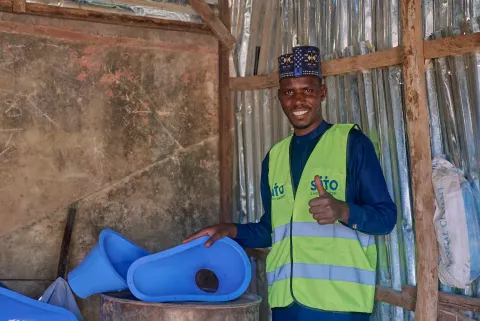
Across Shelleng and Ganye, around 300 WASHCOMs were established between 2025 and 2026. Many of them are led by women. They go door to door, they talk, they demonstrate, they show what is possible, even with limited means.
One of them reached Lydia.
“They taught us why having a toilet matters,” she says. “And they showed me I could build one in my own home.”
That part still surprises her.
“I never knew it was possible.”
What she learned went beyond construction. It changed how she saw her own life.
“We had been doing it the wrong way, but we thought it was normal.”
The shift was immediate, but the impact runs deeper.
“The fact that I don’t have to worry about someone watching me anymore,” she says, pausing for a moment, “that is a big relief.”
It sounds simple when she says it. It never was.

With support from the WASHCOM, Lydia built a toilet and even added a septic tank to safely manage waste. Something that once felt out of reach is now part of her everyday life.
“We used to walk through faeces on the way to the mountains,” she says. “Now, we don’t live like that anymore.”
No drama in her voice. Just quiet certainty.
For Lydia, the hills are still there. They haven’t moved.
But her life has.
She no longer climbs them in the dark, or in fear, or out of necessity.
She stays home.
And in that small, powerful shift lies something bigger, dignity that does not depend on distance, safety that does not require risk, and the kind of change that begins with knowledge, but ends with something far more human.
A door that closes.
A space that is hers.
A life lived a little more freely.