From Stress to Access
Access to safe water is protecting displaced families and children from cholera and waterborne diseases in Monguno, northeast Nigeria

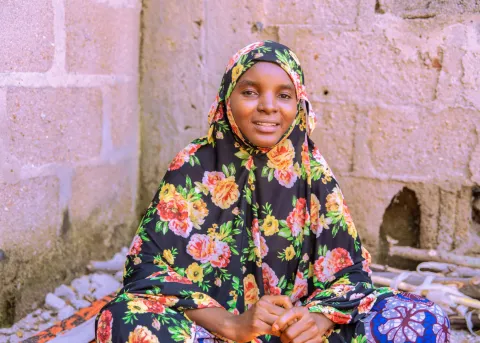
In a quiet corner of Yagana Abdullahi's shelter at the RRR Internally Displaced Persons (IDP) camp in Monguno, northeast Nigeria, stands a worn three-wheel pushcart. Once an essential part of her family's daily survival, it now sits covered in dust, holding nothing more than an old mat and a thin layer of sand.
Just two months ago, the cart rarely stayed still.
Pregnant and caring for three young children, Yagana pushed it for long distances every day to fetch clean water from outside the camp whenever her husband was away.
"My husband also used to take it outside the camp to fetch water, but I had to do it whenever he was not around," she recalls.
For months, the struggle to access safe water shaped daily life for thousands of families living in the sprawling camp, which is divided into six zones of about 10,000 people each.
Yagana lives in the eastern section of the camp, where residents depended on a borehole with limited production capacity. When it broke down in March, pressure on the remaining water points increased sharply. Long queues became the norm, forcing many families to leave the camp in search of clean water.
"We have four water points in the camp, but they are too few to serve everyone. You could spend hours waiting for your turn," she says.
The family's pushcart made the journey easier, but only slightly.
"The push-push carriage helped, but it came with a lot of frustration and stress. We had to reserve it only for fetching drinking water. The stress was overwhelming and often caused disagreements between my husband and me," she says.


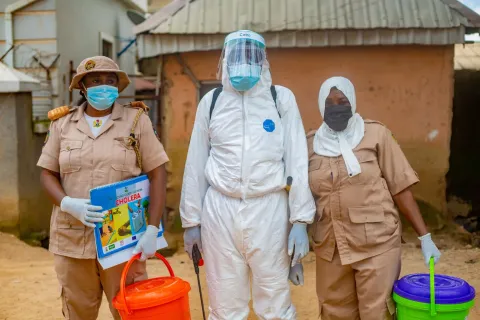
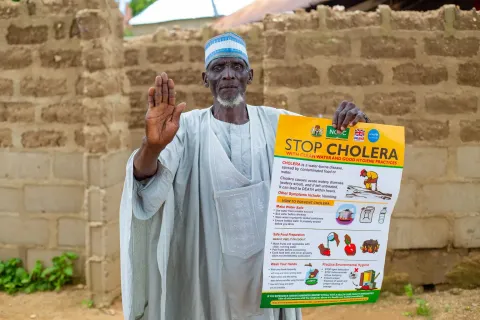
In June, the RRR camp recorded the first cholera case in Monguno. By the time the Borno State Government declared an outbreak, nearly 35,000 cases and about 150 deaths had been recorded across the state.
Cholera spreads rapidly in crowded communities where access to safe water is limited and sanitation is poor. Children are particularly vulnerable because dehydration can become life-threatening within hours if treatment is delayed.
With funding from the Nigeria Humanitarian Fund (NHF), UNICEF, together with the Borno State Government and the Roadmap for Women and Youth Development (RAWYOD), is repairing and upgrading boreholes and water points in high-density communities to improve access to safe water and help protect vulnerable children and families from cholera and other waterborne diseases.
The borehole closest to Yagana's shelter has now been repaired and restored to full operation.
"The stress has reduced significantly. I can now get clean water for my children within minutes. I no longer have to ration water. We have enough water to drink, cook and refresh ourselves. My husband and I are both relieved," she says with a smile.
The improvements go beyond restoring the damaged facility. The borehole has also been upgraded with solar panels, allowing it to operate around the clock and providing more reliable access to safe water for families living nearby.
For children already weakened by conflict, displacement and undernutrition, access to safe water can mean the difference between illness and good health. Alongside efforts to prevent and treat cholera, UNICEF and its partners are helping ensure that the most vulnerable children have a safer environment in which to survive, recover and thrive.