One Community Volunteer Is Helping Protect Families from Cholera
In Maiduguri, northeast Nigeria, Yagana Laminu is combining vaccination with simple, lifesaving hygiene messages to help protect children and families from cholera.

The immunization hall at Yerwa Primary Health Care Centre in Maiduguri is alive with the sounds of babies.
Some are cooing in their mothers’ arms. Others are restless as caregivers rock them gently. Health workers move from one family to another, administering vaccines, answering questions and reassuring anxious parents.
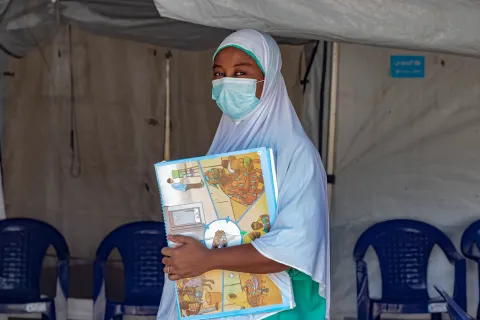
Among them is Yagana Laminu.
With an Oral Cholera Vaccine (OCV) in hand, the 35-year-old community health volunteer moves from caregiver to caregiver. Administering the vaccine takes only a few moments. But for Yagana, her job does not end there.
“It takes a few seconds to administer a vaccine. But the counselling session is more memorable,” she says. “This is why I give hygiene promotion messages to caregivers before each vaccination session.”
It is a simple approach to a deadly threat.
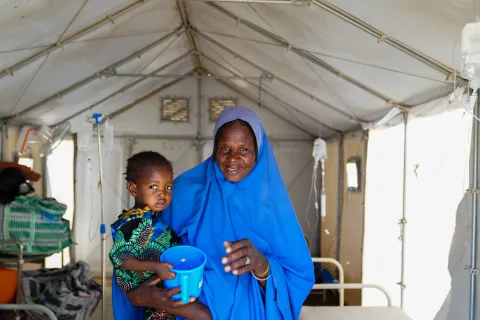
For the past two months, cholera has spread across communities in Borno State, with more than 35,000 cases and over 150 deaths reported. Children and families living in densely populated communities, including those affected by displacement, remain particularly vulnerable.
At Yerwa, vaccination is one part of the effort to stop that spread.
The health facility serves a large population of host communities, settlers and displaced families. As the state government, UNICEF and humanitarian partners support treatment, vaccination, access to safe water and hygiene promotion, community health workers like Yagana are taking prevention directly to the people who need it most.
For Yagana, both Yerwa and cholera are familiar territory.
She began volunteering as a health worker six years ago after completing a diploma in community health. Since then, she has supported vaccination efforts at three health facilities.
Her first experience responding to cholera came during the outbreak that followed the devastating floods of 2024.
“It was a scary time because the flooding contributed to a rapid spread of the disease,” she recalls. “We worked almost non-stop, but thank God we managed to pull through.”
Now, as Borno faces another outbreak, she is back on the frontline.


In collaboration with the National Primary Health Care Development Agency and the Nigeria Centre for Disease Control and Prevention, the International Coordinating Group on Vaccine Provision is supporting the emergency cholera vaccination response. UNICEF, WHO, Gavi, Médecins Sans Frontières and the International Federation of Red Cross and Red Crescent Societies are among the partners supporting the response.
For Yagana, however, the work comes down to something much more immediate: reaching the person standing in front of her.
“Cholera is a dangerous disease that can kill within a short time if treatment is delayed,” she says. “People can become infected by eating contaminated food, drinking unsafe water or through poor hygiene practices such as not washing their hands.”
She explains to families that the oral cholera vaccine provides important protection, but vaccination alone is not enough. Safe water, clean surroundings, proper sanitation and handwashing with soap remain essential.
That is why every vaccination is also an opportunity for a conversation.
“In between responding to COVID-19 and the annual cholera outbreaks, I have discovered that simple hygiene promotion messages such as handwashing with soap are powerful in protecting children,” Yagana says.
“Cholera cannot thrive in hygienic environments. For me, a key part of the vaccination process is not only vaccinating children and adults but also educating families to keep their homes and toilets clean and ensure their children practice good hygiene.”
There is another reason Yagana has found the oral cholera vaccine relatively easy to administer.
No needles.
“Most people prefer the OCV because it is administered orally. It is not an injection,” she says. “Some people are not comfortable with injections and prefer an oral vaccine.”


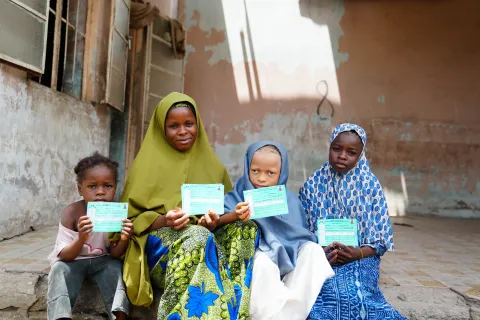
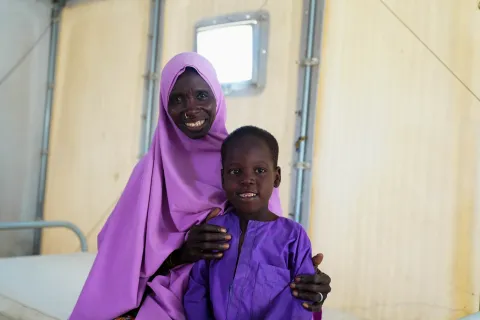
Throughout the clinic day, families continue to arrive. Each vaccination takes only moments, but each one represents another person with greater protection against a disease that can become deadly within hours.
And each conversation carries a message that can travel beyond the walls of the health centre, from one caregiver to a household, and from one household to a community.
For Yagana, that is what makes the long days worthwhile.
“What keeps me going is that I enjoy this work because I have seen the difference it is making,” she says. “Within this short period of the cholera vaccination, we have seen the outbreak begin to decline, and that alone motivates me to keep serving my community.”
She knows that people in Yerwa recognize her and other vaccinators by the vaccine carriers they bring into the community. To Yagana, that recognition carries a responsibility.
“When people see us with vaccine carriers, they know who we are and what we do. We are here to protect them,” she says.
“I feel fulfilled because we are helping to save lives. If we do not do this work, many people may not receive the protection they need.”
Back inside the busy immunization hall, another caregiver is waiting with a child.
Yagana moves towards them.
Another vaccine. Another conversation. Another family better equipped to protect itself from cholera.