No More Bush Business
Ibrahim Kabo is flushing away open defecation through his thriving toilet business

If you had asked Ibrahim Kabo Umar ten years ago what his business would look like today, he might not have imagined the scale of what he has built. As the Chairman of the Bauchi Local Government Toilet Business Owners (TBO), he has gone from running a small public toilet facility to leading a sanitation revolution in Bauchi. His story is one of resilience, innovation, and a deep commitment to improving public hygiene.
Ibrahim started his journey in the sanitation business about a decade ago. He opened a modest toilet facility with 20 compartments at the Railway Market in Bauchi. It was no easy task—he handled everything himself, from maintenance to customer service. On average, his facility welcomed 200 to 300 users daily, bringing in around ₦300,000 per month. However, a significant portion of this—about ₦100,000—went into maintenance and logistics. Despite the challenges, he kept pushing forward, knowing that a clean and functional toilet was not just a business but a necessity for the community.
Everything changed when Ibrahim participated in the Toilet Business Training conducted by UNICEF, the Bauchi Government, and LIXIL as part of the Make a Splash! (MaS!) project. The training opened his eyes to new, improved and affordable toilet technologies, hygiene management, and smarter business strategies to grow his services. Inspired by what he learned, he expanded his operations and built a second facility at the Stadium Market, a place once notorious for open defecation, gaining the moniker – The Central Bank of Shit.
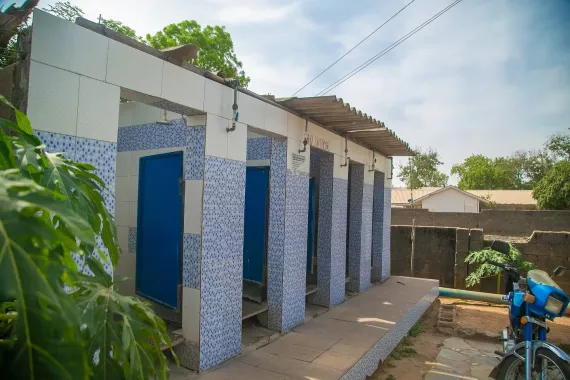


This second facility was made possible through a Private-Public Partnership (PPP) framework, a key strategy championed by Make a Splash! Under this framework, the government provided the land, the business owner constructed the facility following a model, and UNICEF and Government provided Solar motorized borehole and technical expertise. The private investor manages the completed sanitation facility and pays taxes to the Government of Bauchi.
This new facility is truly revolutionary. Unlike his first setup, this one boasts modern, tiled compartments, self-cleaning floors, and a 24/7 water supply provided by the government. There is a designated space for persons living with disabilities and an innovative hot water system. Seeing the success of this new facility, Ibrahim replicated the hot water system at his first location. Using an economical heating method powered by sawdust, his system provides 4,000 litres of hot water daily for up to 250 users.

I have always believed that a business should solve problems, not just make money. If people can access clean and comfortable toilets and bathrooms, it changes everything.
Ibrahim doesn’t just run a toilet business—he is constantly thinking of ways to improve the experience for users. One major problem that market traders faced was the lack of a safe place to store their belongings, especially those in transit. In response, he introduced affordable storage ports, allowing users to keep their items safe for just ₦10 per day or ₦250 per month.
He also introduced laundry and shoe-shining services, making his facilities a one-stop convenience centre. Now, traders—whether they’re passing through or stationed in Bauchi—make a habit of using his facilities daily. With both locations combined, 8,000 to 10,000 people now use his toilets every month.


One day, Ibrahim attended a large event and noticed something disturbing. People were heading into the bushes to relieve themselves. That was the moment he realised another major gap: mobile toilets. With the knowledge and business insights gained from the training provided under the MaS! programme, Ibrahim invested in portable toilets fitted with SATO pans, designed to be water-efficient, easy to clean, odour-free and durable even with high usage. While setting up mobile toilet units requires initial investment in transportation, structure, and waste management, integrating SATO pans has made the service more cost-efficient, water-saving, and hygienic. This innovation has allowed Ibrahim to expand access to safe and dignified sanitation solutions at large events, reducing open defecation.
Even though the mobile units sometimes sit idle for 2 to 3 months before being rented out, Ibrahim doesn’t regret the investment.

This is not just about business; it’s about fighting open defecation and keeping our environment clean.
Ibrahim expanded into household toilet sales, helping families set up their own hygienic toilets. He made sure to offer flexible payment models, allowing people to pay:
- In cash
- Through trade by barter (exchanging millet, goats, or chickens)
- By contributing labor—digging their own toilets and using recycled tyres in place of cement to cut costs
- Through microfinance loans with flexible repayment plans
- With the help of community and religious leaders who sponsor toilets as acts of philanthropy
This approach has made it possible for more families to own private, clean, and functional toilets, reducing the risks of disease and improving overall sanitation in the region.


While Ibrahim is a businessman at heart, he is also a passionate advocate for sanitation awareness. His campaigns are simple, humorous, and effective. Using funny slogans like:
- "Shit in peace"
- "Eat responsibly, shit responsibly"
- "Leave me, let me fall" (a phrase used to explain the convenience of SATO pans)
These quirky one-liners grab people’s attention and make them more willing to listen. Of course, not everyone appreciates his approach. He recalls an incident where an elite individual once asked, "Why should you stand before me and talk about feaces?" But Ibrahim remains undeterred. “Sanitation is important for everyone, no matter their status. We all eat, and we all need to use the toilet,” he says.


Despite running a profitable business, Ibrahim believes in giving back. At his facilities, women, children, and persons with disabilities use the toilets for free. He believes that when you take care of people, they take care of your business in return. “Satisfied customers become your best marketers,” he says.
Ibrahim’s vision for the future is clear—he wants to keep expanding and improving. One thing he loves about this business is that it is high-security; once the setup cost is covered, it generates daily income, no matter the economic situation. “People must eat, and people must use the toilet,” he says with a smile.
To keep his business running smoothly, he has adopted two staffing models:
- Daily wage workers who handle cleaning and maintenance
- Profit-sharing staff who have a stake in the business, ensuring accountability and efficiency
This model ensures that even in his absence, his facilities are well-maintained.

More importantly, he is passing the business down to his children. His first daughter is already setting up her own public toilet facility in Bauchi, continuing the family legacy of clean and accessible sanitation for all.
Ibrahim Kabo Umar daily proves that even the most unlikely businesses can lead to significant positive change in society. From his sanitation facility, he is transforming lives and uplifting communities, demonstrating that clean toilets have the power to change the world—one flush at a time.