Inside Monguno’s only nutrition treatment centre for children
Severe cuts in funding could lead to the closure of a critical nutrition centre for children affected by acute malnutrition in a remote community in northeast Nigeria.

You could hear a pin drop inside the isolation unit of the only hospital for children, critically affected by malnutrition in Monguno, northeast Nigeria. The six-bed unit wears a deserted look, each empty white bed a sober memory of a fully recovered and discharged child.
Painted in yellow with bright green roofs, the facility boasts a total of 60 beds, up from an initial 14 when it was first established in 2022.
Owara leads me round the centre. The store was the first to be converted into a ward. The playroom followed shortly. We went from 14 to 20 beds, then from 20 to 40 beds. We have 60 beds now, said Owara proudly.
The premises of this hospital, called 'Stabilization Centre' aped the mood in the isolation unit – there were no crowds of women with severely wasted children waiting to be admitted into the wards, a stark contrast to my last visit here in September 2024.
Admission is low right now because of the fasting, said Dr. James Owara, the supervisor in charge of the centre, run by UNICEF’s partner Premiere Urgence Internationale.
But clearly, that was not the whole story.
We stopped at the milk room, a fairly big and sterile office where life-saving milk formulated to treat malnutrition in children gets prepared. Three giant black flasks stand on a ledge at the centre of the room. Three cartons of the F-74 milk stood stacked in a corner of the room.
This is the heartbeat of the hospital, explained Owara. But the situation is going to be catastrophic after the fast. We may have to shut down by month end if we do not receive funding to restock medical and nutrition supplies. It will be difficult for children and families because it will coincide with the end of the fast, he added, signaling the impending disaster to come.
We admit an average of 230 children every month, revealed Owara. This centre is the primary referral centre for all the community-based nutrition sites for children in Monguno. It also serves people from Baga and Kukawa which are both a two-hour drive from here.
Owara’s statement hits home as records at the hospital indicate that majority of the patients are from hard-to-reach locations, born to displaced families desperate and dependent on this solitary yellow building, to give their child a fighting chance to recover from the stranglehold of malnutrition.
Since 2021, UNICEF, with funding from different partners, including the European Union Humanitarian Aid and the Foreign Commonwealth and Development Office (FCDO), among others, has been supporting such centres across the northeast region with nutrition supplies. These include the nutrient-dense ready-to-use therapeutic food (RUTF), F-75, F-100, medications and other nutrition commodities.
Supported by various aid and donor partners, including the United States Agency for International Development (USAID), the centre has run entirely on a steady stream of such collective humanitarian funding. And that stream just turned into a trickle thanks to fresh cuts in aid.
A region brought to its knees

If Borno State is the epicenter of protracted conflict and acute malnutrition in northeast Nigeria, then Monguno town is its main artery. According to a July 2024 report conducted by the United Nations Office of the Coordination of Humanitarian Affairs (OCHA), the town of over 400,000 people has the second highest cases of malnutrition in Borno State, second only to Gwoza.
Five local governments, including Ngazai, Monguno, Gwoza, Ngala and Bama were underlined as malnutrition hotspots in Borno State. At 26.7 per cent for Monguno and 35.1 per cent for Gwoza, the OCHA report noted that the malnutrition situation in both communities had already exceeded the Global Acute Malnutrition (GAM) threshold of between 10 and 15 per cent.
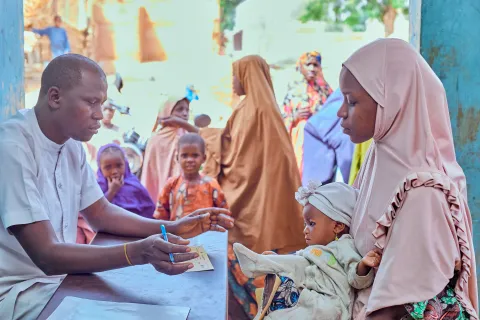
A mid-upper arm circumference mass screening campaign conducted in Monguno between mid-May and June 2024 showed that 22 per cent (1,618) of the 7,250 children screened were malnourished. These results indicate that the malnutrition cases in these LGAs are classified as serious or critical emergencies requiring urgent response, says the report.
But the Monguno scenario is just a microcosm of the humanitarian landscape in Nigeria’s northeast region. As funds continue to dry up, more and more children will sadly become victims of malnutrition. Significantly, Premiere Urgence Internationale and Action Against Hunger, providing first line nutrition interventions in Monguno, have shuttered some of their nutrition sites. Going around town a day earlier, I photographed some of these padlocked facilities. Their emptiness standing witness to the oncoming humanitarian catastrophe.

According to OCHA, the funding from United States accounted for 59 per cent (US$316 million) of the $926 million requirement in 2024 for the Humanitarian Response Plan (HRP).
Will malnutrition win?

If the isolation unit and the playroom were empty, the intensive care and phase one units buzzed with over a dozen children waiting on admission.
We headed back of the hospital, where various structures converted into wards for children glowed in the afternoon sun. Already in its fourth day, the Ramadan fast was well underway in this northeast Nigeria town of over 20,000 under-five children.
We spot a grandmother next to her wasted seven-month-old grandson weighing just 3 kilogrammes. Beside her a great grandmother, cuddled her great grandson weighing the same.
Their mothers are deceased, said Owara. For these children, the challenge is also about wet nursing and for us counselling the caregivers on appropriate feeding practices for children. We are already engaging them on this, but what will happen at the end of this month is anyone’s guess, he said.
Through the European Union Humanitarian Aid and other financial partners, UNICEF has been ensuring that children affected by conflict and malnutrition in Monguno and across the northeast region get a chance to recover, survive and thrive.
In early March, UNICEF launched the first phase of its 'I AM - for every child', a global fundraising campaign to shore up support for children around the world. The campaign aims to rally individuals and partners and mobilise resources for children who need support the most.
We had a meeting with local government officials last week and the feedback is that the hospital should not be shut down. This is a 60-bed capacity centre and we have had to send children back even when we did not struggle so much with funding. With the cuts and lack of adequate nutrition supplies to give to children, there may be simply no way to continue running this unit, Owara added wearily.
With a direct impact on children’s health and development, malnutrition steals the soul of families and the future of nations. While the recent cut in funding might appear to give malnutrition an upper hand, the 'I AM – for every child' campaign might be able to turn the tide in favour of this battle against malnutrition.
But for these malnourished children of Monguno, trapped between hunger and human conflict, the war to simply survive has just begun.