Faisal’s Story: Back from the brink
A cry for help

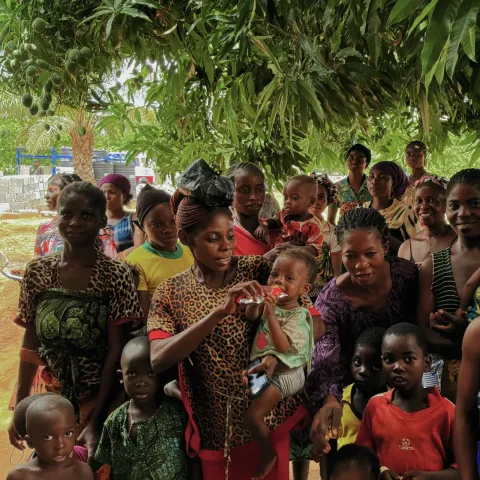
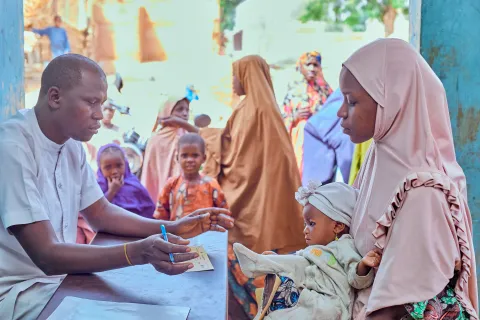
On a cool November morning, the harmattan dust was swirling gently in the hard-to-reach community of Tudun Kusa, when a UNICEF team led by the Country Representative arrived to monitor and assess integrated outreach services in one of over five hundred hard-to- reach communities in Kaduna state. Key services offered during such outreaches include immunization, antenatal care, family planning, nutrition, and diagnostic tests and referrals.
The nutrition service tent was teeming with mothers and their crying babies. Some were queuing for vitamin A, others for nutritional assessment, still others were vying for complementary food prepared on site to teach mothers how to prepare it at home. Amidst the bustle, the team’s attention was drawn to a woman with a baby on her back, covered by her peach hijab. She was sitting still, apart from other mothers, looking desolate. When asked what was wrong, she turned around to show her baby. The baby was Faisal. At 15 months, he couldn’t walk, sit or even lift his head. He was so malnourished, even breast feeding was beyond him. Using the mid-upper arm circumference (MUAC) tape, a simple colored measuring band that wraps around the left upper arm, the team nutrition officer Saratu, assessed Faisal. The reading fell deep into the red zone at 6.5cm. His weight at 4.2kg was another death knell to his chances of survival. The diagnosis, severe acute malnutrition (SAM), is the most life-threatening form of undernutrition in children. Though over twenty babies were diagnosed with wasting that day, Baby Faisal’s case was the most extreme. For Faisal and the other children, the consequences of SAM are not merely physical. Severe malnutrition impairs brain development, weakens immunity, and without treatment, increases the likelihood of children dying from common childhood illnesses such as malaria by up to 12 times.
"Integrated outreaches are all about working with communities to ensure every child grows healthy and strong. Faisal and children suffering like him, can & must survive to grow up and reach their full potential!"

Faisal is the fourth surviving child of his mother - Salaha. Delivered at home, breastfeeding was initiated two days after delivery. In his first six months of life, he was breast fed and given regular sips of water. Complementary feeding, introduced at six months was with plain pap (local porridge), though he persistently refused it. According to Salaha, Faisal was fully immunized up to his nineth month when he got the measles vaccine. Shortly after, he became visibly wasted and continued to refuse any other food except breastmilk. Two weeks before the outreach, Faisal was enrolled at the Outpatient Therapeutic Program (OTP) site at the Primary Health Clinic in Wuchichiri. There he was prescribed Ready-to-Use Therapeutic Food (RUTF), antibiotics (Amoxicillin), and anti-malaria. Unfortunately, there was a state-wide stock-out of RUTF at the time, and as such he went home without it. On hearing of the outreach happening at Tudun Kusa, in Wuchichiri Ward of Zaria, a community more than 20 km away from her home in Bogari, Salaha decided to go and see if anybody could help her.
“Faisal was at death’s door. He couldn’t sit, couldn’t eat. When you look at him, you can count every bone in his body. I never thought he would survive”
The Journey of Recovery
Due to the severity of his condition, Faisal was immediately referred to the stabilization center at Gambo Sawaba Hospital, Zaria LGA. The next day, he was transferred to Barau Dikko teaching hospital, located an hour away in the State capital. Diagnosed with SAM, Acute Respiratory Tract Infection (pneumonia), fever and cough, appropriate medical and nutritional interventions were immediately initiated. The first few days were the hardest. The medical staff immediately placed him on prescribed drugs and began feeding him with therapeutic milk (F-75), designed specifically for the acute stabilization phase using a nasogastric tube. Though his MUAC and weight remained static, in less than a week, there was a gradual response to treatment, most noticeable was lifting his head and reaching out his hand towards his mother. By the end of the second week, a significant improvement was recorded with an increase in weight from 4.2 kg to 4.6 kg, and MUAC from 6.5 cm to 7.8 cm. While other physical parameters showed significant improvement, his appetite remained poor, seen when he failed the appetite test using RUTF, which is one of the significant indicators for improvement. Salaha, always by her son’s side, learned to measure recovery by simple movements. The day Faisal reached out for the feeding cup; she began to believe he would make it.
“The day Faisal rolled over on the bed was when I knew he would survive” Salaha - Faisal’s Mother
Faisal was discharged from the hospital after three weeks. Though still in the red zone, he had stabilized with MUAC at 8.2 cm, weight at 4.9 kg and had an impressive appetite.

The battle at home
Baby Faisal returned home a hero. Escorted back to their doorstep by the UNICEF nutrition facilitator, Hassan Sani, they were happily received by a crowd of children and women upon arrival in Bogari. Before discharge, Salaha was given packs of RUTF. Each day, Faisal would eat at least three sachets, one after every eight hours. That was the only treatment. Salaha couldn’t believe it!
RUTF, is a groundnut based, nutrient dense paste popularly used for the treatment of severe malnutrition. It is easy to use, requires no cooking, addition of water or refrigeration, making it an ideal choice for home-based treatment of malnutrition. Before RUTF became the backbone of SAM treatment protocols in the early 2000s, Faisal would have spent months in the hospital instead of weeks. Today, the Integrated Management of Acute Malnutrition (IMAM) model, treats uncomplicated SAM at home, with regular check-ins at the nearest outpatient therapeutic program (OTP) site, reserving the limited hospital beds for children who arrive, like Faisal, with medical complications and in critical conditions.
Faisal’s home recovery journey: Week by Week
- Week 1 after discharge: MUAC 9.0cm, weight 5.2kg
- Faisal was eating only small amounts of RUTF at a time, most at times crying. Salaha visits PHC Wuchichiri every Thursday, for their weekly check-up at the OTP site.
Week 3 after discharge: MUAC 9.8 cm, weight 5.5kg
- The change is visible. Faisal is able to sit up. He reaches into his mother’s bag to get RUTF. Salaha jokes and laughs with the other women in the compound
- Week 6 after discharge: MUAC 11:0cm, weight 6.3kg
- At this point, Faisal had become a source of inspiration in his village. Fathers were telling their wives to go for antenatal care, while Salaha seized every opportunity to talk to Mothers about seeking help early when it is needed.
- Weeks 7 & 8 after discharge: MUAC 11.5cm & 11.8cm, weight 6.8kg & 7.5kg
- The last two check-ins showed Faisal had exited the red zone, though still not green yet. Everybody at the outpatient therapeutic program (OTP) site, from the health workers to support staff, to UNICEF officers including drivers and community volunteers drew a deep sigh of relief. Salaha smiled with her whole face for the first time since we met.
Faisal’s journey from the day of the outreach to the day he was formally discharged from care took eleven weeks. Eleven weeks to bring a child back from the brink of death. In that interval, he was able to increase both his weight and mid upper arm circumference by almost 80%! A few weeks later, Faisal’s MUAC finally entered the green zone. It was a remarkable achievement, though routinely achieved thousands of times each year across the country, when nutrition programs are adequately funded and supplies needed are made available.

The Impact of Child Nutrition Fund & RUTF
Less than twenty-four hours prior to the outreach at Tudun Kusa, Kaduna state government had received a massive supply of nutrition commodities, including over 8,000 cartons of ready-to-use therapeutic feed (RUTF), procured through the Child Nutrition Fund (CNF). The CNF is a pooled funding mechanism between UNICEF and State Governments, on an equal (1:1) ratio, that supports delivery of life saving nutrition supplies such as RUTF and small quantity lipid-based nutrient supplements (SQ-LNS) in Nigeria. A few years ago (2023) CNF was operating in only 3 states with about 600 million naira released by the State. Currently (in 2026), CNF operates in 20 of Nigeria's most nutrition-vulnerable states (including Kaduna State), with almost 8 billion released by the government. The fund continues to support community health workers like Saratu with training, MUAC tapes, and a steady supply of RUTF.
The CNF provides a critical window for treatment and prevention of malnutrition, but Nigeria being one of the top three producers of groundnuts in the world, needs to promote use of local resources and invest more in local production of RUTF to sustainably treat malnutrition.
Clearly, improving the child nutrition landscape in Nigeria requires a holistic approach and an increased investment in the first 1,000 days of life of a child, starting from conception. According to UNICEF[1], Nigeria has the second highest burden of stunted children in the world. The 2024 National demographic health survey estimates both the National & Kaduna State stunting prevalence rate to be about 40% & 41% respectively, meaning more than two out of five children under five are affected. It is no wonder the country accounts for roughly 10 percent of the global burden of acute malnutrition in children, with about two million children requiring treatment for SAM annually. Yet it is estimated that only two out of every ten children affected by SAM are currently reached with treatment. Faisal was one of the lucky ones.