In Kagara, a Community Volunteer’s Colour-Coded Tape Saves Lives
How Community volunteers are helping in early detection of child malnutrition in Katsina state and saving lives

When six-month-old Nafisa stopped eating, her mother Maryam Abdulkarim knew something was wrong, but like many mothers in Kagara, her first instinct was to try what she knew. She turned to herbs, hoping they would work, hoping this would pass. It didn’t. Nafisa grew weaker, and with each passing day, hope began to slip.
Relief came in the form of a knock on the door.
Fatima Abdulkarim, a community volunteer trained with support from UNICEF and partners, supported by United States Government, had arrived during one of her routine visits. She listened, observed, and then reached for a simple tool, a colour-coded Mid-Upper Arm Circumference, MUAC, tape. Wrapped gently around Nafisa’s small arm, it told a story Maryam could not see. At 11.5 centimetres, Nafisa was at high risk of moderate acute malnutrition, a level that, at her age, could quickly turn deadly if left untreated.
Maryam did not need convincing. Fatima immediately referred Nafisa to the Kagara Primary Healthcare Centre, knowing that time mattered.
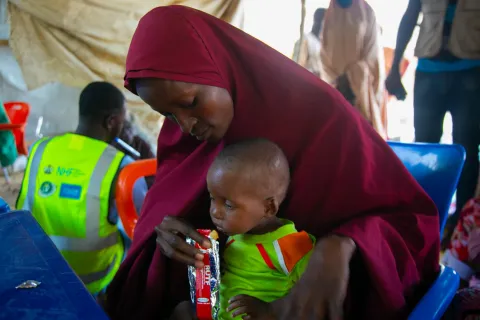
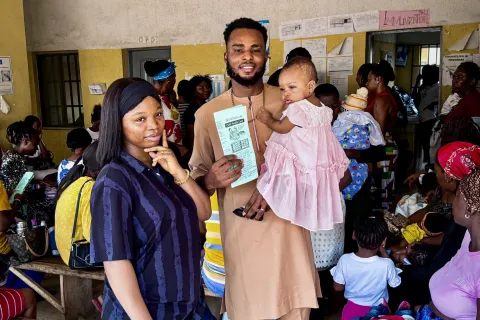
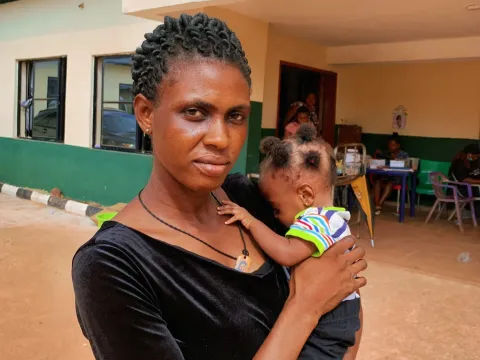
The next morning at the health centre, the harmattan air was sharp and cold, but it did little to keep people away. Mothers arrived early, children tied to their backs or held close in their laps, waiting patiently as the small team of health workers prepared for the day. Some sat on wooden benches, others spread mats on the ground, each one carrying a quiet urgency.

Among them was Maryam, Nafisa resting on her lap.
Fatima was there too. This is what she does, not just identifying children at risk, but following through, making sure they do not slip through the cracks. “I visit about 150 homes every month,” she explains. “I check children, I refer them when needed, and I come here to follow up.”
At the facility, Nafisa was measured again. The reading did not change. Still 11.5 centimetres. Still high-risk moderate acute malnutrition. But this time, there was something else, certainty that it had been caught early.
Treatment began immediately.
Maryam was given a week’s supply of ready-to-use therapeutic food, RUTF, supported by United States Government, along with counselling on breastfeeding and how to use locally available foods to rebuild Nafisa’s strength. It was a simple intervention, but one that could mean the difference between decline and recovery.
For Nafisa, it marked the beginning of a slow but critical turnaround.
Across Kagara, this quiet system is saving lives.
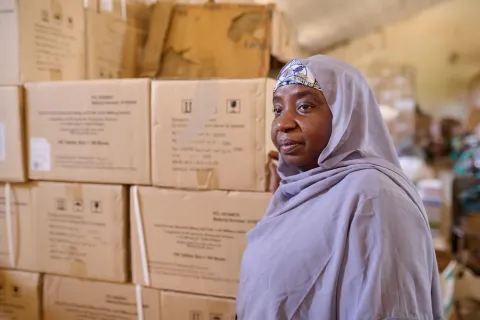
Fatima is one of 15 trained community volunteers working in the area, supported by UNICEF, the World Food Programme and the Katsina State Government, supported by United States Government. Together, they are part of a broader shift towards early detection and treatment, guided by WHO recommendations, ensuring that children are identified before their condition becomes severe.
The numbers tell part of the story. In 2025 alone, an average of 33,690 children were screened every month, with over 1,500 referred for further care and more than 10,000 admitted for treatment. Behind each number is a child like Nafisa, and a moment where intervention came just in time.

But Fatima’s work goes beyond measurements and referrals.
She speaks to mothers about nutrition, encourages them to attend antenatal care, and reminds them of the importance of exclusive breastfeeding in the first six months. She speaks to fathers too, urging them to support their families with better food and care. It is a quiet kind of advocacy, rooted in trust and lived experience.
“No child should be missed,” she says, not as a slogan, but as a responsibility she carries every day.
With funding from the United States Government, UNICEF and partners are supporting the Government of Katsina State to reach every malnourished child, even in communities affected by violence, with lifesaving prevention and treatment services. At the centre of this effort are volunteers like Fatima, moving from home to home, turning early warning into early action.
Because sometimes, saving a life begins with something as simple as a strip of coloured tape, used at the right time, by the right person, who chooses to show up.