At 59, Deborah Built Her First Toilet
How a former student helped his retired teacher leave behind more than 50 years of open defecation in Kilankwa II Community

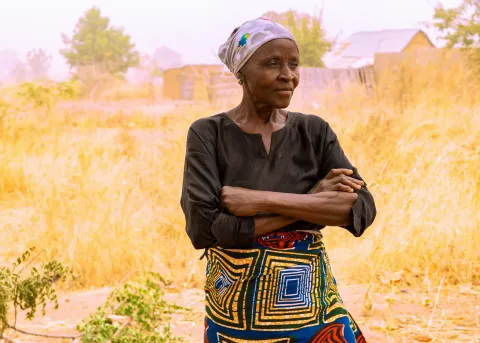
For most of her 59 years, whenever Deborah Abawa needed to use the toilet, she walked into the bush.
As a child, she did it. As a young woman, she did it. Even after she became a teacher at Kilankwa II Primary School, raised a family and eventually retired, little changed.
There was simply no toilet at home.
“Since my primary school days, that’s how we have lived,” Deborah says.
It was not something she had chosen. It was simply how generations of families in Kilankwa II had lived. Building a household toilet cost money, and for Deborah and many of her neighbours, there were always other pressing needs.
So, the bush remained their toilet.
It meant walking outside whenever nature called, sometimes in the heat, sometimes in the rain and sometimes when it was dark. There was little privacy and no protection from the health risks that came with open defecation.

For more than five decades, Deborah lived with it.
Then, one day, one of her former pupils came back to teach her something.
Ishaya Micah grew up in Kilankwa II. He knew Deborah first as the woman standing in front of his primary school classroom.
He also knew what it meant to grow up without a toilet.
“When I grew up here, there was no toilet. All we had was the bush,” he says.
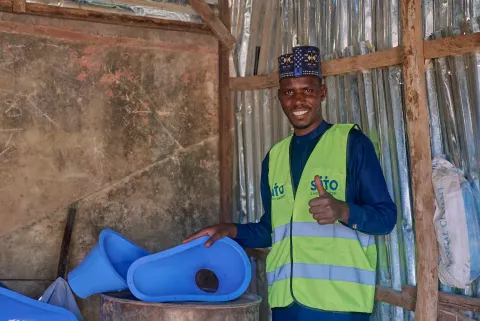
Years later, Ishaya became a Social and Behaviour Change Facilitator and participated in sanitation sensitization training supported by UNICEF and China EXIM Bank. He learnt about the health risks of open defecation and, importantly, how to have conversations with families about changing practices that had existed for generations.
He returned to Kilankwa II with a different kind of lesson to teach.
Ishaya began moving from household to household, talking to families about toilets, hygiene, health and dignity. One of those conversations brought him back to his old teacher.
Deborah still finds the reversal amusing.
“He was my pupil that I taught in primary school,” she says with a smile. “Now he is the one teaching me.”
This time, Deborah listened.
Ishaya explained what having a toilet could mean for her family. No more walking into the bush. More privacy. A safer environment for her children and grandchildren. Less exposure to the health risks associated with open defecation.
For Deborah, the message stayed. She decided she would build a toilet. But deciding was the easy part.
Deborah did not have enough money to build one immediately. So she began saving. A little money bought some cement. More savings paid for blocks and other materials. Piece by piece, she gathered what she needed.
There was no grand construction project. Just a retired teacher quietly putting aside what she could afford until there was enough to call local builders.
At 59, Deborah finally built the first toilet she had ever owned.
“Now, if I want to use the toilet, I don’t have to go outside again,” she says proudly. “I’m happy with this toilet.”
It is difficult to measure what that simple sentence means after more than half a century of walking into the bush.
Today, 16 members of Deborah’s extended family, including her children and grandchildren across two households, use the toilet.
Already, Deborah is thinking ahead.
“It will be overused,” she says. “That is why I want to add another one.”
Once again, she is saving.


For Deborah, however, the change is about much more than convenience. She remembers suffering from infections when open defecation was part of her everyday life.
“Before, when I used the bush, I used to have infections,” she says. She believes things have improved since her family began using the toilet.
“Now I do not have infections anymore, and I go to the hospital less often.”
Across Kilankwa II, Ishaya continues the work that brought him back to his former teacher. He talks to families about sanitation and encourages them to make changes within their own homes.
It is a simple idea, carried from one household to another: a toilet is not a luxury. It means privacy. It means dignity. It means children and families no longer having to walk into the bush whenever nature calls.
With support from UNICEF and China EXIM Bank, community facilitators like Ishaya are being equipped with the knowledge and skills to help families understand the risks of open defecation and make informed decisions about sanitation.
But in Deborah’s compound, the impact of that work is already standing there.
A toilet.
Built slowly, block by block, with her own savings.
For a woman who spent much of her life teaching others, there is something fitting about the person who helped change her mind being one of the children she once taught.
“I am proud,” Deborah says. “At my age, I am still learning.”
More than 50 years after she first learnt to walk into the bush to relieve herself, Deborah has finally left that part of her life behind.
And this time, the lesson is travelling to the next generation.