Little Bugs ECD Centre
providing a ray of hope for families in Sossusvlei

Namibia, Sossusvlei, 25 April 2016 - Thirteen years ago, Jeanette Swartbooi (38years) relocated to Sossusvlei, in the middle of the Namib Desert. This move was in response to a breakthrough in employment opportunities which the booming tourism industry provided. The testimony of her life today demonstrates the paradox of how this employment opportunity has resulted in her children being excluded from essential social services such as schools, health facilities and even shops.
With a heavy heart, Jeanette had to send her eldest son Tangeni off to boarding school at the age of six, contending with only seeing him once every three months during holidays. For the last seven years a 180km stretch of a dirt road, which is not serviced by public transport, has separated Jeanette and Tangeni.
“It is never easy for a mother to send her six year old into boarding school, but I had no choice because there are no schools in the desert,” says the mother of four, who believes living in an isolated community has deprived her of the chance to nurture and influence Tangeni’s academic, social and physical growth.

As Jeanette continues to monitor Tangeni’s progress from a distance, fortunes are turning for Tangeni’s siblings, Freddie and Rudolf. An Early Childhood Development Centre has opened up its doors to usher in hope that children from Sossusvlei will one day overcome life’s adversities and achieve great academic and social excellence.
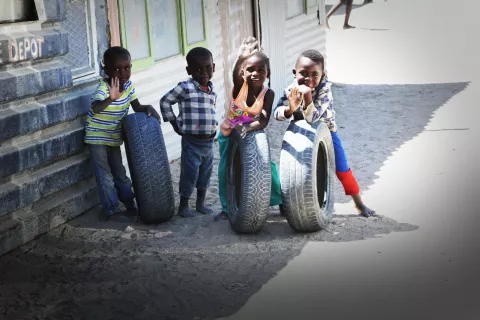
The bright colours which decorate Little Bugs ECD centre are a welcome contrast to the ashen and sandy setting of the Sossusvlei environment, and symbolic of the nurturing experiences which have become a part of life for the 28 children aged between three and eight years.
Initially set up as a family establishment, Little Bugs ECD Centre is today one of five regionally diverse centres being supported by UNICEF to strengthen the implementation of quality pro-poor integrated ECD programs.
By offering these children from disadvantaged and often disengaged communities with professional early learning, health, nutritional, child protection and social experiences, the model centres are pivotal in UNICEF’s work towards re-positioning ECD services in Namibia, including the importance of meaningful parental involvement for a child’s holistic development.
Throughout Namibia, issues of poverty, distances from school and a host of other social and economic inequities often prevent children from accessing and enjoying the benefits of early learning. School dropout and retention rates are worrying, with 13% of primary school aged children out of school, while only 13% of children between the ages of 0-4 years old have passed through an Early Childhood Development (ECD) programme.

“Poverty and some of the many inequities within our communities have long prevented Namibia’s children from enjoying the benefits of integrated Early Childhood Development,” says UNICEF Representative, Micaela Marques de Sousa.
“These model centres therefore show the possibilities and importance of breaking barriers and providing a good start to life for every child, irrespective of their geographic, social or economic background.”
Little Bugs ECD centre also places importance on engaging and encouraging parents regularly to boost their parenting skills, so that the lessons adopted at the centre do not fade away when the children go back home. For Jeannette, the lessons on developing a vegetable garden, also being supported through UNICEF, are an enlightenment on how to overcome the struggle of relying on commercial food products when shops are too far away.
Jeanette hopes that the pace set by Little Bugs ECD gives impetus for future education and social interventions in Sossusvlei so that the foundations set for the family remain unshaken.