
Namibia celebrates Day of the African Child (DAC) 2020
Theme “Access to Child-friendly Justice System in Africa”
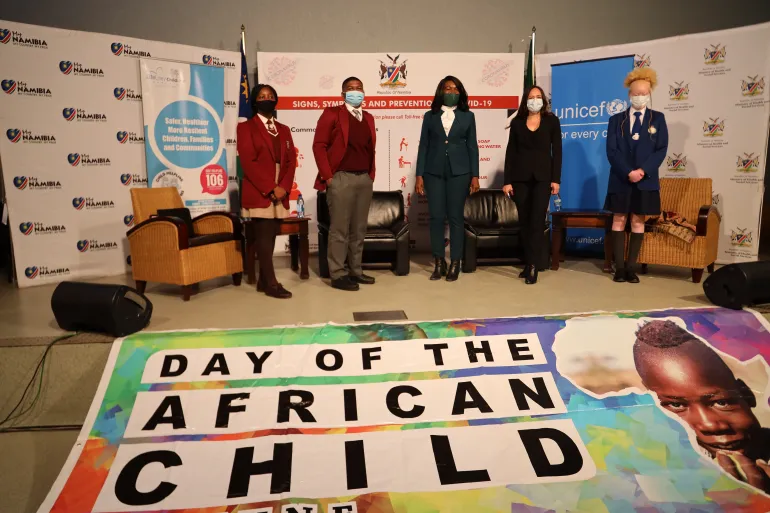
NAMIBIA, Windhoek, 16 June 2020 – Today, the Government of Namibia, through the Ministry of Gender Equality, Poverty Eradication and Social Welfare and in partnership with UNICEF, joined the African Union to reflect on the challenges that still face children who find themselves in conflict with the law in order to pave a way to ensure access to a child-friendly justice system in Namibia.
To commemorate the event, the UNICEF Representative to Namibia, Rachel Odede said “A child-friendly justice system should ensure that the best interests of the child is given primary consideration. It should be a system that better serves and protects all children irrespective of who they are.”
Despite the adoption of laws that are specific to children by African governments, and the considerable investment into the protection of children, scores of children are still unable to access or benefit from child friendly justice systems in a meaningful way for a number of reasons.
Global reports states that more than 1 million children worldwide are detained by law enforcement officials. In many prisons and institutions, children and young persons are often denied the right to medical care, education and individual development.
The Namibian Government’s commitment to building a child friendly justice system is evident through the enactment of the Child Care and Protection Act. No. 3 of 2015 that recognized fundamental principles of child-friendly justice system. This act that is in line with the Convention of the Rights of the Child and the African Charter on the Rights and Welfare of Children, has resulted in various capacity development exercises of all key government staff to ensure that the fundamental principles of child-friendly justice system contained int the Act, are adhered to.
Irrespective of these investments, many children who go through the justice system are not fully benefitting from the child friendly justice system and the treatment they receive, fall short of expected levels of care.
“When a child is believed to have committed a crime, the way the justice system responds can have a lifelong impact – positive or negative. Following the principles established by the Convention on the Rights of a Child, we need to treat any procedure or case, with special attention for their wellbeing and needs, and with full respect for their physical and psychological integrity, irrespective of their capacity or legal status,” said Odede.
Speaking at a panel discussion organised by the multisectoral organising committee, 15-year-old Hon. Emma Paulus, member of the Children’s Parliament, said that jails and detention should be a last resort for children in conflict with the law.
“Petty crimes where a child steals bread from a supermarket should be seen as a protection issue. A child might be hungry, from a poor household and in need of protection. Therefore, the system should be able to differentiate children in conflict with the law and children in need of protection” said Emma
To address some of these challenges, yesterday the Namibian Police force in partnership with the Ministry of Justice and Ministry of Gender Equality, Poverty Eradication and Social Welfare, embarked on a training for Law Enforcement Officials with focus on dealing with Children in Conflict with the Law. The training which is supported by UNICEF, aims to equip law enforcement and other officers on the ground in responding to child protection issues and supporting children in conflict with the law during the COVID-19 pandemic.
###
Note to editors:
The Day of the African Child commemorates the 1976 march in Soweto South Africa, when thousands of African school children took to the streets to protest the inferior quality of their education and to demand their right to be taught in their own language. Hundreds of young boys and girls were shot down and in the two weeks of protest that followed, more than a hundred people were killed and more than a thousand injured.
To honour the memory of those killed and the courage of all those who marched, the Day of the African Child has been celebrated on 16 June every year since 1991, when it was first initiated by the Organization of African Unity. The Day also draws attention to the lives of African children today.
Media contacts
About UNICEF
UNICEF promotes the rights and wellbeing of every child, in everything we do. Together with our partners, we work in 190 countries and territories to translate that commitment into practical action, focusing special effort on reaching the most vulnerable and excluded children, to the benefit of all children, everywhere.
For more information about UNICEF and its work for children, visit www.unicef.org.


