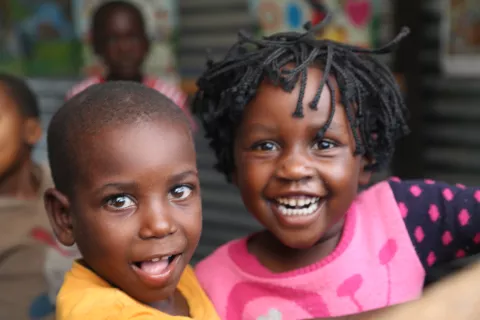
“Early Moments Matter for children’s brain development”

06 November 2017 - Namibia today launched the #EarlyMomentsMatter campaign to drive increased awareness on the importance of the first 1,000 days of a child’s life and the impact of early experiences as critical for the future of Namibian children.
The campaign kicks off with illustrating that providing a child with the foundation and stimulus that they need in the early years does not need to be complicated or expensive. Instead, parental actions such as loving, nurturing, caring, playing and feeding a child, provide them with the best possible start in life.
The Ministry of Gender Equality and Child Welfare, together with the Ministry of Education Arts and Culture, the Office of the Office of the First Lady and UNICEF are driving this initiative, which resonates with the National Development Plan (5)’s indication that Early Childhood Development (ECD) is a key role-player in addressing issues of poverty, inequality, and low economic output, as well as for personal, holistic well-being and fulfilment.
“The time between conception and a child’s second year of life is a unique period when optimum health, growth, and brain development takes place. If a child is poorly nourished, if s/he is not properly stimulated and if s/he is subjected to violent episodes, then the growth of the child, the family, the society and the country is undermined in the long run,” said Minister of Gender Equality and Child Welfare, Hon. Doreen Sioka.
According to global findings, early stresses in the form of lack of food, lack of stimulations, abuse, poverty, illness, and neglect, have long-term impacts on a child’s health, ability to learn, social skills, personal relationships, emotional and physical well-being, and ability to
contribute to a prosperous, and functional society.
Anecdotal as well as statistical evidence shows that thousands of children in Namibia do not fully enjoy the investments that have been made in the areas of health, protection and water and sanitation in the country. Far too many children still suffer from deprivation, exploitation and neglect as a result of being born into poverty, having limited access to education, limited access to health facilities and being exposed to violence and abuse.
A recent study of ECD centres across eight regions which is entitled “Needs Assessment of under-resourced and vulnerable Early Childhood Development Centres in Namibia,” revealed how both human and financial constraints continue to hamper essential services for children’s cognitive and physical developments in the country.
According to the findings from the assessment, the passion and commitment of ECD caregivers to support the cognitive and social development of children is shortchanged by the gaps in investments to training and provision of quality early learning, nutritional and sanitation services.
This report corroborates with earlier surveys such as the 2011 Population and Housing Census, which show low investments in early childhood development at household and institutional levels across Namibia. According to this survey, only 13.9% of children between the ages of 0-4 years access Early Childhood Development (ECD) programme and a lot of children with disabilities are not benefitting from early intervention programs.
“Investing in and expanding early childhood development services in homes, schools, communities and health clinics is a key mechanism to address gross inequalities in the nation, said First Lady of Namibia, Madam Monica Geingos. “Providing a child with a good foundation enables them to perform better in school, avoid life-long health concerns and ailments, and helps them to contribute meaningfully to the national growth and development.”
At the launch, the Minister of Education, Arts and Culture Katrina Hanse-Himarwa, used the opportunity to read a story to children. She emphasized the importance of storytelling as one of the ways that children learn about their culture, instilling values and developing their language skills.
“Reading to and with children builds curiosity and develops vocabulary needed to master a language. It is through reading and storytelling that a child’s imagination is triggered - taking him/her to places and times they have never been - enlarging and enhancing their worlds”, said Katrina Hanse-Himarwa.
Strengthening parental involvement in children’s development, early stimulation, the use of indigenous knowledge systems on parenting and addressing negative cultural beliefs and practices, in a sensitive and evidence-informed manner will be at the centre of the #EarlyMomentsMatter campaign in Namibia.
“By engaging with families, the initiative aims to drive demand for quality, affordable early
childhood development services and to urge Government and other stakeholders to invest in programmes and services targeting the most vulnerable children,” said UNICEF
Representative, Ms Rachel Odede.
In the medium term, the #EarlyMomentsMatter campaign seeks to foster closer working relationships between key line ministries, development partners, parents and Civil Society Organisations to improve ECD policy, increase funding for ECD, and improve the frequency and quality of conversations about ECD, as informed by neuroscience.
Media contacts
About UNICEF
UNICEF promotes the rights and wellbeing of every child, in everything we do. Together with our partners, we work in 190 countries and territories to translate that commitment into practical action, focusing special effort on reaching the most vulnerable and excluded children, to the benefit of all children, everywhere.
For more information about UNICEF and its work for children, visit www.unicef.org.