Healing young hearts
The critical need for mental health support for children after Myanmar's deadly earthquake

- English
- မြန်မာ
In the aftermath of the devastating 7.7 magnitude earthquake that struck Myanmar on March 28, 2025, the destruction is plain to see – collapsed buildings, damaged infrastructure, and makeshift family shelters now define the landscape across affected regions. But beneath this visible devastation lies a silent, but deeper crisis: the profound psychological trauma carried by survivors, especially children.
Khin Yadanar, a 5-year-old girl from Kyauk Chet village in Zeya Thiri Township, Nay Pyi Taw, lost her mother and aunt when a brick wall collapsed on them during the earthquake. Her simple, heartbreaking words captured the depth of her loss: "I hate earthquakes. Earthquakes took my mother and my aunt away."

Thurein Oo, a 10-year-old boy who was praying at a mosque in Mandalay when the earthquake struck, shared his own harrowing experience: “When the earthquake happened, buildings outside collapsed and blocked the entrance. People inside couldn’t get out. When it shook again, the light bulbs fell down,” Thurein recalled. “I was so scared. My heart was beating so fast— and all I could think about was my parrots and cats at home.”
Thurein's story reveals both trauma and resilience. Even in the chaos, his first thoughts were for his beloved pets— four cats and four parrots. As soon as the tremors subsided, he ran back to his damaged home, determined to rescue them. He carried the parrots’ cage to safety, though the cats had scattered and were nowhere to be found.
"He loves these animals so much," his mother explained. "He was afraid they would suffer, so he grabbed the two cages and ran downstairs. But the cats couldn’t be found. It still breaks his heart."

For Thurein, the earthquake disrupted not just his home— but his entire social world. “My friends are all scattered now, just like my missing cats,” he said quietly. Before the disaster, he had plans to go swimming, ride bicycles around the Mandalay moat, and play football during school holidays. Now, his friends are gone— their whereabouts unknown.
Khin Yadanar is also still struggling. Since losing her mother and aunt, she has become quiet and withdrawn, often waking in tears and gripped by anxiety. “I can’t sleep,” she whispered. “I think the earthquake will come again.”
Across earthquake-affected areas, parents are witnessing similar signs of distress in their children— sleepless nights, sudden anxiety, and emotional withdrawal. For many parents, the psychological toll on their children is proving to be one of the most difficult aspects of this crisis.
“I don’t know how to help her,” said Thida, a mother whose 8-year-old daughter, Thiri, is now a shadow of her once-bubbly self. “She cries in her sleep, and I worry something inside her has broken. But I’m also trying to hold everything else together.”
The earthquake has compounded existing vulnerabilities in a country where over 6.5 million children were already in need of humanitarian assistance - enduring escalating conflict, insecurity, and severe disruptions to vital services like education and healthcare.
In response to this growing mental health crisis, UNICEF and its partners have mobilised quickly to provide critical psychological support to affected communities.

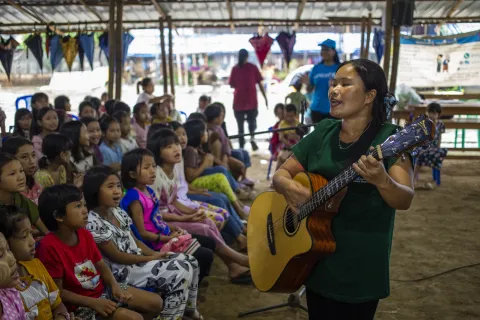
A cornerstone of UNICEF's mental health response has been the establishment of child-friendly spaces in affected areas. In Mandalay, new child-friendly spaces have been set up specifically to promote psychosocial wellbeing, build resilience, and restore a sense of normalcy to children's routines. Since the earthquake, UNICEF and its partners have expanded support across severely affected townships in Mandalay, Nay Pyi Taw, Sagaing, and other regions.
These safe spaces provide structured activities for children to play, learn, and process their experiences in a supportive environment. Trained facilitators offer psychological first aid and mental health support tailored to children's needs.

For children like Thurein, the child-friendly space has become a refuge. “I like coming here,” he said. “I feel safe, and I made a new friend who also lost his home.”
Khin, once withdrawn and silent, has also started to respond. “I coloured a picture of my mother,” she shared softly, clutching a crayon drawing. “I feel better when I draw.”
These small but powerful moments reflect the vital role safe spaces play in helping children begin to cope, connect, and regain a sense of safety after crisis.
In addition to child-friendly spaces, UNICEF is providing specialised support for children who have been separated from their families, conducting family tracing and reunification efforts, and offering case management services for the most vulnerable children.
UNICEF staff and facilitators on the ground are seeing the difference - but also the scale of what still needs to be done.
“We see children slowly opening up – smiling again, talking, playing,” said Khet Mar, a UNICEF Child Protection Officer based in Mandalay. “But their caregivers are overwhelmed. Many are grieving, displaced, and unsure how to support their children. If we don’t reach them with mental health support too, we risk an even deeper crisis.”
Her words are a reminder that supporting children also means strengthening the adults around them – because healing must happen at every level of the family.

As the situation continues to unfold, families are still reeling from the devastation —and now face new threats with the arrival of the monsoon season, which could trigger further destruction through flooding, waterborne diseases, and heightened displacement.
While the physical rebuilding of affected areas – homes, infrastructure - will take years, the emotional and psychological toll on children cannot be left for later. With urgent support through child-friendly spaces and mental health services, even the deepest wounds can begin to heal— giving children like Khin Yadanar and Thurein a chance to reclaim their childhood and look toward a more hopeful future.