Delivering child protection support despite hazardous environment in central Myanmar
Danger in the Dry Zone

- English
- မြန်မာ

Seng Nu1 was extremely concerned. Her colleagues should have been back from a field visit by now. She tried connecting with them on their mobile phones, unsuccessfully.
“As the project manager, my staff are my responsibility,” said Seng Nu, recalling the incident.
The previous day, the two UNICEF local partner staff, Aye Aye and Thinzar, had set out to deliver child protection services in a village in the heavily conflict affected Sagaing Region, in central Myanmar.
Due to travel and security challenges, it was not unusual for staff to stay overnight in villages - as the two women had the prior evening – but both had been due to return that day.
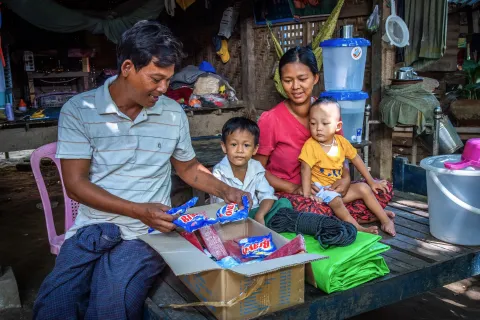
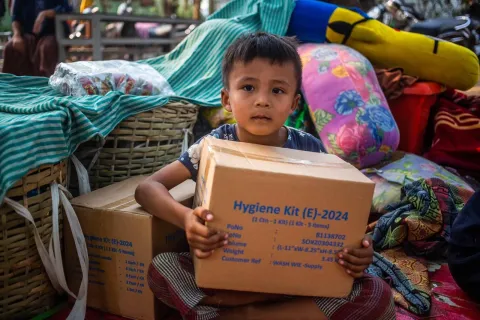
UNICEF and its partners have continued to deliver vital aid to conflict-affected communities throughout Myanmar’s Dry Zone, despite immense security challenges. With funds from the UN Central Emergency Response Fund (CERF), UNICEF strengthens the capacity of local child protection providers, like Seng Nu’s team, to deliver targeted child protection services and emergency assistance, improve awareness of child protection issues, improve local child protection systems and reporting pathways, and provide vital aid and supplies to conflict-affected children and their families.

Seng Nu had heard from her contacts that an armed clash had erupted near the village her colleagues were visiting. “I tried to reach every possible contact I have in the area, but I couldn’t get any more information,” she said. “I was desperately worried.”
She tried calling again – no answer.
While conflict increased across Myanmar in the aftermath of the military takeover, it is perhaps nowhere fiercer than in Myanmar’s central Dry Zone.
The conflict has caused many people to flee their homes. Across northwest Myanmar, it is estimated that there are more than 855,000 internally displaced people,2 including at least 624,000 in Sagaing Region alone.3
It was later discovered that earlier that day, Thinzar and Aye Aye had woken up to prepare for the day’s planned activities in the village. However, at around 11am, panicked word came that the military had suddenly arrived at a nearby village to conduct a search. Assuming that their village would be next, the villagers quickly organized themselves to flee into the nearby fields.
They insisted that Thinzar and Aye Aye go with them. Knowing there was no other option, both decided to go – they packed a blanket and some food and set out with the rest.
Belongings were stacked in carts, some valuable items were quickly buried or hidden, as the villagers prepared for the worst. A few rode motorcycles or bikes, but most walked. Mothers clutched their babies tightly, and fathers held onto their children's hands as they walked, hoping for safety.
The villagers apparently did all of this quickly and with experience. It was not the first time they had done this.
The place was left quiet and deserted.
As they fled the village, they heard the sound of gunfire in the distance, a constant reminder of the danger that lurked around every corner. Some of the children cried and clung to their parents, their hands trembling with fear.

After walking for several hours with the villagers, with the hot sun high in the sky, Thinzar and Aye Aye arrived at some huts in the fields, where farmers usually rest and sleep during harvest time. They sheltered there for nine days, with no means of communication, while the sounds of gunfire rang out due to armed clashes between the military and People’s Defence Forces nearby.
Finally, word came that the fighting had stopped. Thinzar and Aye Aye were, at long last, able to arrange for travel back to their office together.
“We saw a lot of destruction on the way back,” Aye Aye later recounted.
“I was so happy when they finally came back,” said Seng Nu. “I remember that I started clapping and praising God.”
The experience was harrowing for both women. To help manage their trauma, they used self-care techniques they learned from a UNICEF-provided training.
Aye Aye relieves some stress by going to get soup from her favourite restaurant. “My favourite dish to order is a traditional Chin soup,” she said.
Thinzar needs more solitude. “I go home by myself and close all the windows and doors. I sit quietly, listen to music, and I massage my fingers to calm myself down, just like I learned from the training,” she said.
“Overall, the situation is intense,” said Seng Nu. “We often have to make quick decisions at short notice, whether to proceed or postpone activities. The security situation in the villages can change very suddenly.”
In the last three months since the project began, Seng Nu’s organisation has established child protection working groups in 35 villages in Sagaing Region and provided child protection kits to 1,900 children. In addition, more than 1,250 parents and caregivers have received parenting education training sessions.
Seng Nu is proud of the work she and her colleagues have been able to deliver in the Dry Zone.
“Other areas have had conflict for a long time – they have been receiving child protection services and there is better awareness of how to cope. There is limited child protection knowledge and capacity here in Sagaing compared to Kachin, for example,” she explained.
“Things are getting more and more challenging. That is how I know that this is where I should be,” Seng Nu said resolutely.
- All names in this story have been changed to protect confidentiality.
- https://reliefweb.int/report/myanmar/myanmar-humanitarian-update-no-26-2-february-2023
- https://reliefweb.int/report/myanmar/myanmar-humanitarian-needs-overview-2023-january-2023