Why delayed vaccination schedules can be harmful to children
Most families vaccinate their children at the recommended times, but some caregivers wonder if a delayed or alternative vaccination schedule is safer. Here is what we know from more than 75 years of research on tens of millions of children.
- Crnogorski
- English
- Shqip
The vast majority of children worldwide receive their vaccinations at the recommended times. Almost 17 out of every 20 infants, for example, have received their three recommended doses of the vaccine against diphtheria, tetanus and pertussis (DTP). However, some families consider changing or delaying vaccination schedules out of the belief that it is safer for their child.
In fact, an alternative or delayed vaccination schedule can put children at risk. There is no evidence that delaying immunizations offers any benefits to children's health, either short- or long-term.
Here are what we know about vaccinations in general, and alternative vaccination schedules in particular.
1. Childhood vaccinations are overwhelmingly safe, while the diseases they protect against are not.
For more than 75 years, scientists have closely studied the short- and long-term health and development of hundreds of millions of vaccinated children around the world. Over all of those years and millions of cases, no credible links have been found between vaccines and autism, auto-immune disorders, or any other long-term health conditions. Vaccinations also do not increase the risk of contracting other infectious diseases. In fact, there is evidence vaccines may help the immune system fight against even those viruses that weren't specifically vaccinated against.
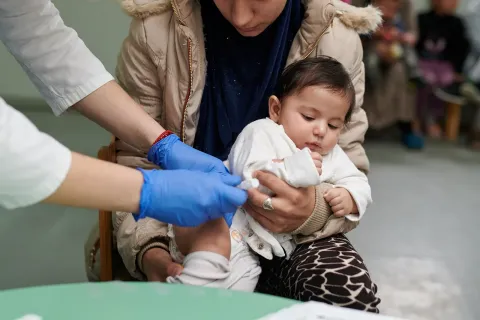
When side effects from vaccination occur, they are usually mild and temporary, like swelling at the injection site. More severe side effects, like anaphylaxis (allergic reaction), are extremely rare. There is a one in a million chance of experiencing anaphylaxis after a DTP vaccine, for example. Any risks of vaccination also must be weighed against the risks of the diseases they protect against. For example, if an unvaccinated infant contracts pertussis (whooping cough), they have a 1 in 20 chance of developing severe health complications that can lead to death. If an unvaccinated child contracts measles, they have a 1 in 500 chance of dying if they are in a middle- or upper-income country. In some populations in lower income countries, the risk of an unvaccinated child dying from measles is much higher.
This means the risk of health complications from disease is many, many times higher than the risk from vaccines.
2. If vaccines are delayed, children aren't protected from disease when they need protection the most.
Because their immune systems are still at their earliest stages of development, babies and children are less protected against viruses and other diseases than healthy adults. Their bodies and organs also are still developing, which can mean that a disease that causes mild symptoms in a healthy adult may leave a child with severe health complications. By "teaching" their immune systems how to recognize and fight certain diseases, vaccinations help make up for this vulnerability.
This is why the vast majority of all deaths from diseases like whooping cough and measles are small children and babies. The best protection against complications and death from these diseases are vaccines. Waiting to vaccinate a baby or child against these diseases puts them at increased risk of becoming severely ill, or even dying, if and when they are exposed.
We only have to look at overall child mortality figures to understand what an impact vaccinations have made in saving lives. In 1990, around 93 children out of every 1,000 children died before the age of five. Today, mortality rates are a third of that number – 37 children per 1,000. Much of this is because of global vaccination programmes.
In fact, over the last 50 years, vaccinations have saved 154 million lives. Most of those – 101 million lives – were of babies.
Because children are more vulnerable to disease the younger they are, it is important that they receive vaccinations on time and that vaccines are not delayed.
3. There is no need to "spread out" vaccines to reduce the number of antigens.
Some people incorrectly believe that the regular vaccination schedule introduces too many antigens to a baby or small child at the same time, and that this can be bad for them. This is untrue.
Antigens are the tiny parts of viruses or of bacteria that, when introduced into the body, spark an immune response. This is what makes vaccines work.
Antigens are everywhere – even in the birth canal with the baby. In fact, the number of antigens that a child is exposed to from any vaccine, or any recommended combination of vaccines, is far lower than what they are exposed to on a daily basis in their environment.
A baby's immune system is incredibly resilient, capable of responding to hundreds and thousands of antigens, bacteria and allergens every day. Receiving a few vaccines at a time is easy for their immune system and does not pose a risk. It has been estimated that infants' immune systems are so cleverly designed, they could safely and effectively respond to 10,000 modern vaccines all given at the same time.
This is why studies have found that children who have received vaccinations have the same overall levels of prior antigen exposure as those who were not vaccinated. Vaccines don't overwhelm the immune system; they simply help it recognize and fight specific diseases without adding any extra burden.
It is also worth remembering that the number of antigens in a vaccine is much lower than what a child is exposed to when they are exposed to a disease itself.
Furthermore, the number of antigens children are exposed to in vaccines has plummeted over time. The number of vaccines that are regularly offered has increased over the last few decades. But the total number of antigens in these vaccines has dropped from more than 3,200 to 320.
4. Getting multiple vaccines at once does not weaken a child's immune system.
There is no evidence that the number of vaccines children are given, or the antigens within them, increase the risk for infections or any health conditions.
Multiple studies have looked at whether vaccinated children are more or less likely to fall ill with an infection they were not vaccinated against, compared to unvaccinated children.
They have overwhelmingly found that children who receive vaccines are no more likely to get sick from unrelated infections than children who are not vaccinated. In fact, the risk is reduced significantly.
For example, over the three months after receiving the measles, mumps and rubella (MMR) vaccine, vaccinated children were no more likely to get either an unrelated bacterial or viral infection than children who were not vaccinated. This demonstrates a type of cross-protection, where vaccines can indirectly protect against other infections, further strengthening a child's immune defense. Another study found that three-month-olds who received vaccinations against diphtheria, pertussis, tetanus, HiB and poliomyelitis all at the same time were less likely to have unrelated infections afterwards than children who were not vaccinated.
5. The amount of aluminium used on the normal recommended schedule is safe and does not need to be spread out.
Aluminium has been used in vaccines since 1926. It is used as an "adjuvant", which helps the immune system respond to a vaccine, for example by keeping the vaccine at the injection site a little longer. While it can cause local, short-term reactions like swelling, nearly 100 years of research have found no cause for concern about frequent, severe, or long-lasting effects, including neurotoxicology.
Meanwhile, studies have found there is no difference in the amount of aluminium in the bloodstreams of children who are and who are not vaccinated.
Aluminium is a natural element that comes from the Earth's crust. It is everywhere, including in our food and water. As adults, we normally ingest five to 10 mg of aluminium per day in our food compared with the average of 0.125 to 0.5 milligrams of aluminium per vaccine dose. Babies and children ingest aluminium, too. It is in infant formula and baby food, as well as other everyday ingredients like baking powder.
It is true that our bodies absorb much less aluminium when we eat it than when it is injected. Even when it is injected, however, we are very efficient at eliminating aluminium from our systems. After entering our bloodstream, aluminium is eliminated by the kidneys. Fifty per cent of aluminium is eliminated by our bodies after 24 hours, 85 per cent is eliminated within two weeks, and 96 per cent is eliminated within three years. The tiny amount of aluminum used in vaccines is processed quickly and safely by the body.
Of course, having very high amounts of any substance, including aluminium can be harmful, vaccines use only tiny, safe amounts of aluminium to help strengthen the immune response.. This is not specific to aluminium: even consuming too much water or oxygen can kill you. But this is why public health authorities set aluminium limits for vaccines, which also take into account that several might be administered at once.