Veljbana Naza dreams about the happiness of all young Roma
In school and in the field, the mediator is helping Roma children to have a better quality of life

- Crnogorski
- English
- Shqip
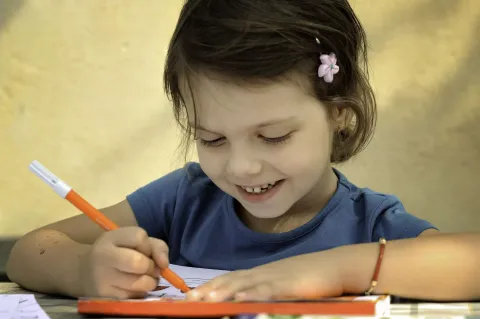
NIKŠIĆ, 9 April 2022 - Veljbana Naza is a mediator for the social inclusion of Roma and Egyptians into the education system. She was one of the first Roma women in Montenegro to complete secondary school, and she is a single mother, aunt and grandmother. In addition to all the roles she has, Veljbana would also like to engage in humanitarian work and, as she says, to fulfil her objective: to put a smile on the faces of young Roma.
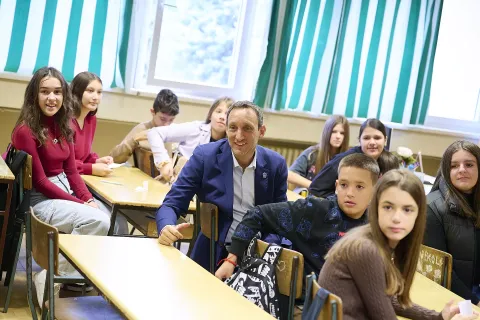
Veljbana is employed at “Mileva Lajović Lalatović” Elementary School in Nikšić as a mediator, but she also volunteers in preschool education. She explains her desire to be in constant contact with children by the fact that grew up as the only child in her family. “It is the world I missed – spending time with a lot of kids,” Veljbana says.
According to Veljbana, it is extremely important for children to attend kindergarten. “They need to grow up with their peers, hang out, play, understand that a life that looks like a fairytale can be their own life.”
Veljbana’s working day starts at around nine o’clock. She verifies the number of students present at classes and, in the case of any absence or other problems, talks to the teachers, school psychologist, pedagogue or principal... “I am like a postman: from parents to school, from school to parents.”

She is also active in the field. She often takes notes and homework assignments from the school to Roma families, talking to parents in the process.
In order to be successful in this endeavour, Veljbana completed a series of training sessions and workshops – so many of them that, as she jokingly says, she herself became a pedagogue. Inter alia, she participated in a workshop for the development of socio-emotional skills, which is part of a programme implemented with the support of UNICEF and in cooperation with the Education Office of Montenegro.
She completed a fourth-degree qualification in a trade vocational school. “It is a rarity in my generation. I was one of the first Roma women to complete secondary school. No skipping class, no failed classes...,” Veljbana says.
She intended to enrol at a pedagogical faculty. With a sigh, she says that it did not happen, but that she has not completely given up.
On top of the schoolchildren, Veljbana also takes care of her family. Although her sons have grown up, a mother’s worries never end. “It is hard for me, but I manage. As soon as I get home from work, I roll up my sleeves. I find time to go out as well. A woman must not neglect herself. If she goes forward with positive thoughts, a woman gives herself the strength needed.”

Veljbana believes that the position of Roma in Montenegro is getting better over time, but that much remains to be done. “Young people are raising their awareness, they want to advance, but there is always something missing. The most important element is financial support. Children do not have clothes, shoes...,” she points out.
She has a special message for young women.
"Girls must be independent. Young Roma women should clearly set their goal, creating a life for themselves, seeing their future in a positive light, and having freedom that they will tell their children about.”

In her opinion, patriarchy is more distinct among Roma than among other nations. “If a girl goes out, she will be asked questions upon her return: ‘Where have you been?’, ‘What have you been doing?’, ‘What have you been talking about?’... Everything must be disclosed.”
According to Veljbana, systemic problems arise from the desire for liberation, as well as from financial troubles. “Young people know that they cannot get the money from their parents, so they decide to support themselves. Then they start skipping classes at school, get married, lose the will to socialize, get into trouble or end up on the streets.”
Veljbana was lucky to grow up in a healthy family. “My parents were also patriarchal, but not violent. My mother did not demand that I do housework, but referred me to reading instead. Parents are the wind in children’s sails, and the sails of the whole world,” she points out.
She says that she prefers not to impose attitudes on her children “by force”: “I want them to understand things on their own.”

The fact that she has lived in a mixed environment also helped her. “I had all the nations around me, not just Roma and Egyptians, Veljbana indicates.
Her wish is to do charity work.
“I would like to become a link between donors, humanitarian organizations and children in need. To provide children with clothes, shoes, school supplies, to take them on a trip, to the cinema, to the theatre. They should not spend all their time in their settlement. I would be like a guide. The children need to see that someone is thinking of them, that I can give them attention. It is not all about flour and macaroni,” Veljbana says, concluding that her only interest in this endeavour would be to see children smile.
It would be more difficult without Veljbana
Students of “Mileva Lajović Lalatović” Elementary School in Nikšić, who spend time with Veljbana on a daily basis, describe the support they have received in the same way: It would be more difficult without Veljbana.

Fifteen-year-old Medin Delija, a ninth-grader, emphasizes the good relationships built between the mediator and parents, as well as her constant availability to the children.
“Whenever I skip class, Veljbana calls me to check where I am, how I am feeling, why I skipped class. I tell her everything. I only skip class when I am sick; I attend classes regularly otherwise. My parents love her because she helps me,” Medin says.
According to Medin’s peer, Mirsada Sejda, Veljbana helped her a lot during online classes. “Veljbana informs us about the workshops, recitals... Her task is to take care of us, to support us,” Mirsada says.
Thirteen-year-old Adis Špatolaj is grateful to Veljbana for helping him with his homework.
“She also drops by for coffee and talks to the parents. Her support is immense,” this eighth-grader says.
Fourteen-year-old Leontina Špatolaj, a ninth-grader, breaks into a smile while she explains that Veljbana is not strict and that students can talk to her about anything.
“She motivates me highly to complete secondary school,” Leontina adds.
UNICEF is calling for the engagement of as many mediators in schools as possible, so that they too can support children, just like Veljbana.