Schools to develop socio-emotional skills to prevent violence
UNICEF and the Austrian Embassy are calling for support to be given for the social and emotional development of every child through schools by expanding the socio-emotional skills programme into all schools in the country.

- Crnogorski
- English
- Shqip
Nikšić, 7 March 2022 – As peer violence is a serious issue that Montenegro, like other countries, is having to deal with, UNICEF and the Austrian Embassy are calling for support to be given for the social and emotional development of every child through schools by expanding the socio-emotional skills programme into all schools in the country.
With UNICEF’s support, more than 20,000 children have benefitted from this programme so far in more than 100 primary and high schools. Mileva Lajovic Lalatovic Primary School in Niksic is one of them. This programme has helped the school become a safer and more nurturing environment for every child.
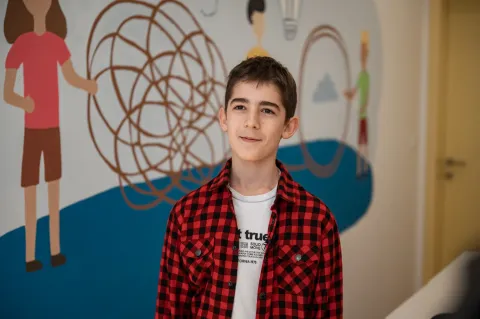
“Through the project ‘My virtues and values’ I have learned more about skills that should be spread in every democratic society, such as tolerance, empathy, self-control, cooperation, gratitude, respect and many others,” said Ivana Đukanović, a student attending the socio-emotional skills programme in Mileva Lajović Lalatović Primary School in Nikšić.

These kinds of programmes have become even more important during the pandemic. Providing children with support to be honest and tolerant, to have understanding towards each other and towards different opinions and to collaborate well is essential, according to the Mileva Lajovic Lalatovic school pedagogue, Nada Mitrović.
“It is extremely important for the socio-emotional skills programme to be alive and well in schools, as children develop communication skills, learn to speak up, and to express and share their opinions,” said Mitrovic.
Celebrating diversity is a key value of this school in Nikšić, according to the school principal Irena Vasiljevic.
“The school is well-known for being a multicultural community, because it embraces diversity and recognizes that diversity makes us all richer,” said Vasiljevic.
UNICEF Montenegro Representative Juan Santander was impressed with the socio-emotional skills class that he attended during his visit to Mileva Lajović Lalatović Primary School in Nikšić.
“I was impressed by the stories I heard today from the students and teachers involved in this programme. It helps students cope with the stress from the pandemic and everyday life. It helps them build good, strong values. They learn to recognize and manage different emotions effectively. This allows them to have better-quality relationships with peers, with family, with teachers",
He reminded that not every child is currently able to benefit from this programme.
“We are calling for the expanding of this programme into all schools so that every child in Montenegro is supported by social and emotional development,”
The Austrian Ambassador to Montenegro, Karl Müller, joined UNICEF’s appeal, as he was also impressed by this programme during his visit to Nikšić.
“I am impressed with the social and emotional teaching of children that find it hard to express feelings, hard to interact and hard to develop these skills. Also, this is something which is difficult in families with challenges. So, I appreciate very highly what all the teaching staff are doing here,” said Müller.
With UNICEF’s support, in cooperation with the Bureau for Education, the programme for developing socio-emotional skills was introduced into Montenegro’s education system in 2015. So far, it has expanded to more than 100 primary and secondary schools supporting students to learn to recognize their own and other people’s emotions, help each other and solve problems together.

The Austrian Ambassador to Montenegro, Karl Müller, joined UNICEF’s appeal, as he was also impressed by this programme during his visit to Nikšić.
“I am impressed with the social and emotional teaching of children that find it hard to express feelings, hard to interact and hard to develop these skills. Also, this is something which is difficult in families with challenges. So, I appreciate very highly what all the teaching staff are doing here,” said Müller.
With UNICEF’s support, in cooperation with the Bureau for Education, the programme for developing socio-emotional skills was introduced into Montenegro’s education system in 2015. So far, it has expanded to more than 100 primary and secondary schools supporting students to learn to recognize their own and other people’s emotions, help each other and solve problems together.