No More Goodbyes for School
Closer to Home at the Borshoo Border Unit

Borshoo Border Unit, Davst soum, Uvs aimag
“I cry a lot because I miss my siblings,” says Gegeen-Ujin, 4, the youngest child in a border-staff family at Borshoo.


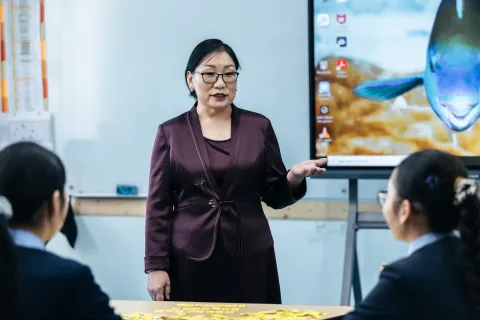
After three days on rough roads and more than 1,500 kilometers from Ulaanbaatar to Mongolia’s northwestern border with Russia, a joint team of UNICEF and the General Authority for Border Protection (GABP) arrived at the Borshoo border unit – where the road ends but our story begins. The steppe wind wakes first, rattling the felt door of the round ger that serves as Davst soum’s kindergarten. One by one, small boots thump beside the threshold and a line of children spills into warmth. Teacher Tungalag – trained in preschool education and stationed here since 2019 – checks the stove, kneels to eye level, and counts soft greetings until the room settles into a steady hum. In this outpost where border duty runs in rotations, school bends around the shifts. “From Monday to Friday, I live with the children,” she says. “Border control staff parents work in rotations. So do I.” The days run long here – nap times sync to night work, pick-ups drift toward dusk, and comfort comes in a voice that holds both routine and reassurance.
Borshoo’s ger kindergarten started as a modest day-care with a small budget from the Davst soum kindergarten. After Mongolia’s 2023 push to make early childhood access universal, it became an official branch – still circular, still warmed by a stove, still the first classroom for the youngest children of border staff and nearby herder families. The ger is ingenious and inadequate in the same breath: adaptable, close, and always improvising; drafty on bad days and sometimes smoky when the wind shifts. Handwashing happens in a careful corner with a little plastic bottle and children queue for a shared toilet at the border unit. Yet the essentials of childhood – songs, stories, snack time, a hand on a small shoulder – find a way to fit.


Among the students is Gegeen-Ujin, a four-year-old with careful braids – the youngest in a family split between Borshoo port and Ulaangom for schooling. Her mother runs the border unit’s canteen; her father works in customs. Gegeen-Ujin lives with both parents at the border, but her older brother – Saruul, a ten-year-old, and Yesun-Ujin, a six-year-old – live nearly 120 kilometers away in Ulaangom, the aimag center, with their grandparents so they can attend school. She sees them only a few times a year, mostly during the summer. The months in between feel heavy with absence. “My happiest time is with my brother,” she says. “I love him so much, but I don’t get to see him.” When a familiar game with her classmates reminds her of a summer afternoon, tears come quickly. “I cry a lot because I miss my siblings,” she admits. Homesickness can look small in a classroom – quieter answers, a sudden outburst – but it comes from a big place: distance.
A half-day’s bumpy drive away in Ulaangom, Saruul follows his own routine. He has lived apart from his parents since kindergarten, now with his grandparents, and he misses home in a way that sometimes turns into restless scrolling. His father, concerned, eventually blocked his phone. “He was consuming too much data, too much content,” his father told him. Saruul shrugs, half relieved; the device had become a stand-in for a room he could picture but not enter. “Sometimes when my 6-year-old calls me, she cries and says she misses her parents. It is a very difficult time in our lives,” his father says. “If there were a school at the Borshoo border post, we could live together with our children… Being together as a family is the most wonderful thing.” So Saruul keeps his grades up, helps his sister when he can, and imagines a simple future: going to school in the same community where his parents work and his younger sister lives.
Yesun-Ujin, six and in Grade 1, feels the distance in her notebooks. She tries hard to keep up but struggles with homework that needs an adult to sit beside her. “I need help for my homework and study,” she says. “I want to ask my dad for help to understand my homework and class learning materials because he knows everything I ask!” Some evenings she calls her mother between canteen rushes, reading out a question across a shaky connection. They work slowly, patient and proud, until the call flickers and ends. Yesun-Ujin breathes out, less alone and a little braver. But a system that relies on a child’s bravery every day needs repair.
Back in the ger-kindergarten, Tungalag teaches alone. She scans for small shifts – a lingering cough, a child gone quiet – while tending the stove, attendance, learning corners, and the inevitable spills. She cannot leave the room, so she waits for nap time to use the toilet: “I hold it until they’re asleep, then I run.” Safety comes from simple routines – buddy pairs, a handwashing line, short movement breaks – and a small notebook for follow-ups. The load is heavy, but the room stays steady in her hands.

The harsh Mongolian climate itself demands better tools and stronger infrastructure. Winter here does not ask for compromises; it enforces them. At -40°C, a stove that heats and cooks inside the ger can also fill the room with smoke, irritating young lungs and raising the risk of respiratory illness. cold air seeps in – children adapt, the teacher makes do. But adaptation is not the same as adequacy. There is also a gap for the very youngest – children under two – who are barely reached by the current set-up. Since more than 40 percent of staff either live away from their families or send their children away to study, many families ask for parenting support and short crèche-style options that would allow infants to learn safely while caregivers rest or do chores. “We need something for children under two years old – so no child is left behind,” the teacher says, echoing a concern heard in many remote baghs.
Bagh School is the answer to these communities’ layered needs. It promises integrated, child-friendly pre-primary and primary education services – right where families live – so children can stay together and parents no longer measure the school year in goodbyes. For Gegeen-Ujin, that means an ordinary miracle: walking to class with Saruul and Yesun-Ujin instead of counting months to see them. For Saruul, it means homework at the kitchen table, not on a call. For Yesun-Ujin, it means a teacher beside her to untangle a tricky reading passage while her parents are close enough to cheer. Across the Bagh School, this looks like age-appropriate toilets and handwashing stations; warm, ventilated classrooms that keep smoke out; a supervised digital corner for the early grades where teachers guide music, movement, stories, and basic digital skills; dignified workspaces for teachers; and dedicated spaces for parent engagement built into the weekly routine.


The program design is both strategic and human. Keeping early grades local reduces reliance on dormitories for children ages 5–12, lowering exposure to bullying, long unsupervised hours, and harmful substances. School-based social-emotional learning (SEL) routines – feelings check-ins, peer play, movement, and music – help children name emotions and recover from separation stress. A supervised digital classroom turns screens from private escapes into shared learning tools, using offline, age- and language-appropriate playlists with planned pauses for discussion and clear time limits. Parenting sessions – on media literacy, reading at home, and positive discipline – extend support into the household. Simple WASH upgrades make healthy habits second nature rather than a daily workaround. A light-touch child-protection pathway ensures that persistent distress or harmful peer dynamics are discreetly referred for appropriate support.
For the three siblings we met, the change is clear. Gegeen-Ujin, 4, wants her brother and sister “to come back so we can live together.” Saruul, 10, is ready for a normal routine at home – “We want to reunite as a family.” Yesun-Ujin, 6, simply wants steady help with Grade 1 work from the people who know her best. Bagh School would put those simple goals within reach: walking to class together, learning close to parents, and finishing the day under one roof.


The teacher’s priorities match what families ask for: child-friendly WASH facilities, clean air and steady heat, a supervised digital corner for age-appropriate learning content, and options for children under two so no child is left out. She also calls for practical support that recognizes remote workloads – materials that last, a safe storage area, and a space where she can plan lessons without leaving children unattended. These are small things in design terms, but they are decisive in daily practice.

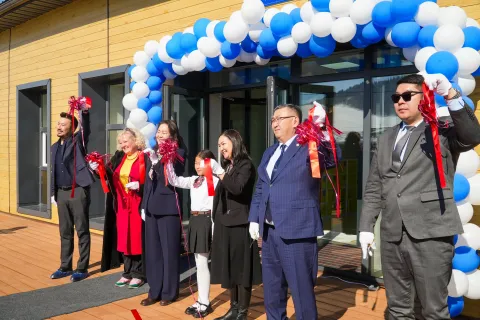
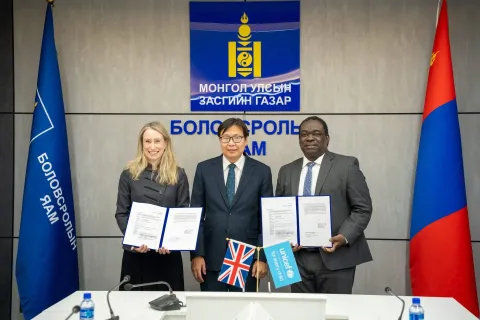
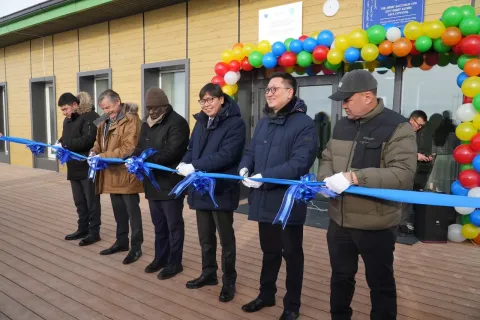
UNICEF, together with the Ministry of Education and the General Authority for Border Protection – and with funding from private-sector partners – is advancing the One Bagh, One School initiative, bringing quality early learning and the first years of primary school to where families live. Keeping early grades local will reduce the need for dormitories for young children, protect family bonds, and make it easier to spot and support learning or well-being needs early. It also honors the commitment already shown in Borshoo: a teacher who covers every hour alone, and parents who juggle duty rosters while trying to keep childhood intact.

What changes when school is close? For children, continuity. For parents, a daily rhythm that fits both duty and family. For teachers, dignity is made visible in space and tools that work with them. For the community, traditions practiced in real time – not remembered from a distance. The border wind will still rise, and the work of guarding Mongolia’s frontier will continue. But a child-friendly school close to home means learning will no longer require a season of separation. “When the complex opens here, families won’t have to separate for school. Children can study close to home,” the teacher says. The high-ranking officer of the General Authority for Border Protection has watched the cost of distance for decades: “I walked eight to ten kilometers to school as a child; thirty years later, the problems remain. Over 40% of my staff live away from their families so children can study. We adjust shifts to help parents – but it’s a stopgap, not a solution. Some travel 200 kilometers just to vaccinate a child.”
Scaling One Bagh, One School is a national investment in equity and early learning. By bringing pre-primary and the first years of primary to where children live – border posts and remote herder baghs – the initiative reduces dormitory dependence for 5–12-year-olds, lowers family transport and living costs, improves early-grade retention and reading, and makes it easier to deliver WASH, health screening, and parenting support. It also helps keep teachers in post with safer, better-equipped spaces. Each complex is a durable, modular asset that can be replicated; the dividend is clear: more children learning at home, more families staying together, and stronger school–community ties across Mongolia.
For Borshoo, that is the measure of success – siblings walking to class together, parents near enough to help with homework, and a classroom built to hold childhood well.