From the Whistle of Rockets to Children’s Smiles: Cristina’s Journey
A Ukrainian mother rebuilds safety and purpose for her children in Moldova.

There are sounds that belong to childhood: the hum of a lullaby, the clang of a school bell, the rustle of pages in a classroom. And then there are sounds that do not belong: the whistle of rockets tearing through the night. Cristina Shuljenko has heard both. Her story is about moving her children from one soundscape to another, from the noise of war to the rhythm of ordinary life abroad.
When Home Becomes Uninhabitable
Cristina’s home was once Shabo, a small village in southern Ukraine. She studied languages, dreamed of teaching, and was raising her two children, Eva and Vlasii, in a pattern of schoolbags and rented flats. Then came the night when sleep itself became unsafe.
“I woke up to the hiss of a rocket above our heads. I grabbed my son, we hid under the table. I called my mother and told her: if anything happens, this is goodbye. I love you.”


That moment brough fear, but also clarity. Rockets made the decision for her: motherhood now meant leaving.
In 2022, Cristina crossed into Moldova with her children. Not because she had a vision of the future, but because there was no future left at home. She told herself it was temporary, just a pause until the shelling stopped.
But uprooting is deceptive: it pretends to be a break and then stretches into years. As the old saying goes, nothing is more permanent than the temporary.
That truth slowly sank in as she stood in lines for paperwork, enrolled her children in a new school, and searched for work. What was supposed to be a stopgap began to look like a life.
She remembers her first weeks in Chișinău as a race against paperwork. Rent compensation forms, school registrations, questions.
“I didn’t wait for pity. I went everywhere alone, asking questions, solving problems. It was hard, but it made me stronger.”
Building a Life, Not Just Surviving
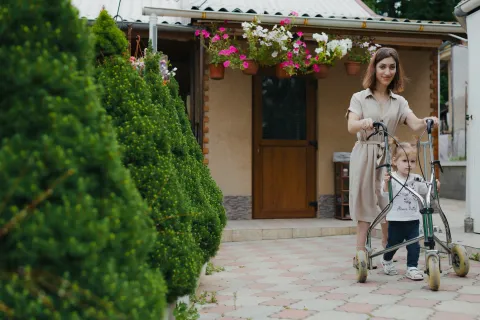
Survival was not enough. Cristina wanted her children to have a timetable again, lessons, homework, playground fights, even the boredom of ordinary school days. Today, Eva is in fourth grade and Vlasii in first, enrolled in a Moldovan lyceum. They carry new textbooks, learn a new language, take part in school plays, all the small things that rebuild a child’s sense of tomorrow.
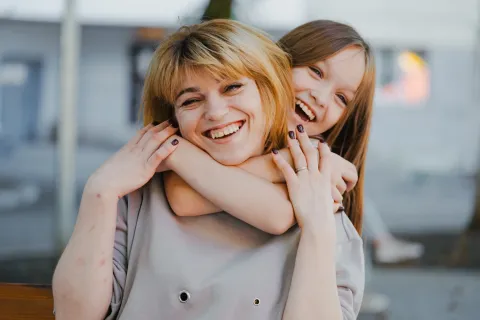
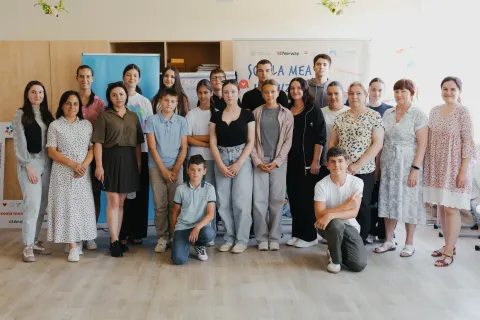
For herself, Cristina found work as a social pedagogue with AVE Copiii at the Divertis Center, supported by the UNICEF and the European Union. There she guides children, Ukrainian and Moldovan through recreational activities and Mental Health and Psychological Support (MHPSS). “When I enter the room, they shout my name and hug me. For a moment you forget the hardships outside.”, says Cristina. Work gave her more than a salary. It gave her a purpose, a reason to leave the house each morning, proof that she was more than a refugee waiting in line.


Her story is echoed in the broader picture that UNICEF monitors daily.
“Since the beginning of the war, more than one million people have crossed into Moldova, and around 127 thousand refugees remain, with children making more than 40% and women almost 60%. This prolonged crisis has put immense pressure on the child protection system, making it harder to ensure access to education, social welfare, and specialized services. Strengthening integration is vital, because without inclusive policies and trained professionals, both refugee and local children risk being left without the stability and opportunities they deserve.”, said Tatiana Danilescu, Child Protection Officer, UNICEF.
Integration as a Daily Practice
Cristina’s story is about the practical scaffolding that allows a displaced family to live, not just survive. About a school where her children can keep learning, even in a new language. A job that gives her dignity and financial independence. A routine that replaces fear with predictability, mornings of school runs, afternoons of work, evenings of homework checks.
War has altered Cristina’s sense of value. “Life is not about money, new clothes, renovations. No one remembers those things. What matters are the small moments, your children laughing, the walks you take together.”
Safety, she insists, is not a place on a map. It is the ordinary structure of days, lessons, salaries, meals that makes children feel the world has a shape again.
Cristina is an ordinary mother. Her life tells us what real win looks like for thousands of refugee mothers like her: in the building of a temporary, but meaningful life elsewhere, for herself and for her children.
At the same time, UNICEF’s partner organization AVE Copii sees the impact in numbers and daily realities.
“Since February 2022, the AO AVE Copiii team has supported thousands of refugees and local children at risk. Today, we coordinate 25 child-friendly spaces nationwide, where every day more than 590 children, both local and refugee find a safe place for educational and recreational activities receiving timely and professional support regardless of their status.”, said Mariana Ianachevici, Executive Director of the AO AVE Copiii.
For Cristina, being a winner means her daughter will one day recall not the whistle of rockets, but a school recital in Chișinău. Her son will not remember nights under a table, but a summer camp in a city far from home.
That is the quiet power of integration: turning uprooting into a life where tomorrow makes sense again.
Stories like Cristina’s are possible thanks to a broader effort that brings together local organizations, international partners and sustained support.


With support from the European Union, UNICEF, the Ministry of Labor and Social Protection and AVE Copii are strenghtening Moldova’s child protection system. The project “Children First: Protection and Support” helps both refugee and local chidlren access care, protection and opportunities. Through safe spaces amd recreational activities, partners improve children’s mental health and psychosocial well-being, giving them the support they need to grow and thrive.