School–Family Partnership - real support for every child’s inclusion in education
Inclusive education in every school

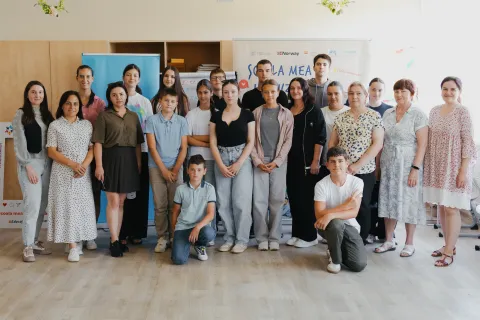
Between 23 October and 7 November, 63 teachers and specialists from nine districts across the country are taking part in a series of training-of-trainers workshops on inclusive education. The sessions focus on promoting the inclusion of children with disabilities and special educational needs (SEN), refugee children, and children from ethnic minorities. Participants learn how to communicate more effectively with parents, actively engage them in the educational process, and turn the school-family partnership into real support for every child.
The first training workshop takes place on 23–24 October and brings together 22 specialists from Soroca, Glodeni, Sângerei districts, and Chișinău municipality.
“Changing attitudes towards children with disabilities and SEN does not happen overnight. It is a long, sometimes painful process that starts with understanding and acceptance. Our role, as professionals in the system, is to stand by parents, listen to them, and offer support. Sometimes even a small gesture, a kind word, can change a perspective,” said Tatiana Lungu, Deputy Director of the Republican Centre for Psycho-Pedagogical Assistance.

Participants discussed ways in which schools can become more open and friendly environments for all children, regardless of their needs. They analyzed models of effective collaboration between teachers, parents, and specialists, as well as examples of good practices in working with all children.
“The partnership between school and family continues to be one of the biggest challenges in the education system. Data show that many parents still hesitate to accept children with disabilities and SEN in mainstream schools, which is a warning sign. Through these trainings, we aim to find real and sustainable solutions that can become part of the education system and make inclusion a reality for every child,” emphasized Galina Bulat, Education Programme Coordinator, UNICEF Moldova.

The workshop agenda included practical activities, group exercises, and case studies focusing on involving students, teachers, and parents in the educational inclusion of children with disabilities, SEN, refugee children, and those from ethnic minorities. The next training workshops will be held on 30–31 October and 6–7 November, bringing together participants from five additional districts and municipalities.
“Partnership is not built only through signed agreements but through real, living relationships between children, parents, teachers, and the community. When these partnerships are authentic, the child becomes the center and the link that unites everything. Only then can we truly speak about an inclusive school,” highlighted Liliana Rotaru, President of CCF Moldova.

After completing the sessions, participants will return to their educational institutions and become trainers for their colleagues, sharing the knowledge and tools they have gained.
In this way, they will contribute to expanding the network of local trainers in inclusive education. They will also be monitored over the course of one year for their work with parents and for strengthening communication between parents and schools.
The activities are organized by CCF Moldova and UNICEF Moldova, in partnership with the Ministry of Education and Research and the Republican Centre for Psycho-Pedagogical Assistance, under the project “Empowering Children, Parents, Teachers, and Communities to Promote Inclusive Education in the Republic of Moldova”, part of the national campaign “Learning Together.” The project is funded by the Government of the United Kingdom through the Foreign, Commonwealth & Development Office, and runs from July 2025 to June 2026.
Media contacts
About UNICEF
UNICEF promotes the rights and wellbeing of every child, in everything we do. Together with our partners, we work in 190 countries and territories to translate that commitment into practical action, focusing special effort on reaching the most vulnerable and excluded children, to the benefit of all children, everywhere.
For more information about UNICEF and its work for children, visit www.unicef.org
Follow UNICEF on Twitter, Linkedin and Facebook