From Burundi to Chișinău: A Journey from Refuge to School Success
EduTech Labs provide refugee children and vulnerable children with academic support, social integration and psycho-emotional assistance, helping them adapt more easily to a new reality
Sometimes, the journey to school begins long before the first bell rings. For some children, it passes through war, fear, displacement and homesickness.
For thousands of refugee and vulnerable children, the EduTech Labs, launched by UNICEF and the Ministry of Education and Research in schools across the Republic of Moldova and managed by People in Need Moldova, have become more than educational spaces.
They provide academic support, social integration and psycho-emotional assistance for children adapting to a new reality.

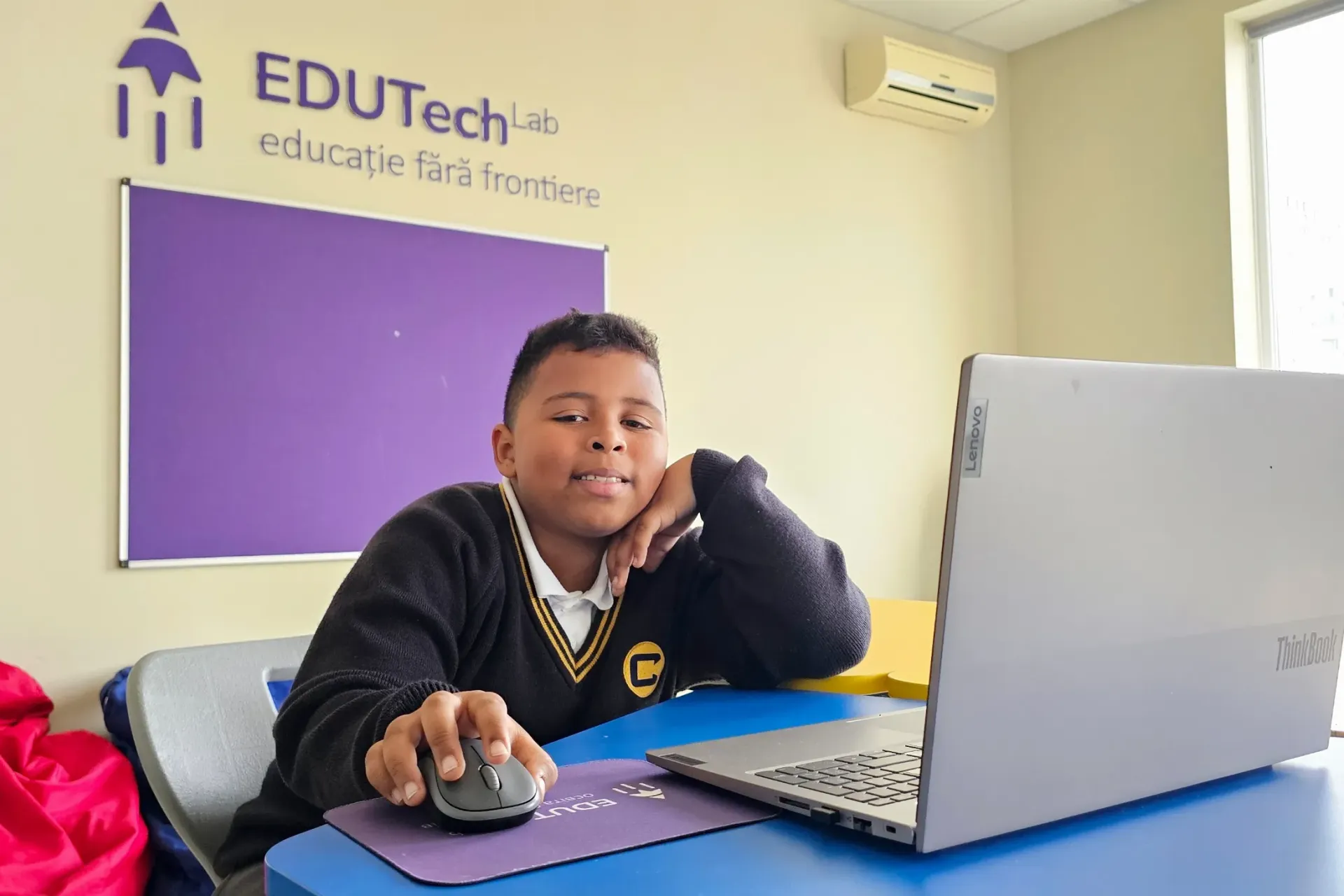
Boss’s story, a 10-year-old Ukrainian boy, shows how a safe space, dedicated people and the chance to feel accepted can change the course of a child’s life.
Boss has a name that immediately catches attention. So does his story. Although he is Ukrainian, speaks Ukrainian and knows his roots, he was not born in Ukraine and has never lived there. He spent the first years of his life in Burundi, where his mother, Natalia, lived for a decade.
In 2022, due to security concerns, Natalia and Boss had to leave Africa. They hoped to return to Natalia’s hometown, Bila Tserkva, in Ukraine, but the war changed their plans completely.
The Republic of Moldova became the place where they found refuge and, as Natalia says, “the closest country where you can feel at home.”

For Boss, arriving in Chișinău coincided with an important milestone: the first day of school in his life. He was enrolled in first grade at “Petru Movilă” Theoretical Lyceum. However, the emotions of this new beginning were overshadowed by the challenges of integration from the very first day, during the solemn school ceremony on 1 September.
At a time when he needed acceptance and support more than ever, the EduTech Lab in the lyceum became the right place for him. Here, Boss found more than additional lessons or help with homework. He found friends, psycho-emotional support and regained his sense of confidence.
“It was very important support for us. It was a starting point without which my child would not have been able to achieve such good academic results,” says Natalia.

For Natalia, the support provided through EduTech also brought financial relief. Free Romanian language lessons, additional mathematics classes and the constant support of facilitators helped make up for the fact that she could not afford private lessons for her child.
“Unfortunately, I cannot afford private lessons, but here he had the opportunity to learn the language for free. In addition, psychologists also work with the children here. It is enormous support,” she says.
Today, Boss already speaks some Romanian, does very well at school and comes to the lab with joy every day, whenever his school schedule allows. If, at first, EduTech was the place where he was timidly trying to adapt, it has now become a space where he feels at ease.
His greatest passion is robotics. Still, when asked what he would like to have more of at the EduTech Lab, his answer is surprisingly mature:
“I would like to have more additional mathematics classes, because it is the most important science.”
A circle of friends has also formed around him. Many of the classmates he told about the lab later began attending EduTech activities as well. For the children, the space has become not only an educational centre, but also a place where they play, socialize and celebrate birthdays or other special moments together.

For Natalia, the most important thing is the peace of mind she feels when she leaves her child there.
“I can leave him here with peace of mind, because I know he is under the care of qualified staff and will gain valuable knowledge. But the most important thing is that he really likes it here. If he did not like this place, no one could make him attend so often and with so much enthusiasm,” she says.

Boss’s story is one of many that show how integration often begins with seemingly simple things: a safe space, patient teachers, children learning to accept differences and the opportunity not to be left behind. For some children, the EduTech Lab means educational opportunities. For others, it means the place where they felt accepted.
The initiative is implemented by the Ministry of Education and Research of the Republic of Moldova and UNICEF Moldova, in partnership with People in Need Moldova and Amici dei Bambini Moldova, with financial support from the Government of the United Kingdom and the U.S. Government.