Advancing digital education in Moldova: Building digital capacity in Moldovan schools
Speech by Maha Damaj, UNICEF Representative in the Republic of Moldova
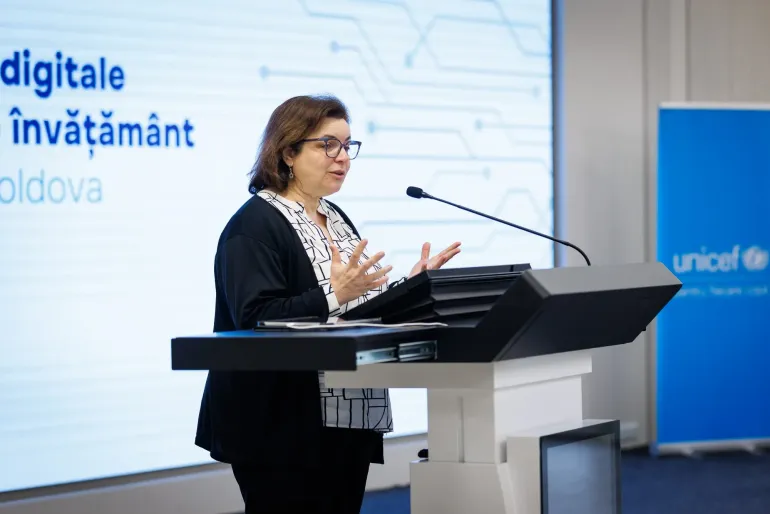
Ladies and gentlemen, colleagues, partners, and champions of education,
We are gathered here today at a moment of profound transition for Moldova’s education system. A moment when the country’s aspirations align not only with European standards, but with a global movement towards smarter, more resilient, and more inclusive learning systems.
Education has always been more than a sector. It is the architecture of a nation’s future — the foundation upon which economic growth, social cohesion, and human progress are built. Moldova’s Education 2030 Strategy recognizes this truth with clarity: quality learning is the cornerstone of national development. Yet it also acknowledges a reality we must confront — persistent gaps in learning outcomes and an urgent need to strengthen how technology is used in teaching and learning.
For years, digital tools have existed in our schools. But availability is not transformation. Digitalization is not simply about equipment — it is about pedagogy, mindset, governance, and the capacity of every teacher and every school to translate technology into better learning.
This is where Moldova is choosing ambition over compromise.
Through the Digital Innovations of the Education System program, funded by the Global Partnership for Education, Moldova has developed its first comprehensive Roadmap for Digitalizing the Education Sector (2024–2027). For the first time, strategic priorities, standards, and guidelines are brought together into a single national framework — a coherent blueprint to ensure that digitalization is not a series of scattered initiatives but a coordinated transformation that reaches every school, including those in the vocational sector.
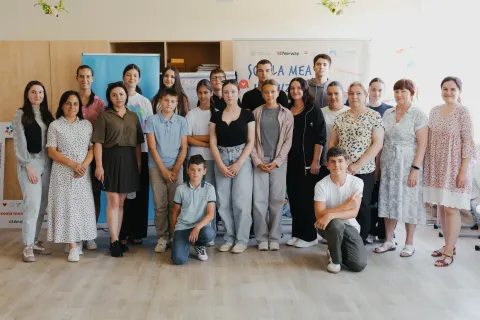
UNICEF is proud to be a partner on this journey. With GPE’s support, we are helping schools across the country integrate digital tools into everyday teaching — from interactive boards and MozaWeb licenses to practical, hands-on teacher training. Because technology only becomes meaningful when teachers are confident, children are engaged, and learning becomes deeper, more creative, and more individualized.
Our partnership with the Ministry of Education and Research, together with EstDev, has already opened important new doors. Through the DigiProf framework, Moldova is equipping its teaching workforce with modern digital skills. Nearly 10,000 teachers are part of this effort — almost 40% of the national teaching force. Already, 3,700 teachers have completed Level A, and 6,000 more are registered for Level B. This is not incremental progress. This is system-level change.
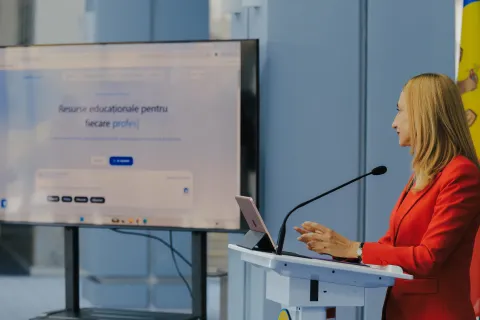
Today, we mark the beginning of the next step — the Digital Accelerator.
If DigiProf builds the digital competence of individual teachers, the Digital Accelerator builds the digital maturity of entire schools. Its strength lies in how it changes culture: through self-assessment, shared responsibility, peer review, and mentorship. Schools will examine their own digital readiness, engage their teachers, parents, and students in setting priorities, and design ambitious but realistic three-year development plans grounded in evidence and aligned with national standards.
The Digital Accelerator is not a top-down reform. It is transformation from within.
Over five mentoring sessions, school teams will work together to explore what digital transformation looks like in practice — from inspiring models and modern pedagogy to data-informed decision-making and the co-creation of school-level strategies. They will pitch their plans, receive feedback, and refine their vision with support from peers and mentors. Funding will be secured in dialogue with principals, regional administrations, donors, and the ministry. Each school will emerge not only with a strategy but with ownership, readiness, and a clear roadmap for action.
This is how resilient systems are built. Not by one reform, but by hundreds of empowered actors moving in the same direction.
And this is where Moldova stands today — at the threshold of a transformation driven by vision, guided by data, and rooted in the belief that every child deserves learning that prepares them for a fast-changing world.
The future of Moldova’s education system will not be written by technology alone. It will be written by the teachers who embrace new tools with confidence, by the school leaders who turn data into strategy, by the parents and students who engage as partners, and by each of you — the architects of a digital education system that is modern, equitable, and ambitious.
Together, we are not simply digitalizing education. We are redefining what quality learning can look like for an entire generation.
Thank you.
Media contacts
About UNICEF
UNICEF promotes the rights and wellbeing of every child, in everything we do. Together with our partners, we work in 190 countries and territories to translate that commitment into practical action, focusing special effort on reaching the most vulnerable and excluded children, to the benefit of all children, everywhere.
For more information about UNICEF and its work for children, visit www.unicef.org
Follow UNICEF on Twitter, Linkedin and Facebook