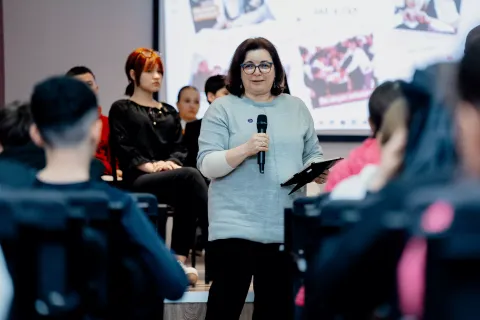
Your Excellency, Madam President Maia Sandu,
Your Excellencies, Madam Ambassadors and Mister Ambassadors,
Dear audience,
Hello.
I am honoured to speak at the Parliament of the Republic of Moldova today about UNICEF’s global mission to reach the world's most vulnerable children and to protect the rights of every child.
As a disability activist myself, I am also thrilled to be in a room where I’m not the only one pushing for inclusion, but rather in this admirable company looking to see how we can best respect children with disabilities and ensure their rights to education, and thus their social, economic, civic and political participation.
You know what the statistics look like - international statistics show that persons with disabilities are more likely to be out of school, less likely to complete primary or secondary education, and less likely to possess basic literacy skills. Also, children with sensory, physical, and intellectual disabilities are 2.5 times more likely to have never been to school as their peers without disabilities.
COVID-19 related school closure has exacerbated the challenges for children with disabilities. Previously enrolled children with disabilities are at greater risk of not returning due to parental fear for their health and safety and lost household livelihoods, as well as learning loss as many children with disabilities did not participate in distance learning. This is a slippery slope that could once again lead to a large divide between children with disabilities and their non-disabled peers, it could lead to them once again becoming invisible and eventually hidden from a fearful and biased society. If children do not grow up together in their school and communities, they do not learn to co-exist later in life.
As the COVID-19 pandemic is already rolling back virtually every measure of progress for children with disabilities, we should start thinking about putting the reforms back on track. This public hearing comes just in time.
In the Republic of Moldova, great strides have been made in favour of inclusion, and UNICEF is proud to have contributed to them. UNICEF supported the reforms of the residential childcare system and inclusive education from the very beginning. An important step in the reform of the system of social protection of persons with disabilities was the creation of the National Council for Determination of Disability and Work Capacity, following the restructuring on the Republican Council of Medical Expertise of Vitality. The new Council had a new approach based on the social model of disability, which was already a tremendous rights-based advance.
In 2013, to support advancing inclusive education, the Republican Centre for Psycho-pedagogical Assistance (RCPA) was created at the national level and Psycho-pedagogical Assistance Services (PAS) at regional level.
These two services replaced the medico-psycho-pedagogical commissions that in most cases would recommend the placement of children with disabilities and developmental delays in special and auxiliary schools. The notion that a disability is an abnormal, shameful condition, and should be medically cured or fixed is thankfully already a thing of the past. PAS are now active in all the 35 regions of the country and UNICEF is proud to have supported the capacity development of all newly hired staff of these centres.
To ensure the continued work of the Psycho-pedagogical Assistance Services and ensure the access of children with disabilities to education during pandemics, UNICEF provided 1,000 liters of disinfectants and 4,600 gloves for Psycho-pedagogical Assistance Services in all districts; over 10,000 masks with screens for children with hearing disabilities and staff who work with them; 295 web cameras for schools and the Republican Centre for Psycho-pedagogical Assistance, and 663 education packages for children with special educational needs from primary schools and kindergartens. With a mainstreamed focus on inclusion, UNICEF supported 10,000 early childhood educators to enhance their digital skills, and operationalised the new preschool EMIS module developed in 2021 by training 3000 educators and all EMIS focal points on reporting. These skills will promote the use of digitalized learning methodologies adjusted to the individual needs of young children, and provide real time information on the situation of preschools. An additional 10,000 educators acquired knowledge and skills on positive parenting during pandemics, also covering work with parents of children with disabilities. A total of 2,000 children, including children with disabilities and Roma children, attained access to continued learning through the provision of educational kits, cognitive toys, IT equipment and refurbishment. And on and on.
I list these not to boast our contribution but to reaffirm our commitment. Inclusion of children with disabilities is central to UNICEF’s equity agenda. Globally, regionally, and today, nationally, UNICEF, with its partners, is providing a strong call for action for children with disabilities, including:
- Supporting the practice and culture of inclusion across education systems, which includes all children in the same classrooms in the same schools, without discrimination and with all necessary reasonable accommodations for individual needs.
- Eliminating physical, communicational, informational, and attitudinal barriers from schools and learning spaces.
- Ensuring that curricula and learning resources are accessible to all.
- Training teachers, administrators, and education staff to foster a commitment to inclusion across schools and communities.
- Collecting data about disability to fill gaps and monitor progress; and
- Supporting Ministries of Education to take responsibility for educating all children, including those with disabilities, through an inclusive system.
In 2020, at the Annual National Conference on Inclusive Education in Moldova, which we had the privilege to support, the development of the new Programme for Inclusive Education was launched. The new Programme, developed jointly by MER, RCPA and UNICEF, is based on the findings of the Evaluation of the Implementation of the Programme for Inclusive Education 2011-2020 that was carried out with our support and is under discussion today. A number of priorities emerged for this new programme, but allow me to highlight a few:
One - the promotion of assistive technology use for quality inclusive education, as recommended by the Evaluation. UNICEF continues to advocate for this in Moldova, and around the world.
Two – ensuring that public financing also promotes inclusion. UNICEF has worked with the MER on the development of seven possible funding schemes for preschools to promote equity for children. One of them has a special coefficient for inclusive education. Once approved by the Government, these will ensure equitable access to quality and inclusive early education for all children including children with disabilities.
Three – strengthening systems to mainstream equity for all. UNICEF supported the MER in the development of the new Education Sector Plan and Education Strategy 2022-2030, and corresponding action plans. The draft Education Sector Plan places a special focus on equity, inclusion and participation and aims at building a resilient Education System beyond the COVID-19 Pandemic so that it can respond to the challenges of quality education for ALL children by 2030, no exceptions, no child left behind.
UNICEF is currently in the process of developing its new Country Programme for the coming 5 years, 2023-2027. I can assure you that our main focus is on the social and educational inclusion of the most vulnerable children and youth, including those with disabilities. We implicate ourselves in each of the areas of the call to action, and will do everything we can, as conveners, advocates and partners to support the Government of Moldova in the changes that we are calling for.
Ladies and gentlemen,
In closing, allow me to end with a proverb that best embodies inclusion to me: if you want to go fast, go alone. If you want to go far, go together. We will never reach the Moldova we aspire for without the meaningful inclusion of children and young people with disabilities.