From Vulnerability to Resilience: PAFEEM strengthens communities in Bandiagara.
The programme demonstrates that empowerment is both economic and psychological.

- Français
- English
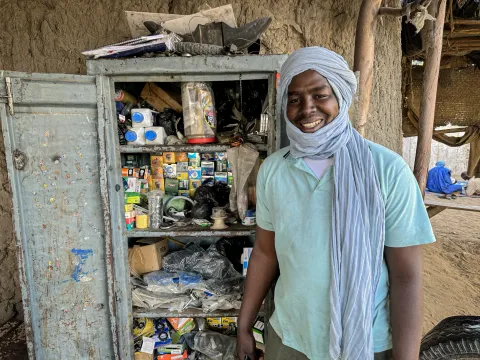
In a suburb of Bandiagara, 28-year-old Aïssata Sangala gets up every day before sunrise. In front of her house, she sets out her wares, which in a few moments will attract local women who have come to stock up on condiments and spices for their daily meals. It is a ritual that has been repeated every day since she set up her small grocery store.

A widow and mother of six children, including three daughters, Aïssata previously struggled to provide for her family. But since she benefited from Income-Generating Activities (IGAs) under the PAFEEM (Project to Promote Access to Finance, Entrepreneurship, and Employment in Mali) in Bandiagara she has launched her own small business selling condiments in her neighborhood.
“Thanks to PAFEEM's financial support, I have been able to develop this business, which now allows me to provide for my children,” says Aïssata with joy.
Her local shop also makes life easier for the whole neighborhood.
"Her presence creates a sense of community and makes it easier for women to get the spices they need. Before, we had to go to the market, which is very far from here, and we don't always have transportation," says Yakôtè Djiguiba, Aïssata's loyal customer.
The success of Aïssata's grocery store has made her indispensable to the community. Thanks to her, the women in the neighborhood have access to essential condiments at any time.
“We are delighted with the support that the PAFEEM project has given us. It has helped me so much that I can now help others, especially internally displaced people,” says Aïssata proudly, talking about the change in her life.
“We help each other. Some people give me a hand in my business and I pay them back,” she adds. The financial independence she has gained not only benefits her family, but also actively contributes to social cohesion and mutual aid in a context of vulnerability.
The impact of psychosocial support
PAFEEM, through UNICEF and its implementing partners such as the non-governmental organizations Yag Tu and APIDEV, did not simply provide funds for TP-HIMO and AGR. Yag Tu has built a social and psychological safety net that is essential to the resilience of programme participants. This is the case for Coumba Nantoumé, a 24-year-old entrepreneur. Coumba runs a small, thriving business selling locally made drinks, cookies, and peanuts. But the path to entrepreneurial stability is not only financial - it is also mental. That is why PAFEEM also facilitates psychosocial support sessions.

“During the discussions, we are allowed to talk about our challenges. We give each other advice on each case to help the person concerned overcome their difficulties,” explains Coumba, who, in addition to being an AGR beneficiary, participates in psychosocial support sessions.
She confides that her difficulties were not related to her start-up capital, but to her emotional management. “Personally, I had trouble controlling my anger and staying calm. The stress of running a business overwhelmed me,” she says. But thanks to the safe and structured space provided by the PAFEEM project, her situation has changed. “Since I started attending these talks, I have been able to manage my anger and stressful moments on my own.” She adds that before joining these discussion groups, she did not know what to do. It was a relative who advised her to approach PAFEEM. This crucial support enabled Coumba to transform her energy, which was previously wasted in frustration, into a constructive force to develop her business and maintain good relationships with her customers and suppliers. Empowerment is therefore both economic and psychological.
Raising awareness about family practices
Beyond economic and psychological support, the PAFEEM project in Bandiagara also incorporated a vital social dimension to improve the overall well-being of the community. It enabled awareness campaigns to prevent malnutrition and malaria, in partnership with CSCOM Central 1 (community health centre) and organizations such as the NGO CIAUD, YA-G-TU, and UNICEF's NGO implementation partners. These actions complemented the economic empowerment of young people and women. The awareness-raising activities carried out by the programme proved effective in increasing attendance at health services and leading to a reduction in severe cases of malnutrition and malaria in the community. This success demonstrates that continuity and reinforcement of campaigns are essential to consolidate gains. Economic empowerment (SFA, TP-HIMO) and improved child health and nutrition go hand in hand to build a more resilient community.

PAFEEM is an initiative of the Government of Mali, financed by the World Bank in the form of grants and loans. It is implemented by UNICEF in its Component 3 in the center and north of the country.
Since 2012, Mali has faced an ongoing political and security crisis whose effects continue to weigh on its economy and may affect the implementation of public policies. In response, the government has launched several initiatives, including the PAFEEM, which aims to support national efforts to address the challenges of financial inclusion, the financing of Micro, Small, and medium enterprises (MSMEs), and job creation.
This objective aligns perfectly with the National Strategy for Emergence and Sustainable Development (SNEDD 2024–2033), which implements the vision “Mali Kura ɲɛtaasira ka bɛn san 2063 ma” in accordance with its third pillar: “Structural transformation of the economy and growth.” PAFEEM’s activities revolve around five components, including Component 3: “Support for Income-Generating Activities (IGAs) and Job Creation,” implemented with operational support from UNICEF.