The impact of PAFEEM in Mopti
Participants have gone from being temporary employees to becoming self-employed entrepreneurs.

- Français
- English
In the narrow streets of Mopti, people are still enjoying the benefits of the clean-up carried out by thousands of young people as part of the Labor-Intensive Public Works Program (TP-HIMO). Sanitation and rehabilitation, although requiring ongoing maintenance, have seen a change in behavior and involvement from communities that are taking ownership of this task, which was previously the responsibility of the municipality.
“In addition to the individual impact, TP-HIMO has a direct effect on improving local infrastructure, making life easier for everyone,” explains Yacouba Coulibaly, TP-HIMO agent in the city of Mopti.
According to him, the public works programme has had positive repercussions for the entire Mopti region. “The roads we repaired during the TP-HIMO programme make it easier for cars, motorcycles, and even pedestrians to get around,” he says, speaking about the impact of several months of training, intense work, and collaboration among young people as part of the PAFEEM program.
In Medina Coura, a suburb of Mopti, young people are proud of their empowerment and the new skills they have acquired through PAFEEM. Djénéba Kanta and Souleymane Diarra, both participants in TP-HIMO, emphasize the acquisition of valuable skills that will serve as a foundation throughout their professional careers.
From temporary employment to sustainable entrepreneurship
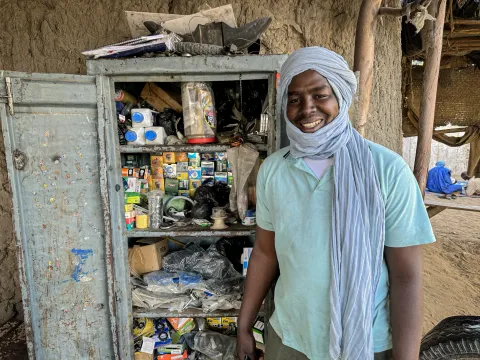
At 30 years old, Yacouba Coulibaly, a TP-HIMO agent living in Mopti, perfectly illustrates this transition, making PAFEEM a real springboard to sustainable entrepreneurship. He developed his own business after contributing to TP-HIMO along the river in the city known as the Malian Venice.
“The benefits of TP-HIMO are endless. They enabled me to develop my Bogolan fabric manufacturing business,” explains Yacouba.

“I was able to make this Bogolan shirt you see here thanks to the income we received every 20 days during the TP-HIMO,” says Yacouba. “Although the work has ended, I am able to buy fabric, make patterns on it (Bogolan), sell it, and even supply resellers. So, resellers are also making a profit”.


Following TP-HIMO's activities, Djénéba and Souleymane, like other young people in the Medina-Coura neighborhood, also benefited from training that enabled them to form economic interest groups.
“We acquired skills that now enable us to participate in city sanitation activities, reforestation in schools, and pest control initiatives launched by the city council and other public bodies,” says Djénéba. She is delighted with the tangible changes that have taken place in her life.

The impact goes beyond direct employability. The income earned has enabled many young people to embark on income-generating activities (IGAs), a crucial step towards independence. The resources that these young people received during TP-HIMO activities have enabled many of them to switch to IGAs.
“We have friends who work in cattle fattening and others who run small businesses. Young people need initiatives to help them escape unemployment. I ask everyone to commit to this cause,” Souleymane continues.
The dual success of Income-Generating Activities
The success of the first phase of PAFEEM in the Mopti region and elsewhere marked a turning point in the lives of communities. Not only did it successfully transition from labor-intensive public works (TP-HIMO) to income-generating activities (IGAs), but above all, it promoted a genuine diversification of IGAs. This phenomenon has enabled beneficiaries to multiply and diversify their sources of income beyond traditional main economic activities. In doing so, IGAs directly contribute to securing and increasing household incomes, particularly for young people and women, providing economic resilience in the face of security and humanitarian challenges. They also give parents autonomy, allowing them to care for their children.
“Today, I can provide for our needs and contribute to my family's livelihood”.

Kadia Dianèpo, 38, a beneficiary of AGR, is one of the pioneers of AGR's success. Thanks to financial support from PAFEEM, she launched a small fish-selling business. This initial venture enabled her to develop poultry farming at the same time. This initiative in turn enabled her to strengthen her financial independence and involve her younger sister in the business.
In the same neighborhood, Diahara Kouyaté is another success story of AGRs, perfectly illustrating this dual success. At 34, Diahara takes care of her cattle, which she was able to buy thanks to support from PAFEEM.

“I raise cattle for slaughter,” she says proudly. I have completed two cycles of rearing cattle. Thanks to this activity, which allows me to support my family, I have also started a small business selling snacks for children".
From ice cream to yogurt, you can find a little bit of everything in Diahara's refrigerator. The business generated has also allowed her to employ her younger sister.
Beneficiaries of PAFEEM, an initiative of the Government of Mali financed by the World Bank in the form of loans and grants, are building a solid entrepreneurial future for young people and women facing unemployment. Far from being a simple handout, TP-HIMO and AGR have provided young mopticians with the skills and start-up capital they need to get started. Programme participants have gone from being temporary employees to becoming self-employed entrepreneurs.

Since 2012, Mali has faced an ongoing political and security crisis whose effects continue to weigh on its economy and may affect the implementation of public policies. In response, the government has launched several initiatives, including the PAFEEM, which aims to support national efforts to address the challenges of financial inclusion, the financing of Micro, Small, and medium enterprises (MSMEs), and job creation.
This objective aligns perfectly with the National Strategy for Emergence and Sustainable Development (SNEDD 2024–2033), which implements the vision “Mali Kura ɲɛtaasira ka bɛn san 2063 ma” in accordance with its third pillar: “Structural transformation of the economy and growth.” PAFEEM’s activities revolve around five components, including Component 3: “Support for Income-Generating Activities (IGAs) and Job Creation,” implemented with operational support from UNICEF.