

Engaging, inspiring, and strengthening social cohesion among young people.
Volunteer initiatives to clean up neighborhoods in Timbuktu and rehabilitate public infrastructure are strengthening social cohesion among young people with support from PAFEEM.
- Français
- English
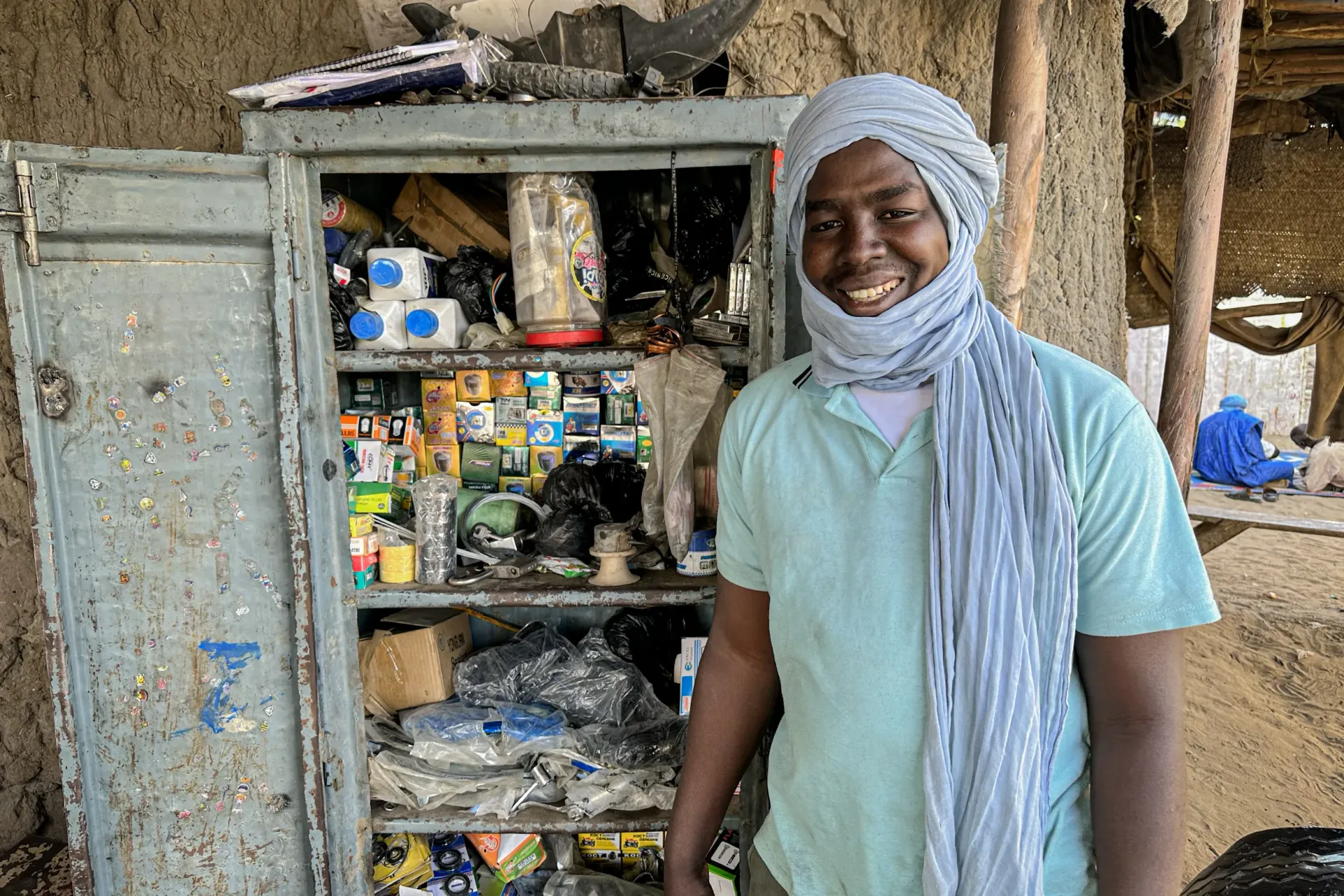
Aboubacrine Ag Amgar, 29, is one of 1,252 young beneficiaries of the Promoting Access to Finance, Entrepreneurship, and Employment in Mali (PAFEEM) in the Timbuktu region. His participation in two cycles of Labor-Intensive Public Works (TP HIMO) helped him get back on his feet after a long period of unemployment amid humanitarian, economic, and security crises. His living conditions improved thanks to an income-generating activity funded by his savings: “Before PAFEEM, I was unemployed and couldn’t provide for my family,” says Aboubacrine. “Thanks to the support I received from PAFEEM through my participation in TP-HIMO, I was able to launch an income-generating business selling motorcycle parts and opening a motorcycle repair shop,” he continues. “I am proud to present my motorcycle parts shop, which i opened using the savings i earned from working on labor-intensive public works projects in Timbuktu". Aboubracrine.

Like other young beneficiaries of the first cycle of PAFEEM’s TP-HIMO program, his participation in the second cycle of TP-HIMO enabled him to strengthen his income-generating business and diversify his sources of income. “When I first started my business, I was alone in my workshop. The support I received during the second phase of TP-HIMO allowed me to invest in and train four young apprentices who are currently working with me in the workshop.”
In addition to his work as a motorcycle mechanic, Aboubacrine has voluntarily committed to continuing the sanitation and rehabilitation of community infrastructure in his neighborhood of Hamabangou following the conclusion of the PAFEEM project. This commitment, shared by 140 other young people from the Hamabangou neighborhood, aims to ensure the sustainability and ownership of the achievements of the PAFEEM project.
Community Engagement and Youth Volunteering
In the neighborhoods of Timbuktu, the sustainability and ownership of the achievements of the PAFEEM program are evident in the cleanup and rehabilitation of streets and local infrastructure. These volunteer activities, led by young PAFEEM beneficiaries with the support of local authorities following the conclusion of the TP-HIMO program, help consolidate the gains made in previous phases while highlighting the communities’ commitment. “It is our duty to clean up our neighborhoods and keep the city of Timbuktu clean,” adds Aboubacrine, thanking the Government of Mali for its support of the youth and women of Timbuktu through the TP-HIMO and Income-Generating Activities (IGAs).

This volunteer work carried out by young people lasts for over two months in the municipalities of Diré, Goundam, and Timbuktu; and is part of the activities carried out thanks to the support and involvement of local authorities throughout the process (prefect, municipal mayors) as well as technical services. It has already had a direct impact on the improvement and maintenance of local infrastructure and demonstrates community engagement and the sustainability of the best practices acquired.
To support efforts to improve sanitation in the city of Timbuktu, a shipment of equipment—including tricycles, trash bins, wheelbarrows, shovels, and various other items—was handed over to Timbuktu’s administrative and municipal authorities during a ceremony marking the handover and transfer of materials from TP HIMO.

This equipment, made available to the neighborhoods of Timbuktu, will facilitate the continuation of the young people’s volunteer work. “We are now well-equipped with all this equipment made available to our neighborhoods. We will continue the sanitation work in Hamabangou,” Aboubacrine told us during the handover and transfer ceremony for the TP-HIMO equipment.
In Timbuktu, the project relied on the neighborhood development committees (CDQ). This committee, established by local authorities, oversees the equipment to facilitate its use in Timbuktu’s various neighborhoods. “PAFEEM has cleared the thorns from under our feet because Timbuktu has now become a charming city,” Aboubacrine emphasized during the handover and transfer ceremony for TP-HIMO equipment. Aboubacrine will now be able to use the sanitation equipment to continue volunteer work in his Hamabangou neighborhood.

The implementation of this additional phase in the Timbuktu region has ensured the sustainability of the PAFEEM’s achievements through the ongoing involvement of stakeholders throughout the process. “This project has fostered social cohesion and provided funding that has had a direct impact on the lives of young people,” concluded Aboubacrine, expressing his hope to continue such initiatives that encourage young people to work and give them hope for a better future.
Since 2012, Mali has been experiencing a difficult political and security situation, the effects of which continue to weigh on the country's economic situation and may influence the implementation of public policies. In response to this situation, the government has taken several initiatives, including the creation of PAFEEM, which aims to support national efforts to address the challenges of financial inclusion, financing for micro, small, and medium-sized enterprises (MSMEs), and job creation.
This objective is fully in line with the National Strategy for Emergence and Sustainable Development (SNEDD 2024-2033), which implements the vision “Mali Kura ɲɛtaasira ka bɛn san 2063 ma,” in accordance with its third pillar: “Structural transformation of the economy and growth.” PAFEEM's activities are structured around five components, including Component 3: “Supporting Income-Generating Activities (IGAs) and Job Creation,” implemented with operational support from UNICEF and the funding from the Government of Mali and the World Bank.


