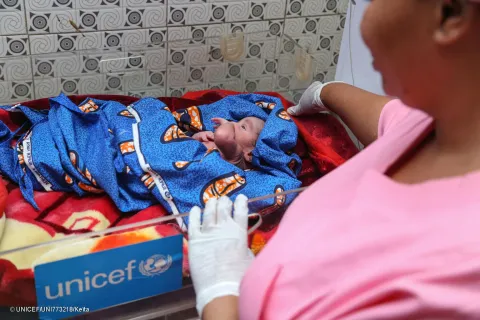
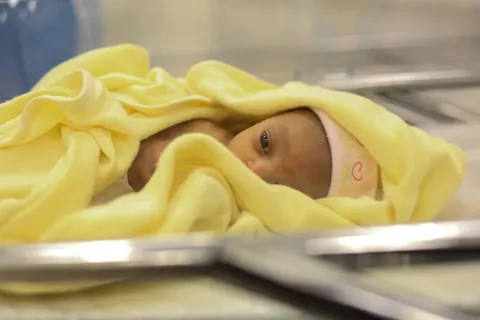
At Timbuktu hospital the sun now illuminates rooftops and the future.
For years, power cuts at Timbuktu hospital put mothers and newborns at risk. Thanks to UNICEF-supported solar energy, critical units now benefit from safe and continuous electricity.

- Français
- English
For years, each power cut could jeopardize a life. A mother giving birth, a newborn with breathing difficulties, a child needing immediate oxygen—all depended on electricity that could vanish without warning. In Tombouctou, as in many regions of Mali, reliance on generators—expensive, polluting, and sometimes unavailable—made healthcare dangerously fragile. The staff did their best, always battling the limits of unreliable power.
Hadizatou Sankaré, senior midwife, vividly remembers the moments when the hospital plunged into darkness. “Imagine being with a mother in active labor and the power goes out,” she says. In these critical moments, she improvised, strapping a phone to her forehead as the only source of light. Acts of ingenuity repeated night after night—yet they should never be necessary to save a life.
For Dr. Djibril Kassogue, the hospital’s Director General, the situation had become untenable.
“We were facing a full-blown energy crisis. The most sensitive units were directly at risk.” Generators did not cover the entire hospital, consumed costly fuel, and emitted harmful smoke for both the environment and health. Mali has one of the highest sunlight rates in the region, so the dependence on polluting energy sources felt even more paradoxical.


Then everything changed. With UNICEF’s support, funded by the Federal Republic of Germany (BMZ), as part of the Sahel Resilience Partnership, the hospital was equipped with solar panels powering the maternity ward, neonatology, and pediatrics—the units where every second can determine the fate of a fragile life. Solar energy, abundant, clean, and free once installed, now provides a continuous supply of electricity, day and night.
The transformation was immediate. Where anxiety once prevailed, a new feeling emerged: safety. In neonatology, nurses no longer need to rush to find someone who can restart a generator. Oxygen concentrators no longer stop mid-treatment. Babies in respiratory distress are now stabilized upon arrival.
Some newborns come from remote villages where access to oxygen is almost nonexistent. For them, reliable energy means far more than light—it is the promise of breathing and surviving. “We recently received twins referred from a peripheral health center,” explains pediatrician Dr. Talfi Maïga. “They had severe pneumonia. In such cases, respiratory distress requires immediate oxygen.”
The twin's mother, Toula, adds: “When I arrived, I saw many machines and I feared the power would go out and my children would die, but thank God nothing stopped. They told me the power comes from the sun. I saw my children breathing normally. For a mother, that is a great relief.”

In the pediatric ward, Dr. Talfi smiles with confidence. “We resuscitate babies without delay. We are no longer in the dark.”
Beyond electricity, the project also strengthened staff skills through training on essential newborn care, oxygen therapy, delivery room management, and emergency care.
“The staff is more skilled, and power is available,” says Dr. Kounindiou Dolo, health and nutrition specialist at UNICEF’s Timbuktu office. “This is a major contribution to an increase in the quality of care, especially for mothers and children.”
This story is not only about a hospital that functions better. It is about a transition to clean energy in a country where the sun is not only a natural resource but a strategic opportunity. Using solar energy in Mali means choosing sustainable, resilient solutions adapted to climatic realities. It protects the environment while ensuring continuity of care. It also reduces costs, limits fuel dependency, and strengthens the autonomy of health facilities.
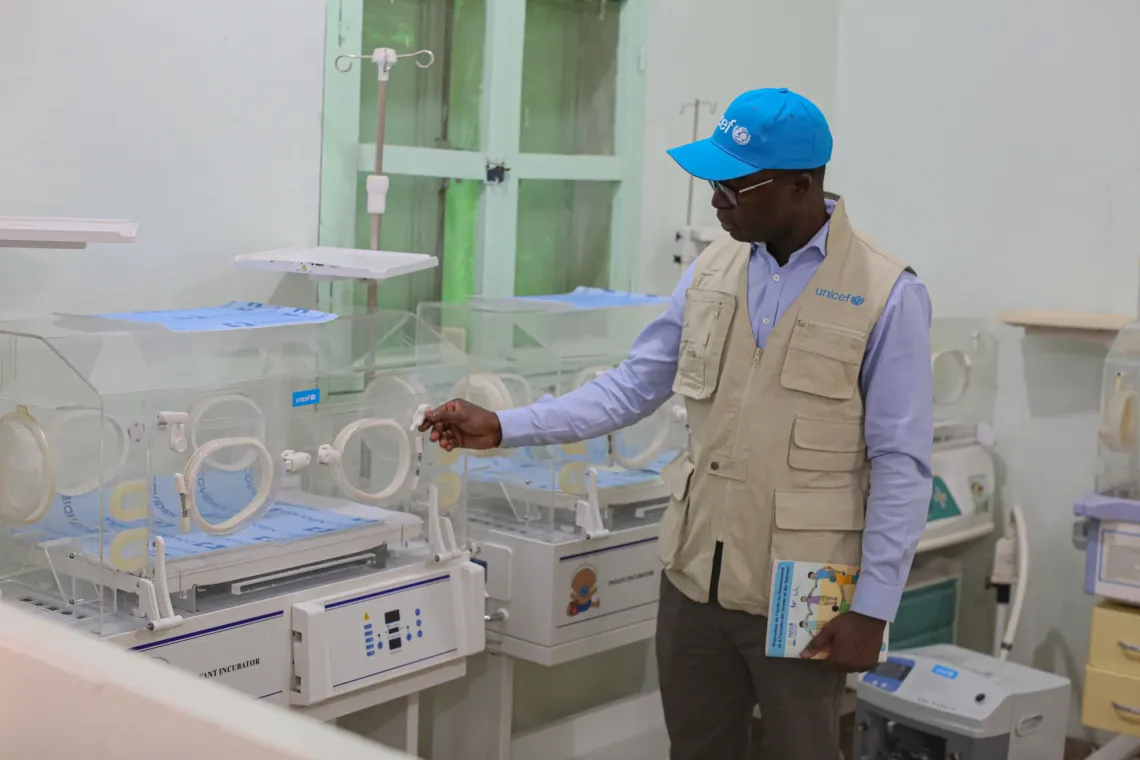
Today, unexpected power cuts belong to the past. Deliveries take place in well-lit rooms. Newborns breathe with the support of machines that never power down. The maternity ward and neonatology—places where life begins in fragility—are now bathed in steady, reassuring light.
For the director, this progress opens new perspectives: expanding solar coverage to other units, upgrading equipment, and continuing staff training. In maternity, neonatology, and pediatrics, the light no longer goes out. The sun—long underused—has become a source of resilience, hope, and dignity.
GIZ, WFP and UNICEF are working together as part of the Sahel Resilience Partnership, alongside local authorities and implementing partners, with financial support from German Cooperation (BMZ).