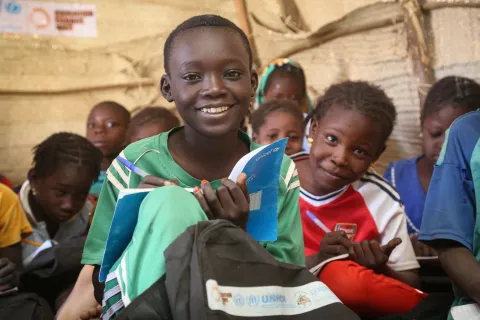
Children in Mali make their voices heard!
The future belongs to children

- Français
- English
We often hear that the future belongs to children. There are many children in Mali, but with more than two million of them not attending school, there are also many who may never get the chance to reach their full potential. It’s a problem that children in Mali would very much like to solve.
More than 3,800 girls and boys have been trained by UNICEF this year in 10 regions and the district of Bamako to serve as Back-to-School Child Ambassadors in the run up to the school year. They’re ready to work in their communities to promote awareness of the importance of education, and what’s more, they’re persistent.

One of UNICEF’s child ambassadors is Alou Badra Keïta. He lives in Mopti, in central Mali. He’s 11 years old and a Grade 6 student.

Alou became a Back-to-School Child Ambassador because he wants to reach out to children who have dropped out of school. He’s fully committed to his role. "Kids who go to school don’t roam the streets.”

Poverty, child labour and child marriage are the main reasons children drop out of school. But in Mopti there are also other challenges, Alou says, such as the lack of school facilities and concerns about safety. By the end of the 2017-2018 school year, 464 schools in Mopti had closed due to high levels of insecurity. "I hope all the schools in Mopti reopen," Alou says. “But sadly, that doesn’t mean that everyone will go back to school. Schools are often far away from where children live, the roads are dangerous and there’s also the river.”

But nothing is going to keep Alou from helping his friends become more aware of the importance of education. He’s doing everything he can to get his message to parents to take their children to school, even if it means he has to travel by dugout, motorbike or on foot, or participate in a debate on Radio Kaoural.

Alou goes to Bayon Djenepo School in Mopti. In his school, there are 6 grades and 589 students, but only 8 teachers. The children study in difficult conditions. Often 10 children have to share one bench.

Alou loves his town, but what he loves even more is reading. His parents are very proud of him: "Today, my father and mother are very proud of my fight to get other children back into school. Even though some parents are reluctant because they don't understand the importance of school, I’m sticking to my goal: no kids on the street, all kids in school.”

Alou has 5 brothers and 2 sisters. He’s very happy that they all go to school. Alou explains that he’s especially focusing on girls. Although many parents do acknowledge the importance of education, a large number of girls are still being kept home. Some families still strongly adhere to the traditional belief that girls are supposed to stay home to do the chores around the house.

Alou is hopeful, both for himself and for his friends. His dream? He wants to become a doctor. He’d also like every village in Mali to have a school. For him, the ideal school would be one that’s safe and has enough benches for everyone.
Upon leaving, Alou compared education in Mali to a tree:
"When you plant a tree, you have to water it so that it can grow. Mali needs to ensure that its children have access to education so that they, too, can grow.”