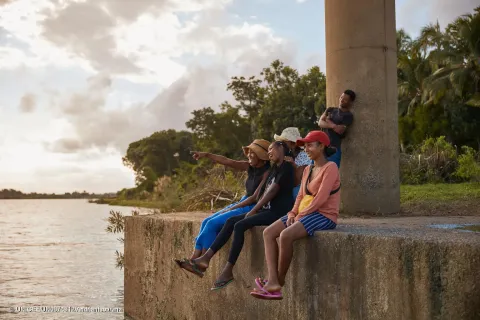
The school of tomorrow, today in Terabovo
In this village in the municipality of Sihanamaro, in southern Madagascar, the construction of new school facilities will transform the daily lives of hundreds of students.

The sound of hammers punctuates the days at the Terabovo secondary school construction site. It has now been a month since the school holidays began. Several buildings are under construction while the students are still on break. At the local grocery store, we meet 15-year-old Sambevave. She has just passed her Brevet d'Études du Premier Cycle (BEPC) and is about to start high school. While waiting for classes to resume, she is helping her mother run the small family business. Sambevave looks back fondly on her years at middle school.
"I had a lot of fun there, but I can't wait to start the new school year in high school. The old classrooms are made of sheet metal, where the heat is unbearable. They lack lighting and ventilation. In these conditions, it's difficult to concentrate in class. It's a bit of a shame not to be able to study in the new buildings under construction, because they look really nice."
The new school facilities at this secondary school will include four classrooms, a multipurpose room that can also be used for science experiments, an office for the principal, a mixed-use sports field, and 100 young plants. They will also be equipped with separate latrines for girls and boys, thanks to funding from the ecovillage fund. The school will also be furnished to enable students to study in good conditions. All of this classroom construction work, carried out by UNICEF and its partners, was made possible thanks to financial support from the Japanese Committee for UNICEF and SL Creations.
Sambevave is part of a large family: she has eight brothers and sisters. Four of them are still in school, including 13-year-old Vavitiana, who has just moved up to 7th grade at the same middle school. “I would really like to be able to study in these new buildings, because right now we still have to share classrooms,” she says.


A dynamic school in the heart of the ecovillage
The school is headed by Sailambo Safidisoa Mihaona Tinahinjanahary, who has been in post for three years. “These new buildings will give our school a new lease of life. Our enrollment could rise from 472 to 700 students next year, as other villages are already considering sending their children here,” says the headmistress.
The village of Terabovo is one of 21 ecovillages established in southern Madagascar to strengthen communities' resilience to climate change. These model villages receive multisectoral support aimed at ensuring access to social services and sustainable infrastructure, promoting green practices, stimulating green and blue entrepreneurship, and encouraging inclusive local governance.
Through concrete actions in the areas of health, nutrition, water, and education, ecovillages offer a more stable and secure living environment, particularly for vulnerable families. They also provide spaces where children's rights are respected, protected, and promoted, notably by guaranteeing their access to education, health care, adequate nutrition, and a healthy environment, while encouraging communities to move toward sustainable development and lasting self-sufficiency.
During her middle school years, Sambevave was part of a club, a space for exchange reserved for students. Thanks to funding from the European Commission for Humanitarian Aid, this program enabled around 30 students to participate regularly. Sambevave learned about her rights as a child, but also practical ways to protect herself from violence.
“This club taught me to speak with confidence and to work in a group,” she says proudly.
Sambevave would like to become a midwife when she grows up. As for her sister Vavitiana, who would like to become a teacher, she is still a member of the “Green School” club, which teaches them how to care for the environment. “In this club, we plant trees, take care of gardens, manage waste, and there are about 60 of us,” she explains.
Note:
UNICEF and its partners, through its ecovillage program, support the “Green School” program with funding from Zonta International, the Findel Foundation, and the Today and Tomorrow Initiative. This ecovillage establishment program is also funded by the National Committees for UNICEF in Belgium, the Netherlands, the United Kingdom (Moondance and Eleva foundations), France, Andorra, Korea and Germany.