Improved Latrines, a new life for Miza’s family
Adopting better hygiene practices brings lasting change to families’ daily lives. It creates a cleaner environment where children can grow up healthier.

- Français
- English
In the eco-village of Tsarapioky, in southern Madagascar, Miza is the matriarch of a large family. She is the mother of twelve children. For a long time, like most people in her community, Miza had no access to a toilet. Open defecation was a common practice, due to economic constraints and habits deeply rooted in households.
This precarious hygiene situation exposed the family to numerous health problems, without their being aware of it. “Before, we relieved ourselves around the village. We didn’t know that it posed risks to our health,” says Miza. Excrement left in the open contaminated the soil and fostered the spread of diarrheal diseases, particularly affecting young children.
Almost every week, a member of our family had to be taken to the health center because of diarrhea. These frequent visits also meant extra expenses for us.
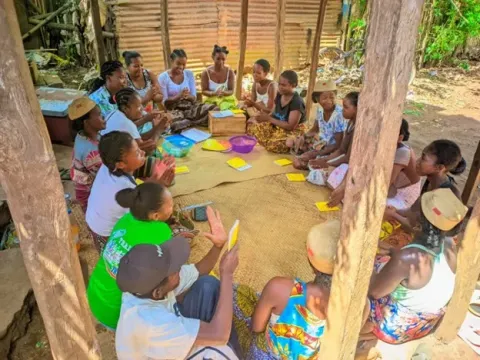
Things began to change with community awareness sessions. They helped families understand the importance of ending open defecation and adopting better hygiene and sanitation practices. These support activities are carried out by the NGO Sahi Mpanasoa. They are part of the Magnovasoa project, jointly implemented by UNICEF and WFP and funded by BMZ through KfW Development Bank. These efforts are also complemented by several other programs operating in the area.
Miza and her family, together with fourteen other households, mobilized to clean up the village and build improved toilets. Within a few weeks, local entrepreneurs from the commune of Ifotaka supported the families in building their sanitation facilities. Among them, Tsangabelo, aged 31, took part in the work.


These new toilets provide much safer hygiene conditions for families. They are equipped with a Sato Pan, a device that reduces odors and limits contact with excrement, a slab, a superstructure that ensures privacy, and a simple handwashing system. To make these facilities accessible to as many people as possible, households also benefit from a three-month payment plan.
Protecting tomorrow’s generations today
Today, the changes are visible well beyond the new infrastructure. For Miza, her family is living in better conditions.
Her eldest daughter, Matsinoro, shares this satisfaction. A young mother, she now thinks about the future of her own daughter, Victorine, aged two. “I am reassured to know that she is growing up in a healthier environment. Today, we know that these simple actions can prevent many illnesses and give our children a better future,” she says.
In Tsarapioky, improved toilets represent much more than new infrastructure. They embody lasting behavior change, driven by an entire community convinced that protecting health starts with everyday actions.
We live better today, because we are healthier and our environment is cleaner.