

Water, Sanitation and Hygiene (WASH) Programme
UNICEF’s WASH programme works to ensure that every child in Lebanon has access to safe, clean water and sanitation services

- English
- العربية
Challenge
Years of economic collapse, compounded by the 2024 escalation of conflict, have crippled Lebanon’s public water and wastewater systems.
Since the devastating crisis started in 2019, public water systems have been unable to consistently operate pumps, treat water effectively or conduct necessary maintenance. As a result, many households depend on costly and often poor-quality private water trucking.
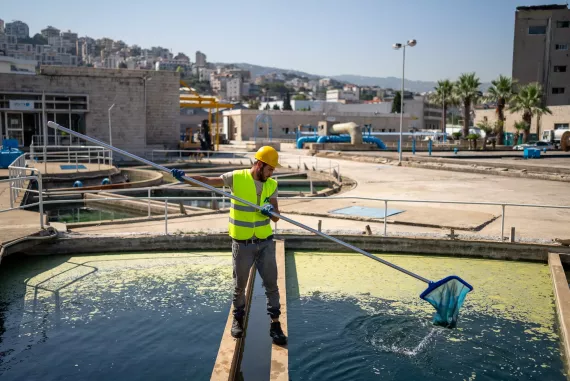
Most wastewater treatment plants are non-functional or severely underperforming, leading to a risk of widespread environmental contamination from untreated sewage. This poses a major risk to public health, especially in dense urban areas and agricultural zones.

The 2024 war along Lebanon's southern border aggravated the impact of the economic crisis. Many of the more than 1.5 million people displaced by the conflict lived in collective shelters, including schools, unfinished buildings and informal settlements, which lack adequate water and sanitation facilities. This sudden and massive increase in WASH needs placed extreme pressure on already overstretched systems and humanitarian partners. Even after the conflict ended, thousands of Lebanese and refugee families still required urgent emergency WASH support. In addition, some 205,000 Syrian refugees living in informal settlements depend entirely on UNICEF and NGO support for water and wastewater services. A 2022 cholera outbreak highlighted the risks of new disease outbreaks, with children particularly vulnerable to waterborne diseases such as cholera, hepatitis A and acute diarrhoea.
Solutions
Significant investments are needed to improve the public water supply and wastewater infrastructure.
Addressing the power crisis should be a top priority, to ensure water and wastewater facilities have the electricity they need to function. At the same time, facilities need to be repaired and maintained.
The water and wastewater networks need to be extended, to reach people who currently rely on costly alternative solutions, and to reduce leakages.
It is also critical that Lebanon develop alternative, sustainable power sources, such as solar energy.


Lebanon’s National Water Sector Strategy (2024–2035) provides a strong tool to address the sector’s critical issues. The strategy includes enhancement of water security, improvement of public services and promotion of sustainable utilities. UNICEF is aligning its WASH programme to support implementation of this strategy, with a focus on expanding access to safe and affordable water and sanitation services for all people in Lebanon, including vulnerable Lebanese and refugee communities affected by the ongoing crisis.

Our Key Achievements
In 2024, UNICEF scaled up its WASH response to meet the urgent needs of displaced families in collective shelters. This included installing toilets and showers, providing bottled water to over 110,000 people in collective shelters and improving water services for over 1 million people.
UNICEF had already increased support to water services following the onset of the economic crisis to ensure everyone has access to safe water. UNICEF is also investing in new infrastructure to strengthen the water supply system. In 2023, support was expanded to include key wastewater treatment plants, and by 2025, UNICEF had supported the rehabilitation of 16 facilities.
UNICEF also provides emergency water and sanitation services to Syrian refugees living in informal settlements.
- In 2024, UNICEF WASH Supported over 500 repairs to water systems, ensuring continued access to public water supplies for over 4 million users.
- Led construction and rehabilitation projects, including four reservoirs, five springs and two stormwater catchments, resulting in the sustainable delivery of an average of 300m3 of water per day.
- Enabled the solarization of 14 water stations, which has improved the sustainability of water provision to over 400,000 users.
- Provided rehabilitation and operational support for 16 wastewater treatment plants, reaching up to 1.4 million users.
- Provided WASH services to over 180,000 people in informal settlements.
- Carried out over 500 urgent repairs to restore functionality in critical water infrastructure.
- Supplied the most urgently needed pumps and pipes, helping to maintain water flow and prevent system breakdowns.
- Delivered five generators to support water supply continuity in key locations, improving access to safe water for more than 400,000 people during escalation of conflict as emergency response.
- Provided chlorine for water treatment, including over 54,000 kg of chlorine gas and 10,200 kg of liquid chlorine. This was done in coordination with the North Lebanon Water Establishment as part of cholera prevention and response.
- Supplied essential laboratory equipment and consumables to water quality testing labs ensuring continued monitoring of water safety.
- Offered technical support and ad-hoc coordination, in collaboration with the Beirut Mount Lebanon Water Establishment.