Hussein’s Story: Holding On to Progress Amid Displacement
Through the National Disability Allowance (NDA), Hussein’s family received support that helped cover essential needs, as he hopes to continue physiotherapy, regain movement in his hand and return home

- English
- العربية
War took away Hussein’s home in a single moment. But what disappeared more quietly, and just as painfully, was the progress he had fought for over years of treatment: the ability to lift his hand, move more freely, and believe that tomorrow could be easier than yesterday. For children with disabilities, conflict does not only bring displacement. It interrupts care, breaks routines, and risks undoing hard-won gains that families build step by step over a lifetime.
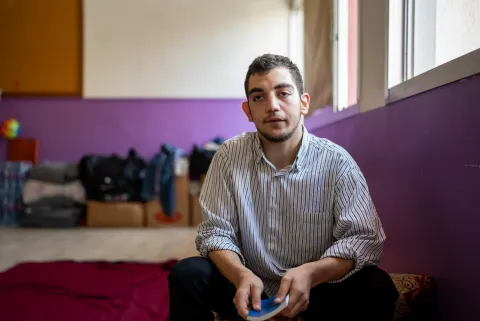
Hussein is a 10-year-old boy from Nabatiyeh, now living with his family in a school turned into a shelter in Dekwaneh after being displaced by the conflict in Lebanon. He lives with a motor impairment affecting his ability to hold objects or move his hand. His twin brother remains close by his side, a quiet source of strength through the challenges they navigate together.
Progress Interrupted
Before the crisis, Hussein's family relied on the National Disability Allowance (NDA) a national, rights-based programme by the Ministry of Social Affairs, launched with catalytic funding from the European Union in partnership with UNICEF and International Labour Organization ILO, that provides income support to persons with disabilities and enables access to services, removes barriers, and fosters inclusion. For Hussein's family, that monthly allowance made his physiotherapy sessions possible, each costing around USD 20. Slowly, the results came.
"My son improved a lot," his mother recalls. "At first, he was very happy to receive treatment. He would say, 'Mom, look, I can lift my hand!' Little by little, he became more active and his walking and mobility improved."
Those steps forward - a hand raised, a steadier movement meant everything and reflected what was possible when support systems were in place and accessible. But when the war forced the family to flee, Hussein’s access to regular therapy and routines was disrupted.
"After we were displaced, his condition worsened. It worsened significantly," his mother says. "He lost much of the progress he had made and can no longer lift his hand. His emotional well-being has worsened since the war began."
Yet amid the uncertainty, Hussein holds on to a simple, clear hope. "I love my mother, she takes care of me. I want to continue physiotherapy so that my hand can improve."

Support at the Right Moment
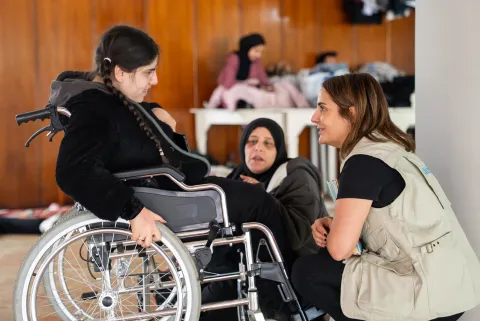
Hussein is one of many children with disabilities now living in shelters across Lebanon, where families struggle to maintain access to medication, rehabilitation, and care while coping with displacement and lost income.
When the conflict escalated, an emergency cash support was activated under the NDA platform to ensure that families like Hussein’s were not left without support.
Regular NDA payments were issued in advance so families could meet urgent needs without delay, and those most directly affected also received additional one-time emergency cash assistance of USD 100 a meaningful buffer at a moment when every resource counted.
For Hussein's family, both forms of support helped cover essential needs: His clothing and medications.
Cash assistance cannot replace the full range of services a child like Hussein needs. But by reaching families through national systems at their most vulnerable moment, the NDA helps ensure that displacement does not mean the end of care, and that children with disabilities are not left behind when crisis unfolds.
For Hussein, the hope remains straightforward: to regain movement in his hand and return home
The National Disability Allowance is financed by the Government of Lebanon, the European Union, the Kingdom of the Netherlands, and other donors, and is implemented by the Ministry of Social Affairs in partnership with UNICEF and ILO.