The European Union, France and UNICEF strengthen sustainable and cost-effective solutions for water access in the North of Lebanon

- English
- العربية
June 13, 2025 – The European Union in partnership between the Agence Française de Développement (AFD) and UNICEF are improving access to safe and sustainable water for more than 1.5 million people across Lebanon.
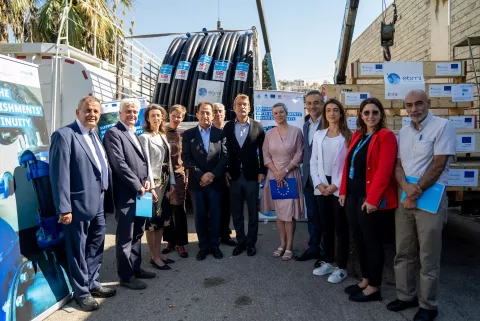
The Ministry of Energy and Water, together with the North Lebanon Water Establishment, the European Union, the AFD and UNICEF inaugurated today the newly rehabilitated Chekka Pumping Station and the Dar Baachtar Solar Park, marking a significant step forward in securing clean and sustainable water access for communities in North Lebanon.
By investing in solar-powered technologies, infrastructure rehabilitation, and network expansion, the partnership supports long-term access to safe water for communities, while promoting environmentally responsible and scalable solutions.
In his remarks, Minister of Energy and Water Joe Saddi emphasized that “access to safe and sustainable water must be recognized as a fundamental human right, as water is essential to life.” He continued: “Securing water for the Lebanese people is a cumulative process that begins with scientifically and accurately identifying the challenges, understanding the resources at hand, and defining practical solutions that are implemented with professionalism and transparency. Equally important is the need to avoid all forms of waste, whether financial, temporal, or human.”
He concluded by stating: “This is the guiding approach we are adopting at the Ministry. We place great value on our collaboration with friendly nations and international partners, notably the European Union, France, AFD, and UNICEF, whose support remains a cornerstone in advancing our mission to serve the people of Lebanon.”
Since the start of the collaboration, the European Union, AFD, and UNICEF have supported the solarization of 14 water stations, rehabilitated eight stations and one water channel, expanded six gravity-fed water networks and installed three new water systems.
Sandra de Walle, EU ambassador in Lebanon, Said: “The European Union is committed to supporting this reform journey. Our work with the Ministry of Energy and Water focuses on strengthening the sector as a whole, from central institutions to Regional Water Establishments, while also helping to establish the legislative and financial foundations necessary for lasting progress. We are also supporting better public budgeting practices to ensure resources are used efficiently in 2026 and beyond. An additional 17 million euros of EU funding will be contracted in 2025 to continue driving these critical changes”

In addition to safeguarding access to water during periods of fuel scarcity and conflict, these investments have helped Water Establishments reduce energy costs and improve long-term financial sustainability.
“Improving access to water goes beyond infrastructure. Through this project, we are supporting solarization, rehabilitation, and better service delivery. Experience in France and worldwide teaches us that for these efforts to be sustainable, stronger institutions, user engagement, and genuine reforms are essential. France, alongside the European Union, stands with the Ministry and the Water Establishements” said Hervé Magro, Ambassador of France to Lebanon.
“These projects are more than infrastructure upgrades, they represent a lifeline for thousands of families, ensuring their right to safe and clean water even during challenging times,” said Andrea Berthe, UNICEF Representative ai in Lebanon. “Together with the European Union and AFD we contributed to a more sustainable and resilient water services contributing to the recovery of the Water Establishments, enhancing their capacity to deliver quality and climate-resilient water services as outlined in the national water sector strategy”.
The new solar park in Dar Baachtar marks a significant advancement for the community, as it now powers the main water station serving approximately 4,000 residents. This solar-powered system guarantees consistent access to safe water for families, schools, and institutions throughout the village. The large solar field, including 336 panels, generates clean and reliable electricity to pump water from the village’s main well. It enables a water supply for up to seven hours a day - even during periods without sunlight - by operating in tandem with the national grid or a backup generator.
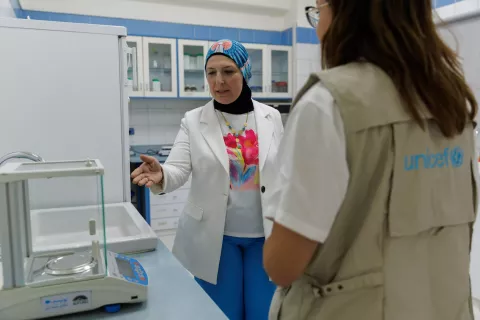
Meanwhile, the Chekka Pumping Station underwent comprehensive rehabilitation, including the installation of four vertical multi-stage submersible pumps, updated electrical control panels, and advanced monitoring systems enhancing operational efficiency and reliability.
About UNICEF
UNICEF works in some of the world’s toughest places, to reach the world’s most disadvantaged children. Across 190 countries and territories, we work for every child, everywhere, to build a better world for everyone. For more information about UNICEF and its work for children visit www.unicef.org/lebanon/.
Follow UNICEF Lebanon on Facebook, Twitter, Instagram, LinkedIn, YouTube and TikTok.