Opening New Worlds: One Teacher's Digital Journey in Rural Laos
Mr. Phonexay is bringing digital learning to children who never imagined it was possible.

For 17 years, Mr. Phonexay Phommasone has dedicated his life to teaching. As the principal of Napho Primary School in the remote Phine District of Savannakhet, he has seen many changes in education. But nothing prepared him for the moment he first held a tablet in 2024.
That small device changed everything and not just for him, but for his students in one of the most remote parts of Lao PDR.
A New Way to Teach
Before the teacher training in digital literacy and Khang Panya Lao – the national digital learning platform - Mr. Phonexay taught the ‘old fashioned way.’ His textbooks were often worn out with pages missing. Preparing lessons meant trying to teach with incomplete materials.
Today, he spends 10 to 20 minutes on the Khang Panya Lao platform before class, finding fresh teaching materials and referring to the national digital curriculum textbooks it contains. During math lessons, he connects his tablet to a projector and shows his students videos from Khang Panya Lao and other learning channels, such as the Khamsaiy SSRYS channel which features Ministry of Education and Sports’ (MOES) approved educational content produced by Research Institute for Educational Sciences (RIES) and shared on YouTube.


This was the first time I tried to use a digital device in training, and it opened a new world for my teaching. When students see digital lessons, their eyes light up. It makes them excited to learn.
When Digital Learning Comes Alive
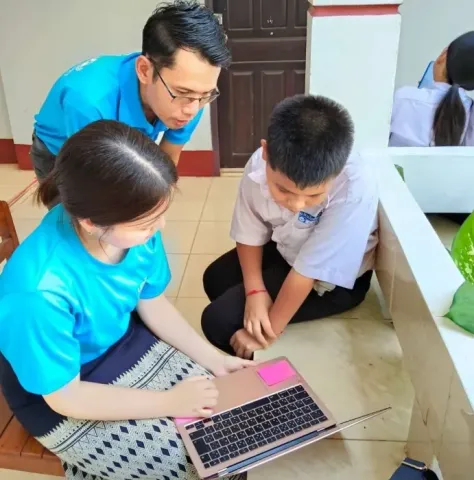
In his classroom, children who once struggled with math concepts can now watch numbers come to life on the TV screen. They can hear explanations in Lao language. Then, they play educational games in small groups using tablets.

For these rural children, many of whom have never used a computer or digital device, the tablet opens a completely new world. Learning becomes an adventure rather than a chore.
Challenges on the Journey
But the reality Mr. Phonexay faces is harsh. He is the only teacher who has received digital training in the school. After class, he shares what he knows with his colleagues, but he understands this is not enough. Many teachers lack basic digital skills and do not know how to bring digital content into their lessons. Without proper training, the potential of digital learning remains out of reach for most classrooms.
Digital infrastructure and equipment shortages present additional barriers. The school lacks reliable internet, and with only six tablets and one laptop for over 150 students, access to digital devices is limited. These challenges mean that only some children benefit from digital learning, many children are still waiting.
Still, Mr. Phonexay pushes forward. He believes rural children deserve the same opportunities as those in cities. MOES, UNICEF and partners continue working to expand digital infrastructure, increase access to devices and strengthen teacher training, ensuring that every child in Lao PDR can benefit from digital learning.

What’s Next: Bringing Opportunity to Every Child
What Mr. Phonexay is doing in his small school is part of something bigger. He is showing that digital learning is not a distant dream anymore. With the right support, training, and tools, rural teachers can transform how children learn and give students access to knowledge that was once out of reach.
For Mr. Phonexay, it began with holding a tablet for the first time. Now he is helping his students hold their futures in their hands.

Mr. Phonexay received training in digital literacy and Khang Panya Lao thanks to the Korean Committee for UNICEF through Schools for Asia Initiative. The program aims to improve digital literacy among teachers and expand access to quality learning materials and more interactive learning opportunities for children across Lao PDR, especially in rural and remote areas.