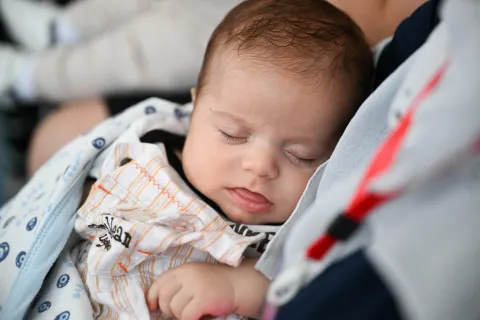
Discovering strength in motherhood: Valmira’s story
Building resilience in families through home visiting and group care

When 34-year-old Valmira Pirraku, from the village of Bujan in Lipjan, learned she was pregnant, her joy was quickly overshadowed by worry. Doctors warned her that due to her health complications, she might lose her baby.
“I was told I might lose the child,” Valmira recalls. “I was scared and uncertain.”
Like thousands of women in Kosovo, Valmira’s first stop was her local Family Health Center – the backbone of the health care system in Kosovo that provides accessible, community-based services for all. This first point of contact ensured she was not left alone with her fears but supported from the very start of her pregnancy by meeting Shemsije Jezerci, a midwife and trained home visiting nurse. With calm words and gentle care, Shemsije reassured Valmira while administering an infusion. She also explained the Home Visiting Programme, which would allow nurses to visit her at home to provide advice and monitor her pregnancy.
“During the infusion, I felt such relief, not only physically, but because she spoke to me, explained things, and gave me hope,” says Valmira.
Sometimes, an unplanned encounter or simply meeting the right person at the right time can change everything. For Valmira, it was that meeting with nurse Shemsije, who gave her the support and reassurance she needed. From then on, Shemsije visited Valmira at least once a month, guiding her through pregnancy, and preparing her for childbirth, as well encouraging her to regularly consult specialists like hematologists.

The Home Visiting Programme was launched to bring essential maternal and child health services directly into families’ homes. Initiated in 2014 with UNICEF’s support and the generous contribution of the Grand Duchy of Luxembourg, the programme is now fully integrated into Kosovo’s primary healthcare system and reaches all municipalities. Last year, for the first time, the government of Kosovo allocated €3.4 million to support it through the specific grant for primary healthcare. Shemsije has been part of the programme since its very beginning, visiting hundreds of families and offering them guidance, encouragement, and personalized care.
In December 2024, Valmira and her husband, Ilir, welcomed their daughter, Danina. With parenthood came new challenges. As a first-time mother, Valmira was eager to put into practice the valuable advice she received from the Home Visiting nurses. When they informed her about the Group Care for Parenting sessions, she was willing to join the programme.

Beyond Birth: Learning to Parent
After Danina’s birth, Valmira joined the Group Care for Parenting programme, led by nurses Shemsije Jezerci and Teuta Reqica. This programme consists of sessions that bring parents together to share experiences and learn about breastfeeding and child development, positive parenting and mental well-being all within a safe, supportive space in the Main Family Health Center. The approach reflects the Nurturing Care Framework, which emphasizes health, nutrition, responsive caregiving, safety, and early learning.
Crucially, the Group Care for Parenting programme is designed to complement the Home Visiting programme. Together, they form a continuum of support within Kosovo’s primary health care system. Through home visits, nurses build trust with families and provide tailored health guidance during pregnancy and early infancy. The same nurses then facilitate group sessions, where parents continue learning, exchange experiences, and support one another. This combination of individualized and group-based care ensures no parents feel alone, whether at home or in a community setting and strengthens the healthcare system’s ability to respond to families’ needs.
The Group Care for Parenting programme is led by the Ministry of Health and supported by UNICEF in partnership with the Grand Duchy of Luxembourg. So far, the programme has been scaled up into 15 municipalities, with the goal of expanding across all of Kosovo.
“I joined with full desire, and I never missed a session,” says Valmira. “We learned everything: how to breastfeed, how to monitor our baby’s growth, and how to manage challenges without stress. These sessions didn’t just give me knowledge; they also gave me peace of mind. Sharing with other mothers and fathers reduced my fears and made me feel I was not alone,” says Valmira.

Ilir, her husband, often rearranged his work schedule to attend these sessions with her.
“At first, I was very worried during her pregnancy,” Ilir states. “But these discussions with nurse Shemsije prepared me too. I learned how to support my wife during and after pregnancy and how to take care of Danina. We don’t argue in front of her; we want her to grow happy.”
Yet in Kosovo, data shows that hands-on parenting is still not equally shared. According to the latest MICS, 63% of children aged 2–4 engage in early stimulation activities with an adult in the household. But mothers are four times more likely than fathers to be the ones engaging their children in learning and playing.
UNICEF stresses that when fathers are actively involved, children benefit from stronger cognitive development, better emotional well-being, and healthier relationships. Encouraging fathers’ participation is essential to give every child the best start in life.
“I’ve realized that my involvement is crucial for Danina’s development. That’s why I want to tell all fathers out there, it’s not shameful to play with your child, to spend time together, to talk, to sing, to feed them, or to change a diaper. This is what being a parent truly means, and it’s essential for your child’s well-being.” – says Danina’s father.
Today, Valmira is deeply committed to giving Danina the best start in life. She avoids screen time, prioritizes play, and follows her baby’s natural rhythm rather than forcing sleep or feeding schedules.
“Some people criticize me for giving so much attention,” she says. “But how I learned during the sessions I know 80% of a child’s brain develops by age three. My priority is to nurture her in the best way possible. Parenting is a school on its own.”

The Nurses Who Make a Difference
For nurse Shemsije, who has worked for 26 years in Lipjan’s Family Medicine Center, stories like Valmira’s are why she continues, sometimes walking long distances or traveling after working hours to reach families in need. She balances heavy workloads, late evenings, and constant follow-ups, yet she remains committed because she knows every visit and every conversation makes a difference. Keeping up with so many families is not easy, but Shemsije believes that every child and every parent deserves the right start.
“Group Care for Parenting is more than information,” says Shemsije. “It’s about listening to parents, helping them support one another, and noticing when a child or parent needs extra care. Sometimes we identify developmental delays or even signs of depression and can intervene early. By noticing early signs of developmental delays or parental stress, the nurses can provide timely support, helping families maintain both physical and mental well-being.
“In the Group Care for Parenting sessions, new mothers come together in a warm and welcoming space, gain valuable knowledge about early childhood as the most important stage of development, learn from each other’s experiences, and build new friendships,” said Teuta Reqica, trainer and facilitator of the Group Care for Parenting.
Together with her colleague Teuta, Shemsije not only provides guidance but also visits families at home when needed, as per the Ministry of Health standards ensuring no parent feels left alone. This integrated approach, linking home visits and group sessions withing the primary healthcare system, provides families with comprehensive, continues support.
Valmira now encourages other mothers to join. “I call on all mothers, don’t hesitate. You’ll learn how to raise your child and face challenges more confidently.”
Valmira’s journey is not only about motherhood, but also a testament to how a strong primary health care system, through programmes like Home Visiting and Group Care for Parenting, saves lives, empowers parents, and shapes the future of children across Kosovo. When primary health care is prioritized, families like Valmira’s gain more than medical support: they receive trusted guidance in their homes, shared learning in their communities, and the knowledge, confidence, and nurturing care every child need for the best start in life.