

UNICEF and KIPD Join Forces to Advance Behavioural Science in Kazakhstan
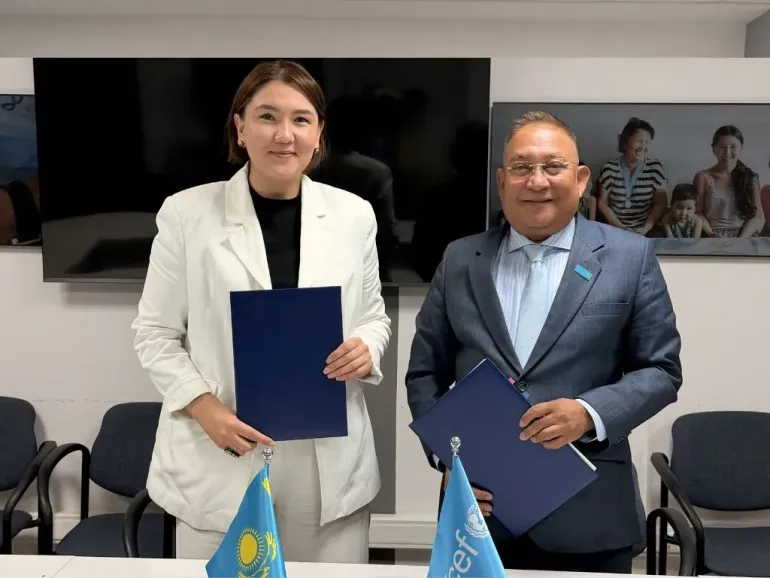
ASTANA, 7 July 2026 – UNICEF in Kazakhstan and the Kazakhstan Institute for Public Development (KIPD) signed a memorandum of understanding to strengthen behavioural science (BeSci) and promote its practical application in designing public programmes, research strategies, and communication campaigns that benefit children, adolescents, young people, and families.
Behavioural science helps explain why people make decisions and uses these insights to design more effective public services, social programmes, and communication campaigns. Many countries already apply behavioural approaches to increase their residents’ participation in prevention programmes, improve their access to social services, promote healthy lifestyles, and encourage positive behavioural change.
Through the partnership, UNICEF will provide technical expertise to help KIPD integrate behavioural science into its work. The partners will strengthen institutional capacity, build practical skills among specialists, improve research methodologies, and introduce modern behavioural analysis tools to support social sector decision-making.
"Even the best-designed programmes do not always achieve the expected results if they fail to consider how people make decisions and the barriers they face in their daily lives. Behavioural science helps us design solutions that work for people. We are pleased to join forces with the Kazakhstan Institute for Public Development to advance this field in Kazakhstan and apply international experience to improve the lives of children, young people, and their families,"
said Dr. Rashed Mustafa Sarwar, UNICEF Representative in Kazakhstan.
Zhuldyzai Iskakova, Chair of the Management Board of the Kazakhstan Institute for Public Development, said:
"Our partnership with UNICEF will strengthen national expertise in behavioural science and expand the use of modern analytical approaches in research and social policy. We are confident that our joint work will promote cross-sectoral collaboration and help introduce international best practices in Kazakhstan."
UNICEF and KIPD will begin implementing a joint action plan in the coming months. The plan includes sharing international experience, strengthening professional competencies, and integrating behavioural approaches into research and analytical work. Through this partnership, the organizations aim to support more effective evidence-informed solutions that improve the well-being of children, adolescents, young people, and families in Kazakhstan.
Media contacts
About UNICEF
UNICEF, the United Nations agency for children, works to protect the rights of every child, everywhere, especially the most disadvantaged children and in the toughest places to reach. Across more than 190 countries and territories,
we do whatever it takes to help children survive, thrive, and fulfil their potential.
For more information, visit www.unicef.org.
Follow us on Instagram, Facebook and X
About KIPD
The Kazakhstan Institute for Public Development is a leading research and analytical centre specialising in public processes, institutional reforms, and family and gender policy. The Ministry of Culture and Information of Kazakhstan is the institute's sole shareholder.
Learn more about KIPD at kipd.kz.


