UNICEF, Almaty Regional Administration and Bureau of National Statistics Identify Priorities to Support Children Following MICS Survey

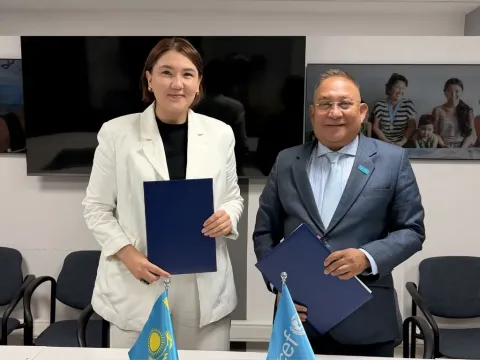
KONAYEV, 4 September 2025 — The Almaty regional administration today hosted an official meeting with representatives from the Bureau of National Statistics (BNS) and the United Nations Children's Fund (UNICEF) in the Republic of Kazakhstan. The dialogue focused on discussing priority areas for cooperation, based on a socio-economic profile of the region compiled from the latest data on the well-being of children and young people.
The parties highlighted the strong partnership during the Multiple Indicator Cluster Survey (MICS), which provided valuable data for making evidence-based decisions in social policy. UNICEF Representative to Kazakhstan, Dr. Rashed Mustafa Sarwar, expressed his gratitude to the Akimat (regional administration) and the BNS for their openness and cooperation in data collection and analysis, emphasizing that this approach is key to effective planning.
According to administrative data, the region demonstrates steady economic growth and significant achievements in the social sector. The region's real GRP grew by 9.6 per cent, and its share of the national GDP reached 4.4 per cent. The region ranks fourth in the country for the development of small and medium-sized enterprises, which employ 32.9 per cent of the population. According to the 2024 MICS results, Almaty Region also leads the country in newborn care, ranking first nationwide: 9 out of 10 infants receive a medical check-up within a week of discharge. Furthermore, the region has recorded low adolescent birth rates (11 cases per 1,000 adolescents and young women aged 15–19), comparable to those in high-income countries.
Additionally, the constructive dialogue helped identify areas for growth that will form the basis for future joint programmes. According to the survey, issues requiring special attention include the further reduction of neonatal and under-five mortality rates and the improvement of child nutrition, as the proportion of children under 5 with stunting is higher than the national average and has shown an increasing trend over the past 10 years.
The data analysis also identified education as a promising area for investment. The Early Childhood Development Index for children aged 2–4, preschool enrolment, and the quality of school education were highlighted as areas for growth with significant potential for improvement. In the same context, the importance of strengthening efforts to promote positive parenting was underscored, given that the survey found that nearly half of all children (49.7 per cent) experience violent disciplinary methods.
Based on this analysis, the parties outlined concrete steps. These include developing early intervention programmes, expanding access to quality preschool education, strengthening the home-visiting nurse system to improve child health and nutrition, and implementing programmes to promote positive parenting.
Concluding the meeting, Dr. Sarwar remarked:
“Almaty Region is a region with tremendous potential, and we see the akimat as a reliable partner in unlocking it. The in-depth data analysis conducted with the BNS allows us not just to state facts, but to design targeted and effective support programmes. We stand ready to provide all necessary expertise and support the akimat’s initiatives to jointly achieve the ambitious goals of improving the well-being of every child in the region.”
The parties reaffirmed their commitment to strengthening their partnership and implementing joint initiatives aimed at creating a supportive and safe environment for all children and young people in the region.
Media contacts
About UNICEF
UNICEF works in some of the world’s toughest places, to reach the world’s most disadvantaged children. Across more than 190 countries and territories, we work for every child, everywhere, to build a better world for everyone.
For more information about UNICEF, visit www.unicef.org.
Follow UNICEF on Instagram, Facebook and X(Twitter).