Helping families to thrive through cash, care and hope for a growing family in Muthanna
For Baneen’s family, financial support opens the door to better health.

- English
- العربية
Baneen rests a hand on her belly as she talks about the fourth child she is expecting in two months.
For Baneen’s family, financial support opens the door to better health.
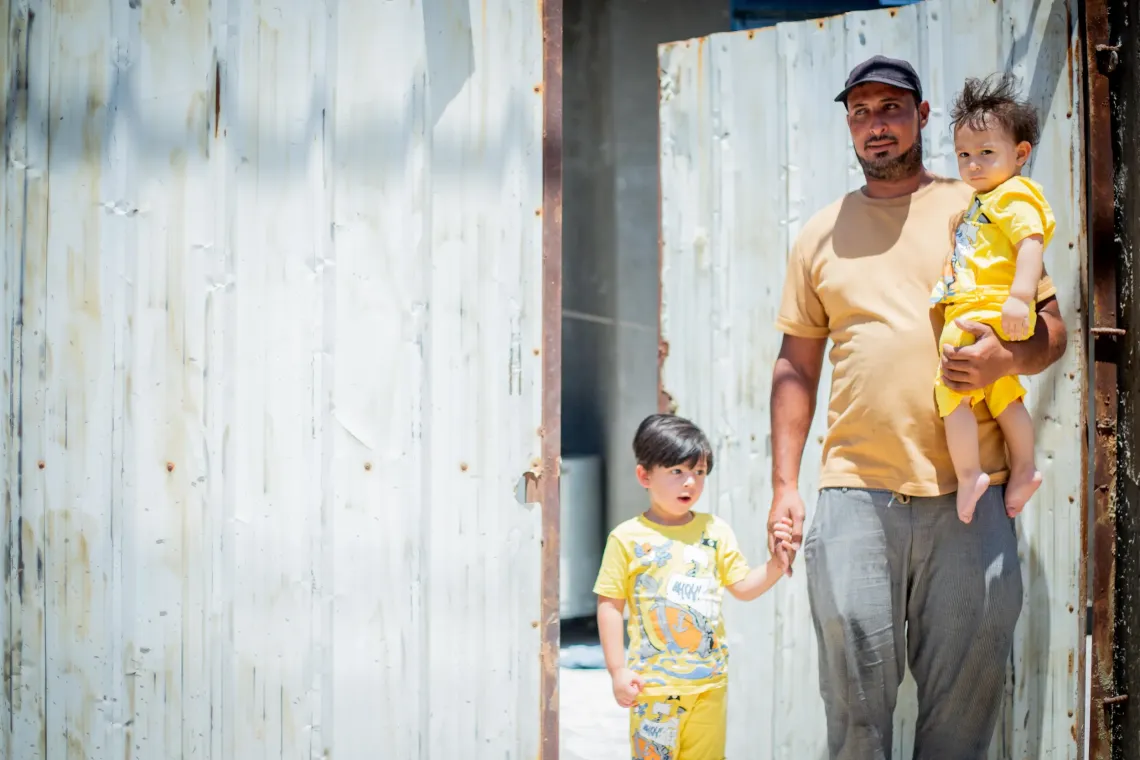
“Raising three boys is not easy,” Baneen says. “My husband and I do everything we can, but life here is hard.” Her sons are Ali Ridha, 8, Jood, 4, and Abalfadhil, one year and four months.
In Muthanna, many parents rely on irregular daily labour to support their families. For Baneen and her husband, Ahmed, each day brings uncertainty. “He is a hardworking man,” Baneen says. “Every morning he leaves to look for work, and whatever he earns that day is what we live on.”
While Ahmed looks for work, Baneen cares for the household and supports her sons’ education. Having completed secondary school, she is determined to help them stay on track.
“I make sure they do their homework every day, that matters to me, even on the hardest days.”
With funding from the European Union, UNICEF and Iraq’s Ministry of Labour and Social Affairs are piloting the Child Plus Benefit, which supports 10,000 families in Muthanna already registered in the Social Safety Net. The programme prioritizes pregnant women and children under 2, recognizing the lasting importance of a child’s earliest years. Baneen and her youngest son, Abalfadhil, are both enrolled.
“The health center near us calls to remind us when a vaccination is due, Abalfadhil and I are part of the Cash Plus programme. The support helps us cover costs we would otherwise struggle to afford, including transport and other daily needs.”
The guidance has also changed how Baneen views vaccination.
“I used to be afraid of vaccinating my children,” she says. “I worried they would develop a fever, and I did not want to see them sick. But the doctor explained it simply: a day of fever is far better than a lifetime of illness, God forbid. That stayed with me.”
Linking cash to care
The calls are part of a case-management system supported by UNICEF. Trained social workers and health staff identify families who need assistance and follow up directly. Parents receive text messages when a health check-up or vaccination is due. If an appointment is missed, a health worker alerts a social worker, who follows up by phone or visits the family’s home.
UNICEF has also strengthened the programme’s underlying systems by upgrading the database used to register and track families, providing social workers with digital tools, and training frontline staff to identify and assist households most in need.
Muthanna is one of three locations in Iraq piloting this approach. In Duhok and Sulaymaniyah in the Kurdistan Region, similar programmes link financial assistance with school attendance. Together, the pilots are helping develop a model that could eventually support families across Iraq.
For Baneen, the goal is close to home. “I just want my boys to be healthy and do well in school,” she says. “That is all I ask for.”