National Forum Highlights UN Support for Women, Children and Families Recovering from Conflict in Iraq
A national forum brings together the Government, the United Nations and partners to strengthen protection for women and children, support recovery and advance peacebuilding in Iraq.
- English
- العربية
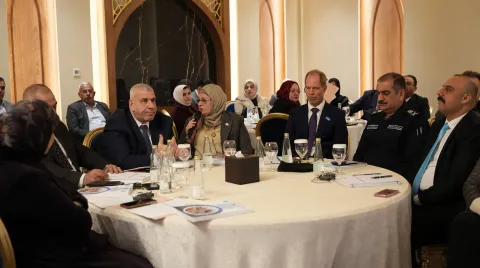
Baghdad, 27 August 2026 — The National Directorate for Iraqi Women, at the General Secretariat of the Council of Ministers, today convened a national forum on the role of United Nations agencies in supporting women, families and children during and after conflict, with the support of UN Women, UNFPA and UNICEF.
The forum brought together the Deputy Minister of Labour and Social Affairs, representatives of the Ministry of Migration and Displacement, the Prime Minister's Adviser on Women's Affairs, national committees on women, family and children, other government institutions, United Nations agencies, academics and media. Discussions covered protection during conflict and displacement, early recovery, reintegration and women's economic empowerment, and cooperation between government, the United Nations and civil society. UN Women, UNFPA, UNICEF and IOM each presented their work in Iraq.
“Iraqi women have not been recipients of protection and assistance alone; they have been partners in resilience, in recovery and in rebuilding social peace,” said Dr. Yusra Karim Mohsen, Director General of the National Directorate for Iraqi Women.
Speaking on behalf of the United Nations in Iraq, Dr. Hind Jalal, UNFPA Representative, said: “Any account of what the United Nations contributes must begin by recognizing what Iraq has achieved itself. Today, Iraqi women across the country are not only beneficiaries of recovery programmes — they are helping to lead them, in peacebuilding, community reconciliation and livelihoods, and in clearing mines and explosive remnants of war”.
Iraq adopted the region’s first National Action Plan on UN Security Council resolution 1325 and is now implementing its third. Since 2017, nearly five million Iraqis have returned to their areas of origin, many to places where damaged housing, land disputes and missing civil documentation still affect daily life, especially for households headed by women.
“The measure of more than ten years of partnership is not the activities delivered, but what is now anchored in Iraqi institutions — from national action plans and referral pathways to Iraq's first National Women's Peace Mediators Network,” said Janneke van der Graaff-Kukler, UN Women Representative a.i. in Iraq. “Only 10.8 per cent of Iraqi women are in the labour force, which makes women’s economic participation a recovery question, not a separate social one.”
“Women and children often bear the greatest burden of conflict. UNICEF remains committed to working with the Government of Iraq, partners and civil society to protect every child, support families to recover, and invest in a more peaceful, cohesive and sustainable future," said Laetitia Bazzi, Acting UNICEF Representative in Iraq, setting out UNICEF's work on child protection systems, education, health and nutrition.
The forum closed with a roundtable discussion on strengthening collaboration between national institutions, United Nations agencies and other representatives, and on priorities going forward. Participants gave particular attention to climate change as an emerging priority and to how it is reflected in the implementation of Iraq's National Action Plan on Women, Peace and Security. United Nations agencies reaffirmed their commitment to Iraq's implementation of the agenda and to coordinated support for women, children and families affected by conflict.
Media contacts
About UNICEF
UNICEF promotes the rights and wellbeing of every child, in everything we do. Together with our partners, we work in 190 countries and territories to translate that commitment into practical action, focusing special effort on reaching the most vulnerable and excluded children, to the benefit of all children, everywhere.
For more information about UNICEF and its work for children, visit www.unicef.org.