How We Venture: Emerging Technologies for Emerging Markets
Identifying tech that improves the lives of children everywhere, then investing to turn potential into impact, is how the UNICEF Venture Fund meets the diverse challenges in emerging and developing markets

Emerging technologies such as AI, blockchain, renewable energy and biotech have market capitalizations in the trillions and offer potential solutions to major global challenges. But these huge investments primarily benefit wealthier countries entrenching inequalities rather than fostering inclusive growth.
We chart a different path
The UNICEF Venture Fund believes there is a better way. For 10 years, we have provided catalytic investment and technical support for innovative solutions built on emerging technology, with the potential to make a difference for all children everywhere. For example, we have supported:
- AI-powered translation of underrepresented languages.
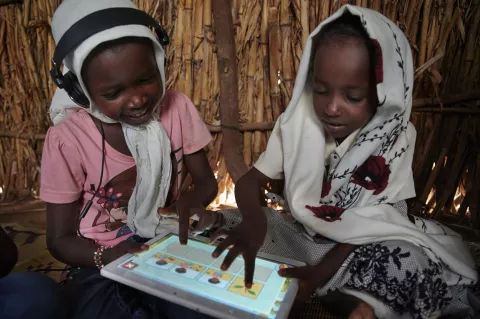
- digital textbooks for children, including those with disabilities.
- blockchain for humanitarian aid delivery, vaccine supply chains and financial services.
- real-time air quality monitoring in schools, feeding an AI model for estimating pollution levels.
When emerging technologies are designed with the needs of the most marginalized children and communities at their heart, we believe they can drive meaningful, inclusive impact locally and globally. This starts with open source so that solutions are freely accessible and adaptable, priming them to become digital public goods (DPGs).
Our open, transparent and accountable approach fosters collaboration – with engineering teams in different places working to solve similar problems as part of a global network of change – provides capacity-building opportunities at the country level and maximizes the value generated from each investment.
We invest in developing and emerging markets
To address asymmetries and inequities in the longer term, we must invest in local ecosystems, talent and infrastructure, redirecting capital flows so that solutions are developed, owned and maintained by those who use and scale them.
This is not the venture capital (VC) industry norm, but not for lack of talent, innovation or business acumen, as our portfolio of solutions demonstrates.
The UNICEF Venture Fund has invested in companies and UNICEF initiatives in over 80 countries, all developing and emerging markets. And we add more countries with every new cohort, investing in entrepreneurial ecosystems, highlighting entrepreneurial potential and tech talent across geographies. Here are just a few of the innovative companies supported by the Venture Fund:
- Somleng developed a low-cost alternative to commercial interactive voice response (IVR) and SMS platforms.
- Cloudline built the first autonomous airship able to carry a payload of 10 kilogrammes over 50 kilometres.
- Weni created a platform that makes less common languages accessible to natural language processing (NLP) chatbots.
- Statwig developed a solution to track data across supply chains.
Our portfolio of investments has reached 174 million people with 35 start-ups being deployed or used beyond their country of origin, and 10 expanding to more than 10 new countries. The 11 companies that received growth funding have been deployed or used 270 times beyond their country of origin, and 54 of these instances were in collaboration with UNICEF country offices.

We find and fund female founders
The UNICEF Venture Fund believes in creating financial and social returns while also closing asymmetries in opportunity. Globally, just 2 per cent of VC funds go to female-led companies, but in our portfolio two-fifths of companies are founded or led by women and more than half the revenue generated by our top 10 performing start-ups come from female-led companies.
We are close to achieving our aim of a gender-balanced portfolio through a deliberate strategy that has seen significant advances in recent years, with applications from female-led companies quadrupling from 15 per cent in 2019 to 60 per cent in 2024. There is no ‘pipeline problem’ if you are willing to do the grassroots work of building networks, seeking out and supporting women entrepreneurs, and prioritizing team diversity.
In 2025, we launched our inaugural FemTech strategy to identify, pilot and accelerate women-centric solutions that solve the diverse, unmet needs of women and girls in emerging markets. This led to a series of regional challenges with GITEX – across Asia, Africa and the Middle East – to understand the tech landscape and inform our inaugural FemTech call for applications.
At the same time, the pursuit of diversity led us to look inward too: our team and its network of experts is 55 per cent female and represents 16 nationalities.
We build solutions that do good and are financially sustainable
The UNICEF Venture Fund is creating a pipeline of innovative solutions that are both open source and backed by sustainable business models, and we have the track record to prove it:
- 70 per cent of our companies generate revenue.
- Eight have successfully exited through acquisitions.
- Our companies have collectively raised from other sources 12.4x initial investment.
We demonstrate how emerging technology can be inclusive, equitable, open and effective – for investors, company leaders and the people our innovations are designed with and for.
Our long-standing focus on open and equitable innovation has influenced UN commitments around digital cooperation, including the promotion of open-source software, content, data and models. In 2019, UNICEF co-founded the multi-stakeholder Digital Public Goods Alliance (DPGA) which advocates for digital assets that might help achieve the Sustainable Development Goals (SDGs) to be made available freely and openly as DPGs.
The UNICEF Venture Fund documents solutions transparently, showcases them powerfully and makes them available openly. Our actions and successes are proof that tech innovation can be designed and deployed to close equity gaps, not widen them, and that common cause can be found between the interests of private sector investors and those of young people and their communities working to solve challenges in emerging economies.