

Top 10 reasons digital learning succeeds or fails
Understanding how we can unlock the potential of digital learning
Children need the foundational skills of reading and writing to engage in school and life. But to benefit, fully and safely, from the technologies that increasingly power the present and future of their societies and economies, they also need to build digital skills. These are critical to enter the world of work, to protect their rights and wellbeing, and to engage constructively as local and global citizens. And yet, the development of digital skills and the use of digital technologies in classrooms and education more broadly is still seen as a luxury.
If your child graduated from school not knowing how to use the internet – to perform a Google search, type an email or document, or engage with ChatGPT – would you think that school was preparing your child for today’s world? If the answer is no, then should we have different ambitions for the children we serve? That said, ambition is one thing, implementation is quite another. The challenges in implementation of digital learning are especially salient in the low-income and emergency settings where UNICEF works, where they threaten to worsen inequities based on gender, income, displacement status, and language skills.
This explainer explores how we can unlock the potential of digital learning, especially in challenging contexts. We present the top 10 considerations for UNICEF and partners to keep in mind when planning a digital learning programme, drawing on lessons learned from ongoing or completed implementation research on digital learning conducted across more than 15 countries, in both humanitarian and development settings.
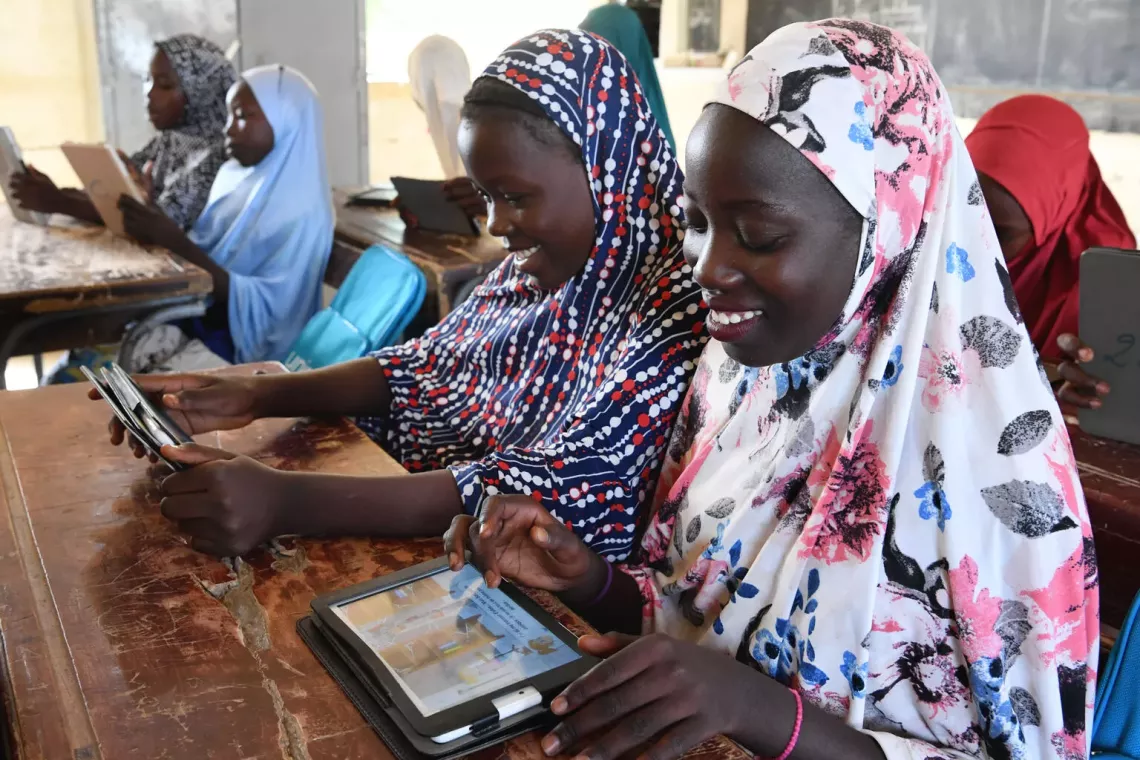
Top 10 considerations
1. Don’t buy a solution and then look for the problem.
Identify a clear learning need first before procuring a product or designing a new one. Digital learning works well when integrated into a learning process and aligned to achieve a clear objective. To quote Mike Trucano’s (fantastic) top ten list, “the best technology is what’s available, what people know how to use and what they can afford.” Today, the use of basic mobile phones is almost ubiquitous worldwide and can be leveraged to support learners in a variety of ways, as shown in this guide for the use of mobile phones to provide learning in emergencies, but these programmes can only work when they are designed and used to address a specific learning need.
2. There is no such thing as plug and play; you need a plan.
Research shows that merely introducing technology into the classroom is not sufficient to improve learning. What matters more is how that technology is integrated into a learning experience. Integrating technology within an educational setting requires major changes in the day-to-day routines of teachers, administrators and students. These include logistical changes, such as scheduling who has access to devices and when; how to troubleshoot technical issues; and protocols to charge, safely store and transfer devices. After this comes the hard part: introducing technology in the teaching and learning process; ensuring that both teachers and students can engage with the technology successfully; and that teachers can integrate the digital learning content into their lesson plans to achieve their learning objectives.
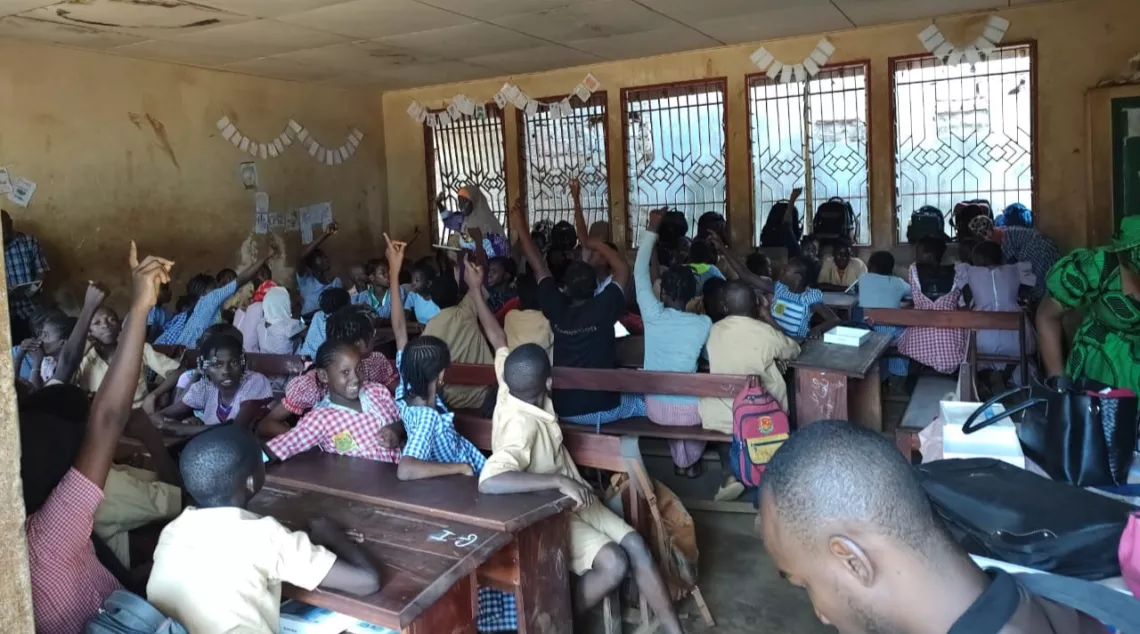
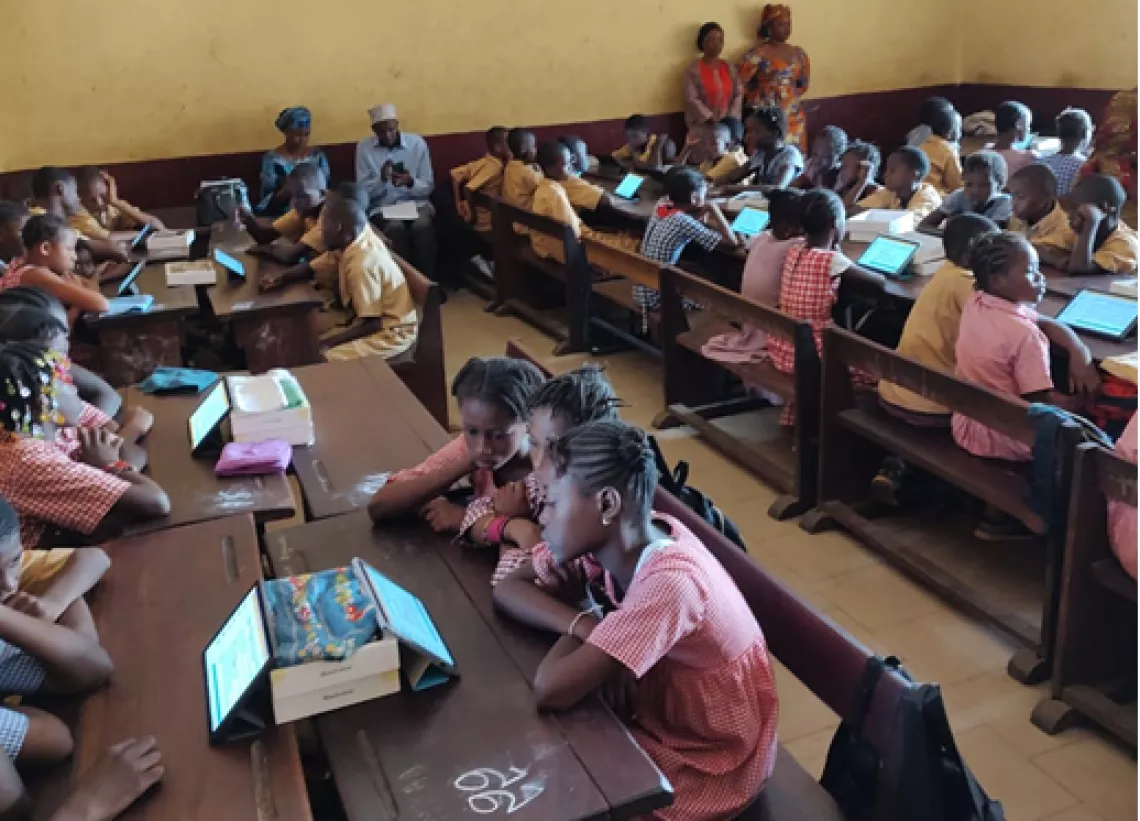
Research around the Learning Passport in Guinea illustrates just how much these adjustments matter. The images below shows two classrooms from two different schools in Conakry. The classes have roughly the same number of students, received the same number of devices and use the same content. In classroom A, up to six students share the same tablet, while in classroom B a maximum of three students are sharing a device. What accounts for this difference? In School A not all tablets were charged and ready-to-use, and a scheduling conflict meant that more students needed to share the same devices. In school B, better planning allowed a more favorable student-per-device ratio and thus a better class and learning experience. The same inputs but very different experience for teachers and students. This has implications for education system planning, including the need for clear standards, guidelines, and checklists for hardware management, scheduling, lesson planning and classroom management, among other areas, and for these standards to be effectively supervised.
3. If it is not useful for teachers, it will collect dust.
Teachers are and remain central to the education process. Digital learning is only a tool, and like any tool teachers will use it only when they see value in it or if it helps their students achieve their learning goals. Research across multiple countries has shown that it takes time, practice, and hands-on training for teachers to learn and integrate a new tool into their day-to-day teaching. Research from the use of the Akelius digital learning programme for refugees and migrants in Lebanon, Italy and Bosnia and Herzegovina showed that dedicated time for teachers to experiment and explore the digital learning content enabled them to integrate it into their lesson plans, and for its subsequent successful use in the class, and improved learning outcomes for students. In Mexico teachers were provided with ongoing trainings and resources to integrate the Pasaporte al Aprendizaje platform into their lessons, but were left with the freedom to use it based on their needs. The title of a recent paper on education technology in Pakistan hits the nail on the head: “Engaging teachers with Technology Increased Achievement, Bypassing Teachers Did Not.”
4. For digital learning to be equitable and accessible for all, having 'offline' functionalities is a must.
Offline functionalities not only allow for continuity of learning anywhere, anytime, but are also essential for scale in marginalized settings. There remains a large digital divide, across and within countries around the world. In Sub-Saharan Africa, just 36 per cent of individuals use the internet. That is in stark contrast to 63 per cent who use the internet worldwide. Even in countries with higher rates of internet usage, such as Greece (78.5 per cent) and Lebanon (86.6 per cent), research on the impact of the Akelius digital learning platform found that having the platform downloadable and able to be used offline was critical to its scale and impact. Having content available offline was not just important in refugee camps and informal settlements where connectivity and the affordability of data are very often major constraints, but also within major urban centers like Athens and Beirut where the strength of connectivity in classrooms was not enough for the concurrent use of digital learning by groups of students. In places like Mauritania, Guinea, Ghana and Sudan, where research on digital learning is currently ongoing, having an offline solution is non-negotiable, and must be planned in advance. The Learning Passport partnership with Microsoft is currently rolling out and testing offline hub devices which allow for this offline functionality in classrooms.
5. Infrastructure matters, and it’s about more than just connectivity or devices.
In Sub-Saharan Africa, where less than half of all households have electricity access, most children go to schools without electricity. Digital learning practitioners must think about devices, but also electricity, wall sockets, generators, internet connections, routers, wireless signal strength and protocols for device storage, security, use and charging in schools or learning centers. While logistically challenging, digital learning can reach those not yet reached by the electrical grid and be a gamechanger in providing learning opportunities for those children on the move, in conflict or otherwise unable to travel to a formal school. In Sudan, e-learning centers managed by communities in remote areas use solar panels to power devices and provide learning to out-of-school children. Many of these centers are still in operation during the current crisis demonstrating how digital learning can provide learning resilience in times of need.
6. Measuring digital education’s impact on learning starts from the beginning of a programme, not at the end.
Every digital learning programme has lofty goals for how many children it will reach and how it will revolutionize learning. However, not many digital learning programmes invest in robust research to test their implementation model and impact. Research often takes a back seat, especially in challenging contexts. Governments, donors and UNICEF must be wary of self-reported evidence on impact with little information on samples, how comparison groups were defined or what methods were used. To test impact, a sound research plan must be built into the implementation from the beginning, even if the impact is measured is at the end of a school term or year.
At UNICEF, research conducted on the impact of digital learning programmes has been possible thanks to strong partnerships from the onset of programme planning, to embed research within the roll out the programme with partners. This combination of implementation and evidence generation allowed the estimation of impacts of the use of the Akelius digital learning programme on learning outcomes for refugees in Greece and Lebanon.
7. Monitoring is critical and it requires more than looking at data from the platform.
Understanding what works by measuring impact is important. But it is equally necessary to understand how that impact happened or why it didn’t. We must learn how classrooms work with digital learning; why teachers and students engage with it and why some don’t; what works best in teacher’s professional development; and how skills gained on a platform transfer to skills in the classroom, at home or at work. We cannot understand these critical questions if we look only at data that comes from the platform itself. We have to combine data from schools, classes, feedback from teachers and students, along with data generated by digital learning platforms to gain a full picture. It is critical to invest in strengthening monitoring systems and to use implementation research to investigate impact but also to understand how programmes work to improve them over time.
8. Not all content is equal and making a textbook a PDF does not make it interactive or accessible.
The recent UNICEF Pulse Check Report on digital learning found that only one third of national digital learning platforms from 184 countries had interactive content. The remainder had static content such as PDFs or slides, limiting their usefulness as a tool for teaching and learning. The same report also found that only one fifth of platforms offered features that supported accessibility for people with disabilities, such as color contrast, captions and adjustable font sizes. If digital learning is reduced to “printed” material on a screen, we may be better off with traditional paper. These findings shaped last year’s Transforming Education Summit call to all governments to improve the quality and equity of national digital platforms and the content they host through the Gateways to Public Digital Learning Initiative. A great deal of the potential of digital learning lies in its ability to deliver engaging, interactive and personalized learning experiences, from gamified content, to interactive activities and quizzes. Furthermore, creating accessible digital content can help make education more inclusive for all, including creating opportunities for children with disabilities. Testing how the use of such content can create more inclusive classrooms has recently been conducted in Jamaica, Paraguay and Uruguay as part of the Accessible Digital Textbooks initiative.
9. Artificial Intelligence will revolutionize education and learning in more ways than one – but change may not be as fast or equitable as children need it.
Artificial intelligence (AI), including generative AI, will power more accurate systems for personalized learning and enable a content revolution that will make production, translation and accessibility cheaper and faster. But, as with other transformative tools, if left only to market forces, we may see the benefits of AI in education focused in the Global North, threatening to widen inequalities. And these gaps are not only related to AI access, but also to how equally widespread AI literacy is and will become. Education systems in rich countries are already investing in programmes to ensure that teachers and students know how AI works and how best to use it –including its limitations and ethical considerations such as the potential for algorithmic bias and perpetuation of discriminatory views. These emergent education priorities, which constitute the "playfield of the future”, will need to be absorbed by less well-resourced education systems that are still grappling with persistent gaps in access and in foundational skills such as literacy and numeracy.
10. Education and learning are intrinsically social and human endeavors. No technology will replace the warmth and affection of school friends and supportive teachers and parents.
What we saw from the global school closures during the COVID-19 pandemic was that children missed out on much more than their physical classroom. Schools are where children learn social skills, interact with their friends, receive nutrition and a host of other benefits. We must not forget that digital learning is just one tool in a toolbox of solutions to support children. It is not, and should not be thought of, as a replacement for the important place that teachers and schools have in the lives and development of children.
This explainer was co-authored by Tom Dreesen and Juan Pablo Giraldo as part of a collaboration between UNICEF Innocenti and Programme Group.
Additional Reading
1. Educational technology in developing countries: a review of the evidence, Daniel Rodriguez Segura, June 2021.
2. Mapping National Digital Learning Platforms, Rui, T., et.al., EdTech Hub 2023.
3. Pulse Check on Digital Learning, UNICEF December 2022.
4. Realizing The Promise: How can education technology improve learning for all? Alejandro J. Ganimian, Emiliana Vegas, & Frederick M. Hess, The Brookings Institution 2020.
5. Unlocking Learning - The implementation and effectiveness of digital learning for Syrian refugees in Lebanon, UNICEF Dec 2021.